The eerie wails wouldn’t sound out of place in a horror film, with some comparing it to a whale’s song or a Pink Floyd track.
While this isn’t the universe’s first celestial melody, we’ve only recently developed the technology to hear them. Astronomers first detected acoustic waves transmitting through the gas surrounding this black hole in 2003.
Principle investigator of the NASA sonification project, Kimberly Arcand, commented, “The idea that there are these supermassive black holes sprinkled throughout the universe that are… belching out incredible songs is a very tantalising thing.”
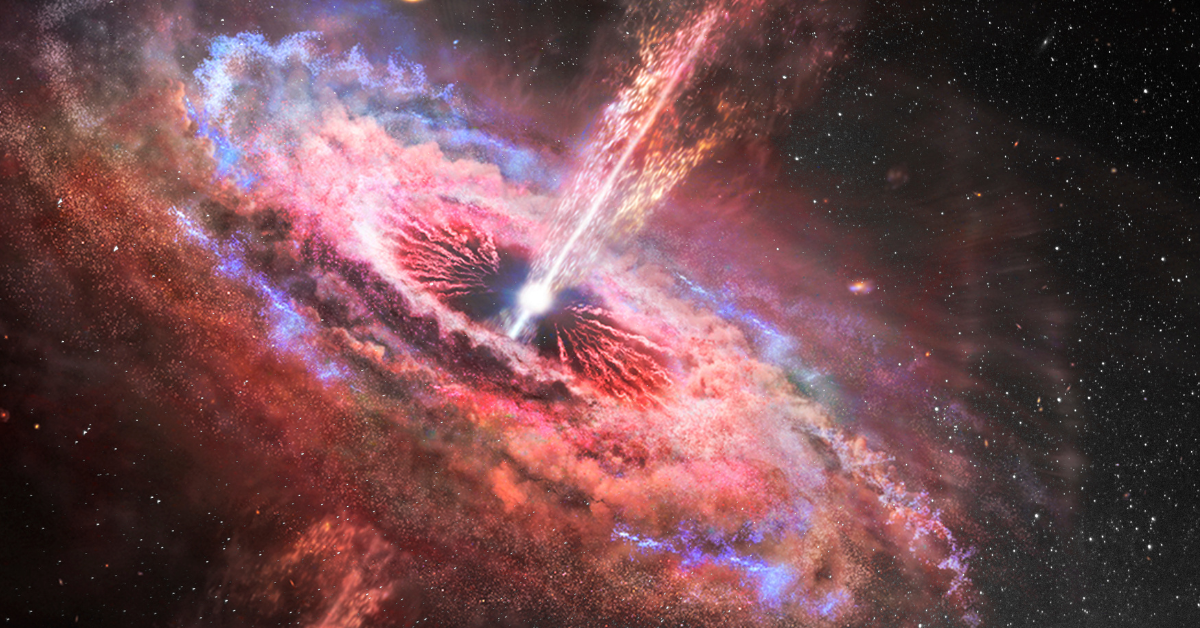
The sound waves originated from the centre of the Perseus galaxy cluster, which is essentially a giant gas cloud. Pressure waves sent from the centre of the black hole have caused the cluster’s hot gas to ripple, with the cluster containing so much gas that it allows some sound to travel.
The Perseus galaxy cluster is one of Earth’s closest clusters. It’s so full of galaxies, experts assume it to be one of the most enormous objects in the universe.
“The misconception that there is no sound in space originates because most space is a vacuum, providing no way for sound waves to travel,” commented a NASA spokesperson. “A galaxy cluster has so much gas that we’ve picked up actual sound. Here it’s amplified, and mixed with other data, to hear a black hole.”
NASA’s experts amplified the noise – translating astronomical data into sound – to give the rest of the world a peek into the unknown. The original sound is 57 octaves below middle C, making it inaudible to humans.
“Another way to put this is that they are being heard 144 quadrillion and 288 quadrillion times higher than their original frequency,” a NASA spokesperson commented.
Black holes are one of the universe’s greatest mysteries. Even after decades of research, there’s still a lot we don’t know.
A black hole’s gravitational field is so strong that no light can escape. We can’t directly view them with any light we are able to detect, or observe them directly with telescopes detecting x-rays or other forms of electromagnetic radiation. We can only deduce their presence by observing their effect on nearby matter. NASA’s astounding discovery triggers new questions about black holes and potential areas of research to better understand them.
This audio clip is a portal into corners of the universe many never dreamed they’d reach. NASA have shed some light on the mystery surrounding black holes – what will be discovered next?
SPACEX RECENTLY REPORTED THAT RUSSIAN SPACE DEBRIS WAS ON A COLLISION COURSE WITH SPACEX STARLINK SATELLITES. RESEARCHERS DOCUMENTED OVER 6,000 NEAR-MISSES.
The debris was created in 2021 when Russia used an anti-satellite weapon (ASAT) to destroy the defunct 2,000kg Cosmos 1408 satellite, launched in the Soviet era. The explosion created around 1,500 pieces of space debris, now orbiting between 300 and 1,100 km above Earth. According to the US Space Command, this debris “will likely generate hundreds of thousands of pieces of smaller orbital debris over time.”
The near collisions were discussed at the Small Satellite Conference in Utah last week. Dan Oltrogge, chief scientist at COMSPOC, reported that debris from the destruction of Cosmos 1408 is causing an increase in close approaches, or “conjunction squalls.” COMSPOC tracked over 6,000 squalls within 10km of Starlink satellites, threatening 841 of their 2,748 satellites in low-Earth orbit.
Russia made headlines again earlier this year when from the same debris “endangered” the International Space Station (ISS), resulting in an avoidance manoeuvre. The ISS crew had to take cover in their escape capsule as the debris cloud passed.
It must be noted that SpaceX’s hands aren’t exactly clean when it comes to space debris. Earlier this month, a sheepherder in rural Australia discovered a large piece of space debris from SpaceX’s Crew-1 Dragon spacecraft. The debris was said to be from the spacecraft’s trunk, which transports the spacecraft’s solar panels and allows unpressurized cargo to be transported to the ISS.
Space debris, also known as ‘space junk’, is a growing problem in the space sector. As of April 2022, the European Space Agency reported over 30,000 pieces of debris with a mass of over 9,000 metric tons. Debris collisions have already caused significant damage to important satellites, and with more launches taking place than ever before, the probability of collisions is increasing. The probability of any satellite in low Earth orbit colliding with a piece of debris over 1cm is now 50% in a year.
With close calls like this becoming a more regular occurrence, it’s clear that something needs to be done about the space junk problem. Experts are currently developing innovate methods to clean up space with exciting projects like Astroscale’s ELSA-d, a spacecraft that uses a magnetic capture system to capture debris, already reporting successful tests.
As the threat posed by space debris becomes greater, the sector looks to these companies for a solution before it reaches breaking point.
IN A WONDERFULLY SURPRISING TURN OF EVENTS, SHAUN THE SHEEP WILL BE FLYING ON NASA’S ARTEMIS 1 MOON MISSION, SET FOR AUGUST 29TH.
Artemis 1 is the first in a series of tests that will allow humans to explore the Moon and Mars. Through the Artemis program, NASA aims to jump-start its exploration plans by over four years, establishing sustainable exploration by the end of the decade. The program also hopes to send the first woman and person of colour to the Moon.
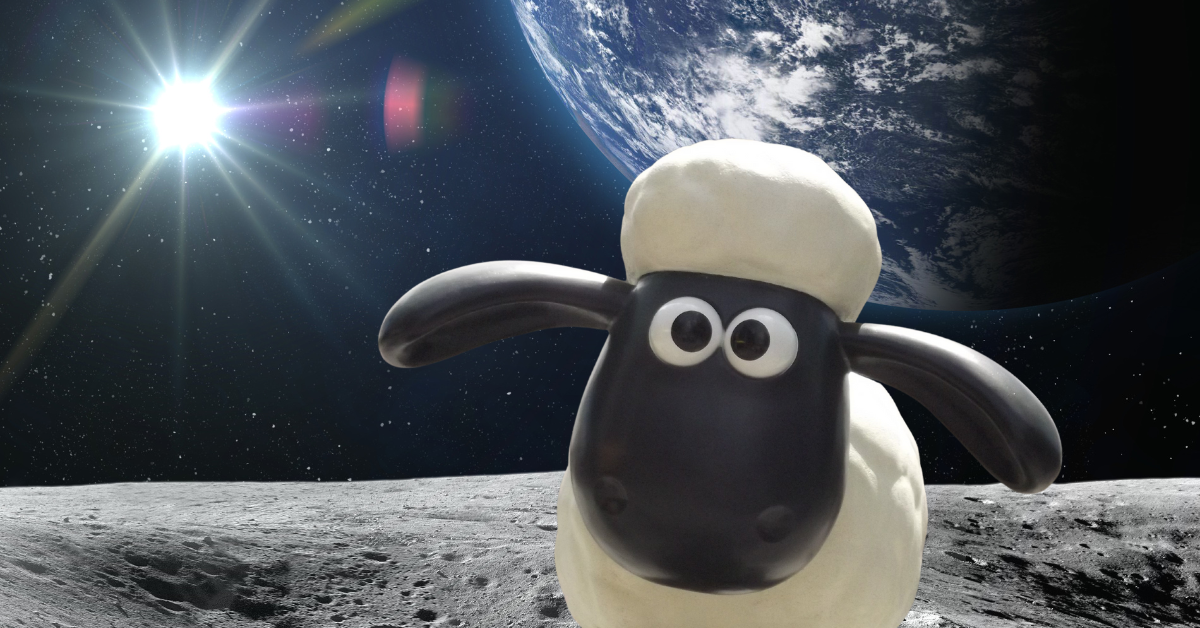
The European Space Agency (ESA) is working in partnership with Shaun’s creators, Bristol-based Aardman Animations, to send the sheep – in doll form – on an adventure beyond the stars.
A long way from Mossy Bottom Farm, Shaun is set to fly beyond the Moon aboard NASA’s Orion spacecraft, returning to Earth after the month-long flight. This will be a solo mission for Shaun, the spacecraft’s only passenger.
The stop-motion star will be flying past the Moon, where the spacecraft will use lunar gravity to propel itself another 70,000km. This is further than man or sheep has gone before.
“This is an exciting time for Shaun and for us at ESA,” said David Parker, ESA’s director for human and robotic exploration. “We’re woolly very happy that he’s been selected for the mission and we understand that, although it might be a small step for a human, it’s a giant leap for lambkind.”
Shaun is currently preparing for his mission, undertaking astronaut training around the world and becoming familiar with the Orion spacecraft. He even flew aboard the Airbus ‘Zero G’ A310 aircraft, which creates a minimal-gravity experience similar to in space.
Aardman’s marketing director Lucy Wendover said, “Aardman is excited to be joining ESA in making history by launching the first ‘sheep’ into space. As one of the first astronauts to fly an Artemis mission, Shaun is leading the way in lunar exploration, a great honour for our woolly adventurer! 2022 marks the 15th anniversary of Shaun’s first TV series, so what better way to celebrate than by travelling farther than any sheep has gone before.”
We’re wishing Shaun the best of luck on his biggest adventure yet.
NICHELLE NICHOLS, MOST FAMOUS FOR HER ICONIC ROLE AS COMMUNICATIONS OFFICER LT. NYOTA UHURA IN THE ORIGINAL STAR TREK SERIES, HAS DIED AT THE AGE OF 89.
Nichelle’s son announced her death on Facebook last Sunday morning,
“I regret to inform you that a great light in the firmament no longer shines for us as it has for so many years. Her light however, like the ancient galaxies now being seen for the first time, will remain for us and future generations to enjoy, learn from and draw inspiration.”
Nichelle was a true pioneer across both the television and space industries. As Lt. Uhura, she pushed boundaries as the first Black actress to be cast in a continuous co-starring role. Not only this, but she featured in US television’s first interracial kiss with William Shatner.
Nichols’ influence spread beyond film and television – she even managed to incorporate her life-long fascination with space travel. She was a passenger on NASA’s C-141 Astronomy Observatory, which conducted an eight-hour high-altitude mission to study the atmospheres of Mars and Saturn. A decade after Star Trek ended, she was even hired by NASA to encourage more women and Black Americans to become astronauts. Check out her 1977 recruitment video.
Many of NASA’s employees referenced Nichols’ performance in Star Trek as their inspiration to join the agency. With her involvement, they went on to recruit Guion Bluford, the first Black American in space, Mae Jemison, the first Black woman in space, and Sally Ride, the first American woman in space.
At Nichols’ 85th birthday party, Jemison recounted seeing Lt. Uhura on her television as a child and knowing her dream was within reach,
“How we think about the world is shaped by our fantasies. Star Trek’ happened to be a really great fantasy. Nichelle represented the fact that we had inclusion everywhere, and it so much has influenced how people think of a hopeful future. What we have to do today is get back to that.”
Following Nichols’ death, Jemison tweeted,
“@NichelleIsUhura is forever for me the embodiment of grace, daring, intelligence, fun, inspiration, beauty, talent & the future. Today I am heart-sad at her passing. I consider our dearest friendship a great treasure & privilege in my life.”
Alongside Jamison, Sally Ride thanked Nichols for inspiring her career,
“I think it’s been one of the most remarkable things in my career … that this one character that was a gift to me … became this iconic image and inspired and impacted so many people’s lives in positive ways.”
Nichelle Nichols’ influence will transcend her lifetime. Her performance fuelled a generation’s fascination with space, standing as testament to the countless influences that have shaped the space sector as we know it. She inspired us to strive for more, regardless of social constructs.
In what was still a segregated time, the representation of a Black female on television – a sci-fi series no less – was groundbreaking. Legends like Nichols paved the way for a more sustainable space industry through diversity, inclusion, and inspiration. As she exemplified so perfectly, space really is for everyone. Representation like this is what will continue to drive the sector into the future, allowing it to progress and thrive alongside humanity.
In light of her passing, the world celebrates the life’s work and accomplishments of a true icon.
Image: Nichelle Nichols speaking at the 2013 Phoenix Comicon at the Phoenix Convention Center in Phoenix, Arizona.
ON JUNE 29, THE EARTH EXPERIENCED ITS SHORTEST DAY ON RECORD. IT COMPLETED ONE ROTATION IN 1.59 MILLISECONDS UNDER ITS USUAL 24 HOURS.
IT MAY SEEM INSIGNIFICANT, BUT THE POTENTIAL IMPACTS HAVE BEEN CALLED ‘DEVASTATING’.
Typically, Earth’s average rotation decreases sightly over time. This has led to 27 ‘leap seconds’ – an extra second to keep our clocks in sync with solar time – to be added to the Coordinated Universal Time (UTC). We last added a leap second on New Year’s Eve 2016. Midnight struck twice worldwide as clocks paused for one second, allowing the Earth’s rotation to catch up with us.
Contrastingly, the speeding up of Earth’s rotation could require a ‘negative leap second’. This means that for the first time in history, timekeepers may need to speed up clocks worldwide and effectively remove time. The potential effects of this could impact some key components of modern life.
If this continues, our satellite communication and navigation systems could be compromised as they rely heavily on time’s consistency with the usual positions of the sun, moon and stars. Not only this, but various IT systems and software that depend on schedulers and timers could be seriously affected. Such systems could experience large-scale outages if their internal clocks were to be moved backwards. Experts have called the potential consequences ‘devastating’.
Scientists have speculated on the possible causes of this record-breaking rotation. One explanation could be the Chandler Wobble – movement in Earth’s axis of rotation that causes latitude to vary. Dr. Leonid Zotov, of the Sternberg Astronomical Institute, noted that, “The normal wobble amplitude is about four meters at Earth’s surface, but from 2017 to 2020 it disappeared.” Without this wobble, Earth is completing its rotation faster than usual.
Another potential cause could be climate change. Rising sea levels are impacting the Earth’s distribution of mass, bringing it closer to its rotation axis and speeding up its rate of rotation. This process has been compared to an ice skater pulling their arms in while spinning to increase speed.
Processes taking places in the planet’s inner molten core could also be to blame. Experts discovered that the Earth’s core is in fact rotating slightly faster than the planet itself. Over the past 100 years, this has resulted in the core gaining a quarter-turn on the rest of the planet.
While the exact cause is undetermined, it may well be a combination of all possibilities.
Following this record-breaking rotation, only time will tell the measures experts may take to keep our clocks in check.
IMAGES FROM THE JAMES WEBB TELESCOPE LEFT THE WORLD STARSTRUCK. THANKS TO ITS STATE-OF-THE-ART TECHNOLOGIES, WE WERE ABLE TO GAZE FURTHER INTO DEEP SPACE THAN EVER BEFORE – UNTIL NOW.
NASA’S NANCY GRACE ROMAN SPACE TELESCOPE, SET TO LAUNCH IN 2026, WILL TAKE US EVEN FURTHER.
This next-generation space telescope promises to be an extremely powerful tool, allowing us to study the cosmos and its many galaxies from a brand new perspective.
NASA recently announced a $255m partnership with SpaceX for Roman’s launch. Liftoff will take place at the Kennedy Space Center aboard a Falcon Heavy rocket.
Roman, which cost $4.3 billion in total, will combine tried and tested technologies with state-of-the-art additions.
With a Hubble-sized mirror and 18 newly developed HgCdTe 4K × 4K photodiode arrays, the Roman Space Telescope will take infrared images of the sky to observe dark energy, stars, exoplanets and galaxies. It will measure the positions and shapes of hundreds of millions of galaxies, the light curves of thousands of supernovae, and the microlensing signals of over a thousand exoplanets toward the galaxy’s bulge.
Roman will have a panoramic field of view 200 times larger than the Hubble Telescope’s, allowing it to create the first wide-field maps of the universe. The telescope is comprised of a 2.4-meter telescope with a Wide-Field Instrument (WFI) – a 300-megapixel infrared camera – and a coronagraph. It’s Hubble-like, but with the added benefit of 30 years’ technological development.
All these instruments working together, and in collaboration with hi-tech future telescopes, will herald a new era of space exploration.
The Roman Space Telescope will survey billions of galaxies, capturing the light of stellar explosions. Its powerful WFI can capture thousands of objects from a single observation. Scientists are hoping to solve the mystery of dark energy, which is causing the universe’s expansion to accelerate. Roman’s sky scans will reveal thousands of exoplanets beyond our solar system, including planets that have never been studied before.
The telescope’s mission lifecycle also promises to shed new light on the heyday of star formation. Astronomers will be able to study a galaxy’s spectrum to learn about its stars’ ages, star formation history, the number of heavy chemical elements it contains, and much more. By doing this for multiple early galaxies, we can learn about the processes that began and eventually ended this period of rapid growth.
Keep your eyes to the sky as NASA prepares for this mind-blowing mission.
NASA AND THE EUROPEAN SPACE AGENCY (ESA) HAVE ABANDONED A BRITISH-BUILT ROVER THAT WAS SET TO COLLECT SAMPLES FROM MARS AND RETURN THEM TO EARTH. THE PROJECT HAS ALREADY COST THE UK £22.7 MILLION.
The rover was a critical element of the Mars Sample Return mission, which aims to retrieve Martian soil and rock for study on Earth in the 2030s. Scientists are hoping to prove once and for all whether life has ever existed on the Red Planet.
This surprise cancellation follows four years of design work by Airbus engineers in Hertfordshire.
NASA and ESA announced the project’s termination at a press conference last week. In a surprising turn of events, they plan to repurpose the Perseverance rover, already stationed on Mars, to complete the mission. Perseverance has been drilling into the site of an ancient lake, searching for signs of bygone microbial life. The rover is gathering and storing samples in titanium tubes for return to Earth.
Two new helicopters will also be launched as a backup. They will leap into action should Perseverance fail to break down and store samples. NASA’s jet propulsion lab has been testing whether the helicopters will be able to pick up the rover’s tubes if required.
NASA attributed this change of plan to a re-evaluation of Perseverance’s lifespan. However, it’s speculated that NASA and ESA had no choice but to cut costs after Russian space agency withdrew from several missions due to the Ukraine war.
Russia has also announced that it will be withdrawing from the International Space Station in 2024, six years earlier than anticipated.
The Mars Sample Return mission is vital in our quest to understand Martian history. Following this roadblock, we hope NASA and ESA will be able to answer once and for all – is there, or has there ever been, life on Mars?
2021 and 2022 has seen huge sectors and companies like HP committing to 2030 diversity and inclusion goals and the space sector has now committed to its own pledge for the future of its workforce. Signed at the 37th Space Symposium by 23 executives, the pledge seeks to increase underrepresented genders, races, religions, cultures, and ethnicities.
EVONA’s own research from a recruitment perspective of hiring women in space, highlighted that whilst 38% of our placements into C-level roles were women, across the rest of the industry this was only 17%. Furthermore, only 12% are founders and CEO’s, one of them being Melanie Stricklan who is taking a front seat in the plans for diversity and inclusion in space alongside Steve Isakowitz and Roy Azevedo.
EVONA’s Research on Gender Diversity in the Space sector 2021
We were really grateful to speak to Melanie on our podcast, EVONA Origin Stories, speaking about her journey into the space sector and insights into the need for diversity to progress the industry.
EVONA Origin Stories Episode 5“WE DON’T NEED PEOPLE THAT THINK LIKE US, RIGHT? WE DON’T NEED PEOPLE THAT COME FROM THE SAME BACKGROUND AS ALL OF US. WHAT WE NEED IS DIVERSITY AROUND THE TABLE THAT ARE ABLE TO RISE TO THE OCCASION AND BRING US TO OUR FULL POTENTIAL AS INDIVIDUALS AND AS A TEAM.”
– MELANIE STRICKLAN
You can listen to the whole podcast on our Spotify Channel here.
WHAT WILL THE PLEDGE DO?
The space workforce 2030 pledge commits those that have signed to reporting data on diversity and inclusion annually and working with universities to grow the numbers of diverse and underrepresented students in technical degrees that are crucial in the industry.
The specific goals Include:
Substantially boost the number of women and employees from underrepresented groups in our collective technical workforce
Significantly escalate the number of women and employees from underrepresented groups who hold senior leadership positions in our collective technical workforce
Work with universities to increase the percentages of women and students from underrepresented groups receiving aerospace engineering degrees to levels commensurate with overall engineering programs
Sponsor K-12 programs that collectively reach over 5,000,000 underrepresented students annually
The 24 executives also agreed to:
Aggregate the numbers on the first two bullet points for annual reporting and hold themselves accountable by annually reviewing the progress against these goals
Allow group-level results to be shared at the annual Space Foundation’s Space Symposium, while highlighting achievements and best practices to promote shared success
Meet twice a year at the working level to exchange best practices on strengthening diversity recruitment, STEM education outreach and representation at leadership levels
Seek like-minded leaders and organizations to join this effort
The Leaders and relative companies that have agreed to the Space Workforce 2030 pledge are:
Roy Azevedo, President Raytheon Intelligence & Space
Payam Banazadeh, CEO at Capella Space
Peter Beck, CEO at Rocket Lab
Tory Bruno, CEO at United Launch Alliance
Jim Chilton, Senior VP of Space & Launch at Boeing
Michael Colglazier, CEO at Virgin Galactic
Tim Ellis, CEO at Relativity Space
John Gedmark, CEO at Astranis Space Technologies
Steve Isakowitz, CEO at The Aerospace Corporation
Larry James, Acting Director at NASA Jet Propulsion Laboratory
Daniel Jablonsky, CEO at Maxar Technologies
Robert Lightfoot, EVP of Lockheed Martin Space
Dave Kaufman, President at Ball Aerospace
Chris Kemp, CEO at Astra
Will Marshall, CEO at Planet
Dan Piemont, President at ABL Space Systems
Peter Platzer, CEO at Spire Global
Melanie Stricklan, CEO at Slingshot Aerospace
John Serafini, CEO at HawkEye 360
Amela Wilson, CEO at Nanoracks
Tom Wilson, President Space Systems at Northrop Grumman
THE PROBLEM STARTS WITH YOUNG PEOPLE
Collectively tackling the issues now will make a difference for future generations, however, it’s understood that the problem begins before workers even enter the sector. The pledge not only recognises gender and race as a diversity and inclusion issue but also students graduating and hoping to enter the workforce, hence the two bullet points focusing on universities and K-12 programmes.
Referring back to our research on women in space, in Engineering alone it’s noted that only 31% of engineer graduates in 2020 were women with only 24% of individuals in an engineering profession as of last year identifying as female, decreasing even further for those entering into a career in space.
Over the past few years EVONA have also recognised the issue surrounding students, facilitating education workshops to inspire them to join the space sector through our space spectra webinars. Recently we contacted local STEM students to gather a further understanding of the barriers STEM students have when considering a career in space.
The main issues noted were that most STEM subjects don’t have space content as part of their syllabus, many have a lack of information about the sector and believe their skills are not relevant.
Copyright of D.Doran (2022) – work cannot be replicated
Previously UKSEDS have noted that “students need to be made aware of potential career paths they can work towards… encouraging them to consider a career they wouldn’t have known about otherwise, fostering interest in particular subjects, making it more likely for them to invest time in developing skills needed within the sector.”
These issues present a demand for the key points of the pledge and could make a real difference to the future of the space workforce for young people, solving diversity and inclusion issues from the bottom up.
INSIGHTS FROM A RECRUITMENT PERSPECTIVE
Workplace diversity is important in all sectors and studies show that currently 57% of recruiters have strategies to attract diverse candidates. Achieving greater diversity has a multitude of benefits, as including a range of perspectives improves problem solving, enhances innovation and creativity, reduced employee turnover and improved hiring results to name a few. Not only does it have internal benefits, companies with higher levels of diversity and inclusion are proven to outperform their competitors by 35%.
Whilst the issue as a whole is complicated, not all solutions have to be. There are a number of simple and creative ways to champion this cause within your recruitment strategies!
Ways to improve Diversity:
· Recruitment teams need to actively strategize how to advertise jobs in order to maximise the audience they appeal to, specifically those of underrepresented groups.
· Family friendly policies like part-time, flexible working, parental leave and onsite nurseries are a great way to indicate the company is inclusive for those with children
· Championing for causes than resonate with underrepresented groups with partnerships/ donations/ fundraising demonstrates the inclusive culture and diversity ethos.
· Using anonymous profiling or software like PitchMe to remove bias from recruitment practices and only hire those with the right requirements for the role
· Belonging to an advisory group to assist with implementing company strategies, policies, and initiatives.
· Offering internships or mentoring for underrepresented groups
· Showing people from underrepresented groups in leadership positions and on the boards
Here at EVONA, we are celebrating GIS day and the power that it gives us to create an understanding of the world we live in. GIS day is more than just an event, it’s a global movement that showcases the importance of GIS and the many benefits it has to offer.
SO, WHAT IS GIS?
Geographic Information Systems (GIS), is a spatial system that creates, manages, analyses, and maps all types of important data, which is utilised in science, organisations of all sizes and almost every single industry. GIS helps users to interpret relationships, patterns, and geographic context which provides a multitude of benefits such as improved decision making, enhanced efficiency, cost reduction and improved communication (to name a few!).
“GIS is an integrated system of computer hardware, software, and trained personnel linking topographic, demographic, utility, facility, image and other resource data that is geographically referenced.” ~ NASA
THE MAIN USES AND BENEFITS OF GIS
Identifying problems.
Monitoring change and understanding trends, therefore allowing users to put preventative measures in place.
Fast recall of data, with ability for complex analysis.
Managing and responding to events efficiently, with improved productivity.
Perform forecasting, whilst displaying information in a different light or view.
Allows for better management of resources.
Better ability to consider environmental and social impact.
For businesses – improved client satisfaction, better decision making and increased teamwork amongst employees.
JUST A FEW OF THE WELL-KNOWN COMPANIES WHICH USE GIS EVERY SINGLE DAY
UBER – is an app which we all know completely changed the world. It’s takeover of the taxi industry coined the term ‘the Uber effect’, which would not have been possible if it hadn’t been for GIS. It heavily relies on geospatial data, when the app matches its user with the closest available driver. However, in a not so obvious way, the app also can identify areas which have the highest demand for drivers and advises those drivers to be near those hotspots during times of elevated demand. It’s also cleverly used to monitor and analyse traffic flow in cities.
Starbucks – this household name relies largely on data to guide its strategies for growth, using GIS to determine the best places for new locations. It analyses lots of factors before deciding to branch out into an area, including:
Population density.
Average income.
Traffic patterns.
Proximity to public transportation.
Other nearby businesses.
The World Health Organisation – GIS enables spatial representation of data to support improved public health planning and contributes towards better decision making. The global health and medical applications of GIS are numerous, but here are just a few of the main examples:
Finding disease clusters and their possible causes.
Improving deployment for emergency services.
Determining if an area is being served adequately by health services.
HOW GIS IS CHANGING THE WORLD
NASA’s Mars Rover
Disease Control – Combating the spread of pests, by identifying critical intervention areas efficiently.
Mars Rover Landing – Examining how to land the Mars Rover safely with operations criteria including latitude for solar power, soil softness, slopes using laser altimetry, dustiness, rockiness, and a landing footprint.
Development Planning – Making citizens happy through smart development planning and understanding the bigger picture.
Self-Driving Vehicles – Sitting back and relaxing while Google’s autonomous car does all the work equipped with LiDAR, GPS, an inertial unit, and sophisticated software.
Mapping – Google Maps is an excellent example of a web-based GIS mapping solution that people use for everyday navigation purposes.
Environmental Impact Analysis – Data gathered via GIS applications is vital for conserving natural resources and protecting the environment. Impact statements assess the magnitude of human impact on the environment.
REASONS TO PERSUE A GIS CAREER
Now that you’ve seen the benefits GIS has to offer, perhaps you’re interested in pursuing a career within GIS. It is a powerful, ever-evolving field with possibilities that increase as the world becomes more connected. The GIS market is projected to reach $25.6 billion by 2030, and competitive salaries aside, a career within GIS can give you the chance to truly make a difference. If that wasn’t enough, there really is something for everyone as some of the unique applications of GIS technology can be utilised in a wide range of industries:
For decades we’ve looked upon the Red Planet as a viable alternative to host life, but we still know relatively little about what form that ‘life’ might take. This month, that changes as we edge that little bit closer to the first crewed mission to Mars.
Between July and August 2020, Earth and Mars align to create an ideal window for Mars mission launches that reduce costs and increase the chances of success. Understandably then, three scheduled launches to Mars will take place this month: NASA’s Perseverance rover is scheduled for launch on 30th July, China’s Tianwen-1 on 23rd – but before that, all eyes are on the new kids on the block, UAE’s Emirates Mars Mission.
Due to launch on the 14th July 2020, the Japanese weather had other ideas and has delayed launch until Monday 20th July at 1.43am UAE time (Sun 19/7 22:43 BST).
At 22:43 BST Sunday 19th July the UAE launch into space exploration with their first interplanetary mission as The Emirates Mars Mission (EMM) takes flight with the Hope Probe; its task – to provide the first ever complete picture of the Martian atmosphere. Catch the launch live here.
Using three scientific instruments on board of the spacecraft, the EMM will provide a better understanding of circulation and weather in the lower, middle and upper layers of the Martian atmosphere. The $200 million mission is due to orbit Mars for a full martian year, or 687 days, and will be sharing the data amongst 200 research institutions, including NASA, for free.
If you weren’t already aware of the UAE’s ambitious space plans, we believe you soon will be. Hot on the heels of their Astronaut Programme, which saw the launch of their first Emirati Astronaut to the ISS in September last year, this post-oil economic diversification is about to put UAE on the space map in a big way. We caught up with Talal M. Al Kaissi, Advisor on Strategic Projects at the UAE Space Agency to get his thoughts on this momentous occasion.
Emirates Mars Mission Hope Mission badge
“It’s really surreal to be this close to the historic launch of our spacecraft.” he explains. “Our Emirates Mars Mission “Hope” probe is the culmination of 6 years of very hard work by a dedicated, professional team of young engineers who have helped us prove that nothing is impossible.”
The UAE’s collaborative mission effort and commitment to data sharing has earned them much admiration. Launching from Tanegashima Space Centre Japan and sourcing help from University of Colorado Boulder, this mission is testament to what can be achieved thanks to a growing commercialisation of the sector, a collaborative approach to space exploration and a dedication to developing expertise in space science and technologies.
As Talal M. Al Kaissi explains “This mission is already a success and has accomplished the goals the government had set in building human capital, acquiring knowledge, forging strong partnerships, and providing the foundation to a space economy and ecosystem in the country. The science objectives will be a bonus, and the STEM education encouraged by this program as well as the inspiration value it induced will continue for years to come.”
The UAE planned to build the Hope probe six years ago, at the same time setting up the Middle East’s first space research centre and announcing the ‘Arab Space Pioneers’ programme. Overseen by the UAE Space Agency, the programme equips talent with the skills and expertise required to expand career prospects in the growing space sector to actively contribute to the global space community. The programme highlights the importance of investing in the multi-faceted space technology as a major driver of the future knowledge-based economy. This is one space mission that has taught us the economic value of investment into STEM space programmes in order to advance the capabilities of the sector and address the future workforce challenges.
Hope is scheduled to reach Mars in February 2021, which coincides with the 50th anniversary of the United Arab Emirates’ formation – that’s a pretty good birthday celebration if you ask us.
Photo by Nicolas Lobos on Unsplash
Get in touch
I am from a company and we are hiring now, or in the future
Register interest or book a call to discuss your hiring requirements.