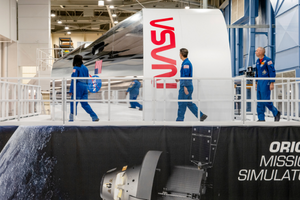
NASA’s Orion Breaks Apollo 13 Record

On Saturday, November 26, at 8:40 a.m. EST, NASA revealed that the Orion spacecraft has now travelled the farthest distance from Earth in over 50 years.

This surpasses Apollo 13’s ‘Odyssey’ record in 1970, at 248,655 miles (400,171 km) from Earth.  

Having entered high-altitude orbit around the Moon, and currently cruising at 1,750 miles per hour, today (Nov. 28), Orion will reach its maximum distance from Earth at approximately 272,514.9 miles. 

NASA’s Orion spacecraft, powered by an ESA European Service Module, was successfully launched to the Moon from the Kennedy Space Center in Florida on 16 November 2022.  

As the first major spaceflight of the Artemis program, this mission is testing the Orion spacecraft’s capabilities; the systems, and procedures that would be used for crewed flights.  

 “Following a successful launch on NASA’s Space Launch System rocket, Artemis I is testing the Orion spacecraft on a rigorous mission in the extreme environment of deep space around the Moon”, NASA said. This multistage plan to assess its durability will result in sending astronauts to the moon and beyond in future missions. 

After entering a distant retrograde orbit on Friday, Nov. 25, the US Space Agency stated, “it will take Orion nearly a week to complete half an orbit around the Moon, where it will exit the orbit for the return journey home.” 

If successful, it will allow the Artemis programme to eventually send astronauts on Artemis II in 2024. 

 Although this test flight is uncrewed, it is carrying three suited mannequins, and the European Space Agency’s newest astronaut – Shaun the Sheep, travelling further than any human has before!  

Image: NASA’s Space Launch System (SLS) rocket with the Orion spacecraft aboard

Photo Credit: (NASA/Joel Kowsky)

NASA’s DART Spacecraft is on an Asteroid Collision Course

NASA’s Double Asteroid Redirection Test (DART) mission is attempting the world’s first planetary defense test.

The multi-million-dollar DART spacecraft is currently travelling through space on an intentional collision course with Dimorphos, the asteroid moonlet of Didymos.

DART was launched on 23rd November 2021 aboard a SpaceX Flacon 9 rocket from Vandenberg Space Force Base in California – you can even track its journey and mission clock. The spacecraft is now preparing to collide with its asteroid target at the end of this month.

The craft will crash into the 160m wide asteroid at 7:14pm ET (00:14am GMT) on Monday 26th September 2022. You can watch the impact live on NASA’s YouTube channel. If successful, this method could deflect future Earth-bound asteroid and save countless lives.

“These objects are hurtling through space and have of course scarred the moon and, over time, also on Earth have had major impacts, have affected our history,” Thomas Zurbuchen, NASA’s associate administrator for science, commented during a news conference.

DART is a small spacecraft, with its core consisting of a box just under a metre wide on all sides. The craft has solar arrays that roll out to 12 meters in width. Once both arrays are deployed, DART will be around the size of a school bus. The spacecraft’s electric propulsion system uses a flow of charged ions to create a gentle but constant push.

On 11th September, the crew confirmed the spacecraft’s “mini photographer” LICIACube (Light Italian CubeSat for Imaging Asteroids) was successfully ejected ahead of the crash. LICIACube will stop at a safe distance of 600 miles from Dimorphos to observe the collision with its two optimal cameras. Once DART hits the asteroid, the CubeSat will continue its journey to inspect the scene from a closer distance. The Italian micro-satellite will transmit the real-time footage to scientists back on Earth.

This will be NASA’s first time using the kinetic impactor technique as a planetary defense method. DART will crash into the moonlet at 15,000 mph, transferring kinetic energy into the asteroid and pushing it closer to Didymos. If successful, Dimorphus will orbit Didymos at least 73 seconds quicker than before. DART will only be changing the period of orbit by a small amount, but this deflection would be enough to veer a future Earth-bound asteroid off its course.

“This will give us all confidence that deflection technology could work in the future,” Andrea Riley, a program executive at NASA working with the agency’s Planetary Defense Coordination Office, commented at a news conference. “If it misses, it still provides a lot of data. This is a test mission. This is why we test; we want to do it now rather than when there is an actual need.”

While DART’s target poses no threat to us, this innovative mission could save millions of lives if an Earth-threatening asteroid were discovered in the future.

“This isn’t just a one-off event,” said Nancy Chabot, the DART coordination lead at the Johns Hopkins University’s Applied Physics Laboratory in Maryland. “We want to know what happened to Dimorphos, but more important, we want to understand what that means for potentially applying this technique in the future.”

As DART’s collision date draws closer, ground-based telescopes will monitor the system and provide further updates. This is an exciting time for the space sector – along with the rest of the plane – as NASA embark on this first journey of its kind.

Could this little spacecraft be the catalyst for missions that one day save us from a dinosaur-like fate?

NASA’s Orion Spacecraft Ready for Deep Space Tests

NASA’S SPACE LAUNCH SYSTEM (SLS) AND ORION SPACECRAFT ARE READY FOR AN UNCREWED TEST FLIGHT AROUND THE MOON ON MONDAY.

This is the first in a series of increasingly complicated tests under the Artemis 1 mission, working towards getting humans back on the Moon and eventually onto Mars.

Monday’s launch will be NASA’s first moon rocket test flight since 1967. For the first time in a generation, this human spacecraft designed for deep-space missions will usher in a new era of space exploration. If Orion returns from the Moon as planned, astronauts could be setting off on their own mission around the Moon in 2023 before actually landing there in 2025.

“We are go for launch, which is absolutely outstanding. This day has been a long time coming,” commented Robert Cana, NASA Associate Administrator. “I’m a product of the Apollo generation, and look what it did for us. I cannot wait to see what comes from the Artemis generation because I think it’s going to inspire even more than Apollo did.”

The entire spacecraft stands at 322 feet, which is almost as tall as The Shard in London. SLS, which will catapult the Orion capsule into space, has been dubbed the most powerful rocket ever built.

NASA has now extended Orion’s initial 21-day mission to 42 days. Once the spacecraft has orbited the Moon, it will have travelled around 40,000 miles beyond the far side of the Moon – further than any crewed spacecraft has travelled before. The craft will spend around two weeks in orbit before returning to Earth for an ocean splashdown.

“We are pushing the vehicle to its limits, really stressing it to get ready for crew. It is incredibly risky,” said NASA Associate Administrator for Exploration Systems Development, Jim Free.

Launch is set for Monday 29th August from the Kennedy Space Centre in Florida, 8:33am local time (1:33pm in the UK). While many space-enthusiasts will flock to watch liftoff in person, you can also catch it on NASA’s websitetheir app and or their YouTube channel.

NASA’s Artemis 1 mission heralds a huge leap in space exploration. This is an incredibly exciting time not just for the space community, but for the whole of humanity. As NASA prepares for this mission milestone, we can’t wait to see where this extraordinary project takes us.

SpaceX Starlink Satellites Threatened by Russian Space Junk

SPACEX RECENTLY REPORTED THAT RUSSIAN SPACE DEBRIS WAS ON A COLLISION COURSE WITH SPACEX STARLINK SATELLITES. RESEARCHERS DOCUMENTED OVER 6,000 NEAR-MISSES.

The debris was created in 2021 when Russia used an anti-satellite weapon (ASAT) to destroy the defunct 2,000kg Cosmos 1408 satellite, launched in the Soviet era. The explosion created around 1,500 pieces of space debris, now orbiting between 300 and 1,100 km above Earth. According to the US Space Command, this debris “will likely generate hundreds of thousands of pieces of smaller orbital debris over time.”

The near collisions were discussed at the Small Satellite Conference in Utah last week. Dan Oltrogge, chief scientist at COMSPOC, reported that debris from the destruction of Cosmos 1408 is causing an increase in close approaches, or “conjunction squalls.” COMSPOC tracked over 6,000 squalls within 10km of Starlink satellites, threatening 841 of their 2,748 satellites in low-Earth orbit.

Russia made headlines again earlier this year when from the same debris “endangered” the International Space Station (ISS), resulting in an avoidance manoeuvre. The ISS crew had to take cover in their escape capsule as the debris cloud passed.

It must be noted that SpaceX’s hands aren’t exactly clean when it comes to space debris. Earlier this month, a sheepherder in rural Australia discovered a large piece of space debris from SpaceX’s Crew-1 Dragon spacecraft. The debris was said to be from the spacecraft’s trunk, which transports the spacecraft’s solar panels and allows unpressurized cargo to be transported to the ISS.

Space debris, also known as ‘space junk’, is a growing problem in the space sector. As of April 2022, the European Space Agency reported over 30,000 pieces of debris with a mass of over 9,000 metric tons. Debris collisions have already caused significant damage to important satellites, and with more launches taking place than ever before, the probability of collisions is increasing. The probability of any satellite in low Earth orbit colliding with a piece of debris over 1cm is now 50% in a year.

With close calls like this becoming a more regular occurrence, it’s clear that something needs to be done about the space junk problem. Experts are currently developing innovate methods to clean up space with exciting projects like Astroscale’s ELSA-d, a spacecraft that uses a magnetic capture system to capture debris, already reporting successful tests.

As the threat posed by space debris becomes greater, the sector looks to these companies for a solution before it reaches breaking point.

Nancy Grace Roman – NASA’s Next-Generation Space Telescope

IMAGES FROM THE JAMES WEBB TELESCOPE LEFT THE WORLD STARSTRUCK. THANKS TO ITS STATE-OF-THE-ART TECHNOLOGIES, WE WERE ABLE TO GAZE FURTHER INTO DEEP SPACE THAN EVER BEFORE – UNTIL NOW.

NASA’S NANCY GRACE ROMAN SPACE TELESCOPE, SET TO LAUNCH IN 2026, WILL TAKE US EVEN FURTHER.

This next-generation space telescope promises to be an extremely powerful tool, allowing us to study the cosmos and its many galaxies from a brand new perspective.

NASA recently announced a $255m partnership with SpaceX for Roman’s launch. Liftoff will take place at the Kennedy Space Center aboard a Falcon Heavy rocket.

Roman, which cost $4.3 billion in total, will combine tried and tested technologies with state-of-the-art additions.

With a Hubble-sized mirror and 18 newly developed HgCdTe 4K × 4K photodiode arrays, the Roman Space Telescope will take infrared images of the sky to observe dark energy, stars, exoplanets and galaxies. It will measure the positions and shapes of hundreds of millions of galaxies, the light curves of thousands of supernovae, and the microlensing signals of over a thousand exoplanets toward the galaxy’s bulge.

Roman will have a panoramic field of view 200 times larger than the Hubble Telescope’s, allowing it to create the first wide-field maps of the universe. The telescope is comprised of a 2.4-meter telescope with a Wide-Field Instrument (WFI) – a 300-megapixel infrared camera – and a coronagraph. It’s Hubble-like, but with the added benefit of 30 years’ technological development.

All these instruments working together, and in collaboration with hi-tech future telescopes, will herald a new era of space exploration.

The Roman Space Telescope will survey billions of galaxies, capturing the light of stellar explosions. Its powerful WFI can capture thousands of objects from a single observation. Scientists are hoping to solve the mystery of dark energy, which is causing the universe’s expansion to accelerate. Roman’s sky scans will reveal thousands of exoplanets beyond our solar system, including planets that have never been studied before.

The telescope’s mission lifecycle also promises to shed new light on the heyday of star formation. Astronomers will be able to study a galaxy’s spectrum to learn about its stars’ ages, star formation history, the number of heavy chemical elements it contains, and much more. By doing this for multiple early galaxies, we can learn about the processes that began and eventually ended this period of rapid growth.

Keep your eyes to the sky as NASA prepares for this mind-blowing mission.  

Britain’s £22.7m Mars Rover Mission Scrapped

NASA AND THE EUROPEAN SPACE AGENCY (ESA) HAVE ABANDONED A BRITISH-BUILT ROVER THAT WAS SET TO COLLECT SAMPLES FROM MARS AND RETURN THEM TO EARTH. THE PROJECT HAS ALREADY COST THE UK £22.7 MILLION.

The rover was a critical element of the Mars Sample Return mission, which aims to retrieve Martian soil and rock for study on Earth in the 2030s. Scientists are hoping to prove once and for all whether life has ever existed on the Red Planet.

This surprise cancellation follows four years of design work by Airbus engineers in Hertfordshire.

NASA and ESA announced the project’s termination at a press conference last week. In a surprising turn of events, they plan to repurpose the Perseverance rover, already stationed on Mars, to complete the mission. Perseverance has been drilling into the site of an ancient lake, searching for signs of bygone microbial life. The rover is gathering and storing samples in titanium tubes for return to Earth.

Two new helicopters will also be launched as a backup. They will leap into action should Perseverance fail to break down and store samples. NASA’s jet propulsion lab has been testing whether the helicopters will be able to pick up the rover’s tubes if required.

NASA attributed this change of plan to a re-evaluation of Perseverance’s lifespan. However, it’s speculated that NASA and ESA had no choice but to cut costs after Russian space agency withdrew from several missions due to the Ukraine war.

Russia has also announced that it will be withdrawing from the International Space Station in 2024, six years earlier than anticipated.

The Mars Sample Return mission is vital in our quest to understand Martian history. Following this roadblock, we hope NASA and ESA will be able to answer once and for all – is there, or has there ever been, life on Mars?