The Exploration Company Reusable Orbital Vehicles

The Exploration Company, a European startup revolutionizing the space industry, has successfully raised €40.5 million in their Series A funding round. This major milestone will finance a series of tests and demonstrations, starting with the inaugural launch of Europe’s Ariane 6 rocket later this year.

At the forefront of innovation, The Exploration Company will launch the Bikini reentry demonstrator, a 40 kilogram, 60 centimeter in diameter capsule, to gather critical data on thermal protections, onboard computer performance and shape validation for larger capsules. And, as the company continues to push the boundaries of space exploration, they have already booked a SpaceX Falcon 9 mission for next year to carry a larger 1,600 kilogram demonstration capsule equipped with propulsion and a parachute for a controlled reentry.

In 2026, The Exploration Company plans to launch the full-sized Nyx orbital vehicle, measuring four meters in diameter and weighing 8,000 kilograms. This vehicle will be capable of spending several months in orbit, demonstrating its capability to perform precise operations, with the ultimate goal of docking with the International Space Station in 2027. A full-sized Nyx will be able to transport 4,000 kilograms to orbit for up to six months, and bring 2,600 kilograms back down to Earth, all for just €20,000 per kilogram.

This trailblazing startup, led by CEO and co-founder Hélène Huby, has even greater plans for the future with missions to the moon and eventual crewed missions. With Hélène’s extensive background as Vice President at Airbus Defence and Space and her experience on the European Service Module for NASA’s Orion spacecraft, The Exploration Company is well-positioned to seize the growing demand for European space station transportation and microgravity missions.

The Exploration Company’s funding round was led by Swedish early-stage investor EQT Ventures and Red River West of France, and supported by investors including Promus Ventures, Cherry Ventures, Vsquared, Omnes Capital, July Fund, Partech, Possible Ventures, Habert Dassault Finance, Schlumberger, and Sista Fund. With a total funding to date of €47.3 million, The Exploration Company is poised for takeoff and ready to shape the future of space exploration.

What are the advantages of hybrid working?

What is a hybrid working model?

Hybrid working models are becoming increasingly popular in today’s fast-paced, technology-driven world. This way of working combines the best of both worlds, offering employees the flexibility and autonomy of working from home or other remote locations, while still maintaining a sense of connection and collaboration with their colleagues and the organization.

Overall, hybrid working models offer a number of benefits for both employees and organisations and are likely to become an increasingly common way of working in the future. With the right technology and support in place, it’s possible to create a hybrid working environment that is productive, efficient, and enjoyable for everyone involved.


What is the difference between hybrid and remote work?

Hybrid work and remote work are similar in that they both involve employees working from locations outside of a traditional office. However, there are some key differences between the two.

Remote work refers to a situation where employees work entirely from a location of their choice, whether that be from home or another location, and do not physically come into the office. This means that all communication and collaboration is done remotely, typically through the use of technology such as video conferencing, instant messaging, and document sharing.

Hybrid work, on the other hand, is a blend of remote and in-person work. It typically involves employees splitting their time between working from home or other remote locations and working from a central office or other physical location. This allows employees to have a level of autonomy and flexibility in terms of where and how they work, while still maintaining some level of in-person collaboration and connection with their colleagues.


Is hybrid working popular?


The pandemic caused a rapid shift in our lifestyles and forced many to adapt to working remotely. During lockdown, working from home benefited both the employee and their organisation by ensuring work could continue effectively, whilst keeping everybody as safe as possible.

In the short term, hybrid working offered vital reassurance in such uncertain times. Emerging from the pandemic, lockdown changed expectations, with employees quickly noticing the benefits of remote work in maintaining their productivity whilst enabling a flexible lifestyle.


Is hybrid working for me?

Hybrid working offers flexibility by combining workplace and remote working. For many remote-capable employees, the traditional (and constraining) nine-to-five working day has transformed and occasionally working from a location away from the office is becoming the norm. Giving more flexibility and freedom to employees, hybrid working intends to sustain productivity in ways that can benefit each employee differently. This combination can improve employee work satisfaction and ultimately the quality of work produced.

When deciding if hybrid work is suitable for you, it is important to consider your schedule and where you feel most productive. Some forms of work will lend themselves better to being at home or in the office. This can depend on the need for face-to-face meetings or video calls, for example. An informal or set working pattern can be established, adapted to suit both the company and the employee.

Despite its advantages, hybrid working isn’t suitable for all industries and is offered at the employer’s discretion. It’s important to be clear on your own expectations as well as a potential employer’s before you accept a job offer.


What are the advantages of hybrid working?

Employers’ newfound person-centred approach to work has many advantageous outcomes. The benefits of hybrid working include a better work-life balance, higher motivation, and improved job satisfaction from employees.

  • Higher productivity

When working from home, employees are primarily focused on independent work tasks in a quiet space, away from the distractions of the office. Hybrid working, therefore, utilises environments that suit the individual, so employees can use their time effectively. This can enable efficient and productive working in a fast-paced role. It can also promote better collaboration of ideas within the team and improve work relationships through both face-to-face and online communication with co-workers.

  • Flexibility

Working full-time from home or in the office could be isolating and distracting. In a hybrid setup, a flexible working schedule boosts morale among employees, improving their work-life balance by allowing them to work in ways most effective for them. This means they are trusted by employers to utilise and manage their independence, which in turn improves productivity and motivation. Employees’ schedules and priorities differ, so hybrid working gives people the opportunity to be flexible around their differing lifestyles, such as doing the school run or going to the gym.

  • Time and money saving

Flexible working is beneficial by reducing long commuting journeys and travel expenses for employees. By allowing employees to work from home or other remote locations, hybrid working models can significantly reduce the time and costs associated with commuting. This can not only save employees time, but also help to reduce their stress levels and improve their overall quality of life. Furthermore, with fewer people in the office, there are significantly lower operational costs for employers and less overcrowded office space. Office space can then be utilised for collaborative team projects and relationship building. 

  • Increased job opportunities

Flexible work increases the number of job opportunities, reducing the need to decide on a company based on location, commute time, or cost. It can also help companies to attract and retain talent by offering a better work-life balance and flexibility. It can also increase the pool of candidates for a given role by making it more accessible to people who may not have been able to commute to an office on a daily basis, such as those with disabilities or caregiving responsibilities. This gives employers access to a wider talent pool when recruiting, attracting a new generation of workers who are accustomed to flexibility.


What does a hybrid work schedule look like?

Employees who need peace and quiet to focus, or those who thrive in an office setting, can be given the choice to work where and when they’re most productive. A hybrid schedule enables individuals to manage their workload in a schedule that suits them best, reducing unwanted stress and preventing burnout. Every individual has a unique way of working, so make sure to find the balance that works for you.


How to find the right balance with hybrid working

Hybrid working can be structured in many ways, ranging from working in the office two or three days a week, or even two or three days a month – it’s completely flexible. In a hybrid workplace, employees can utilise their time better by, for example, avoiding commuting at busy times. Time at home helps hybrid workers efficiently drive personal performance while allowing the flexibility to meet other life responsibilities, such as shopping, exercising, or taking children to school. This allows employees to form an effective routine, giving them control over work hours and location.

The advantages of office working can be utilised for those that wish to socialise in the office, improving the company culture by enabling in-person collaboration and teamwork. Office time becomes more valued, and this can help to combat feelings of isolation that may emerge in a fully remote schedule.

Simultaneously, hybrid working aids those who need a silent environment to work with no interruptions. Here, they can focus on tasks without the noises and interruptions of a traditional office environment. It’s worth noting that remote working can sometimes result in overworking and burnout, so it’s vital to take regular breaks and set proper boundaries. It’s important to have a defined space for home working, so if you don’t have a dedicated workspace, hybrid working might not be the best option for you.


Top takeaways for hybrid working

All in all, hybrid working offers a great lifestyle that shouldn’t affect productivity, but it’s important to make sure that it’s right for you. Being location flexible, alternating between office and home working, has lots of advantages. It can help you to work more efficiently and maintain a healthy work-life balance, preventing burnout and improving performance. However, one size doesn’t fit all when it comes to remote working. Some people work better in the office, while some find it easier to focus at home. Whichever side of the fence you’re on, be reflective and honest with yourself about if remote working really suits you.

If hybrid working is for you, check out our jobs page to find the ideal hybrid role for you in the space sector.

HERE Technologies and AWS Collaboration

HERE Technologies and Amazon Web Services (AWS) have joined forces to revolutionize the way developers track and manage internet-of-things (IoT) devices.

This collaboration combines the power of HERE‘s location data expertise with AWS‘s cloud computing capabilities, delivering an unparalleled solution for developers worldwide.

HERE Positioning, the location technology at the forefront of this collaboration, is a sophisticated system that relies exclusively on Global Navigation Satellite Systems (GNSS) to provide accurate and reliable location data for a wide range of devices and applications. This technology is now being integrated with the AWS IoT Core Device Location feature, which enables developers to track and manage IoT devices globally, without the need for GNSS/GPS hardware. This integration results in a powerful solution that provides location awareness and high-accuracy positioning, while also ensuring data security for users.

The collaboration between HERE Technologies and AWS takes advantage of HERE’s extensive global database of more than 200 million Cell-ID and 5.6 billion Wi-Fi access point locations. These are continuously updated and populated through advanced machine learning algorithms, providing a comprehensive understanding of the location of IoT devices.

Moreover, this partnership brings together two leading companies in their respective industries, enabling developers to leverage both companies’ expertise and capabilities to create new and innovative solutions. The combination of HERE’s location data and AWS’s cloud computing services opens up new possibilities for developers to track and manage IoT devices in new and exciting ways, such as enhancing the performance of indoor and outdoor positioning capabilities, creating new location-based services, and even tracking devices in areas where GNSS/GPS is not available.

The partnership between HERE Technologies and Amazon Web Services (AWS) represents a significant step forward for the IoT industry, opening new opportunities for developers and users. This collaboration is set to change the way the IoT industry operates and bring innovative solutions to the market.

Space-Powered Drugs – Fighting Disease from Outer Space

The National Stem Cell Foundation is leading the way in space-based research to combat debilitating diseases such as Parkinson’s and multiple sclerosis (MS).

With funding secured early this year, the foundation will launch a mission to the International Space Station (ISS) at the end of 2023 to test drugs for these conditions for the first time in orbit.

This will be the foundation’s fifth mission to the ISS, which has been conducting pioneering neurodegeneration studies on the space station since 2019. Thanks to the ISS’s microgravity environment, researchers can observe how cells interact in a way that is not possible on Earth. This allows them to identify what went wrong and why, as well as test new drugs or cell therapies to prevent further deterioration.

The research conducted by the foundation utilises specially engineered organoids, created by reprogramming skin or blood cells sourced from individuals affected by Parkinson’s disease and progressive multiple sclerosis. These organoids are designed to mimic the characteristics of brain cells, providing a unique model for studying the underlying mechanisms of these conditions. The organisation hopes that by studying these cells in the microgravity environment, they will find treatments that can help not only the millions of people affected by Parkinson’s and MS, but also other neurodegenerative diseases such as Alzheimer’s and ALS.

According to Paula Grisanti, the foundation’s CEO, “You can simulate microgravity in a laboratory by centrifuge, but those cells are confused, and if you’re looking under a microscope on Earth, they’re slightly flattened.” She added that “the ability to understand how neurodegeneration begins or can be stopped is important for astronaut health too.”

Additionally, the foundation’s research has implications for astronaut health as well, as space agencies plan for long-duration stays on the Moon and Mars. The foundation is also dedicated to supporting research that seeks to unlock the potential benefits of space-based studies for orthopedic diseases. One area of focus is the investigation of cartilage growth, with the aim of developing new and innovative treatments for knee replacements and other joint-related conditions.

Grisanti said “If we already know that cartilage grows faster in space, how can we use that information? What kind of an experiment could you fly with cartilage cells to rebuild knees, rather than have knee replacements?”

As the cost of access to space continues to decrease, companies are also exploring ways to manufacture other constructs in orbit, such as more uniform crystals for fiber optic cables and better rubber for tires. The pharmaceutical industry could also potentially produce drugs from orbit, offering the opportunity for new and improved drug production.

Grisanti added “I think that research in space will be big for the pharmaceutical industry,” not least because it offers the “opportunity to make drugs differently or improve their production.”

The National Stem Cell Foundation’s pioneering research in space is a significant step forward in the fight against debilitating diseases. This project has the potential to revolutionize the pharmaceutical industry. With costs to send resources to and from orbit expected to decrease in the future, the possibilities for this type of research are endless.

Tips for a Successful Job Interview

Feeling nervous about your interview? Preparation is key!

Regardless of how far into your career you are, interviews can be very daunting. This guide offers plenty of advice on how to succeed in your interview; giving some helpful tips to fully prepare yourself. You may have a face-to-face interview, a phone interview, or even a video interview; regardless, it’s best to be well-prepared and create a strong first impression.

An interview gives your employer a great chance to see if you are the right person for the role, but it’s also an opportunity for you to make sure the company is right for you.

Interview

HOW TO PREPARE BEFORE THE INTERVIEW

This includes your knowledge of the company, the role, and how you suit it. You should even consider organising your travel well in advance to reduce stress on the day. Here are some top tips to set yourself up for a successful interview.

  • Research the company in advance

Thorough research on the company is vital. You may be asked what you already know about the company, so it is important to know what the company does, its history, what they have achieved recently, and the sector they are in. An in-depth knowledge will impress, giving you an advantage over other interviewees. Check out the company’s social media, competitors, reputation, and any mutual connections you might have. You could research your interviewers and important board people as well. This encourages more meaningful and insightful conversations, and you won’t be as nervous about asking questions about the company.

  • Read the job description, remind yourself about how your skills and qualifications fit the role

Study the job description and note the required skills, qualities, and experience. Before you can demonstrate to your interviewer why you’d be a great hire, you need to know what they’re looking for. Make sure you know what is on your CV and remind yourself of your achievements and experience.

Transparency is key here, be open and honest about your skillset, expectations, and your current situation.

  • Read up on recent news/trends in the sector

    Job Interview Panel

Reading the headlines before your interview will help you come across as well-informed about the sector. This shows you are enthusiastic about the industry, up to date on current events, and even gives you an opportunity for a conversation starter.

  • Prepare answers for common interview questions 

Usually, you’ll be asked to tell interviewers about yourself, identify your strengths, and weaknesses, and what you can bring to the company. Be clear about what attracted you to the company in the first place and why you would like to work there. It may be useful to be clear about your salary expectations if this is brought up, or even reasons why you might be leaving your current job.

You also might want to consider instances of when you might have encountered a business-related challenge or an idea of where you might see yourself in 5 years’ time. Be prepared with examples of your work too. Tie your answers back to your skills and accomplishments and be confident in your strengths. This is also useful to consider when asked about any of your weaknesses, it’s great to show that you are self-aware, but turn them into a positive.

Answer questions using the STAR framework (Situation, Task, Action, Result). This is a great method for structuring answers to questions about your skills, qualities, and experiences with real impact.

  • Practice your answers with family or friends

Ask a friend to help practice answering questions and being able to confidently tell your story and best explain why you are a great candidate for the role. Rehearsing your interview makes a huge difference and getting honest feedback from close ones will help you improve.

  • Prepare to ask questions!

Planning a list of questions to ask at the end of your interview is a good idea.  This shows that you’re well prepared and will make you feel at ease, knowing you have lots of things to talk about if you’re put on the spot. Questions could range from asking about the company culture, what an average day looks like, or the technical nature of the work itself. This is an opportunity to learn more about the position and show interest. It will benefit you to find out more, helping you consider if the company is right for you.

  • Prepare anything you need to bring to the interview

It is important to understand the format of the interview and prepare as necessary. Personal documents such as your ID are a must. A copy of your resume or portfolio in a folder may be useful here. It may be a good idea to bring a printed copy of your references’ contact details or reference letters too in case the interviewer brings up the subject. Find an appropriate bag to neatly contain all your items so you can still look professional.

Virtual Interview

If it’s a virtual interview, have everything set up beforehand; try to ensure a constant internet connection and that you are in a quiet, uninterrupted space.


  • Prepare to be early

Organise your travel well in advance and prepare your interview attire the night before. Make sure you are punctual at your interview; you don’t want to make a bad impression – be 10 minutes early! This will help to mentally prepare yourself and save yourself from rushing around the next morning.


DURING THE INTERVIEW: HOW TO MAKE A GREAT FIRST IMPRESSION

First impressions matter! This means you should dress appropriately (even for a video interview), arrive early, introduce yourself, and be polite to everyone you meet. Not only does this make a good first impression, but it will help calm your nerves for when the interview begins.

Interview Handshake

  • Be aware of your body language

Non-verbal communication is key – your body language says a lot. Start by offering to shake the interviewer’s hand to greet them and remember to maintain good eye contact throughout the interview.  Keep good posture by sitting up straight, also, smiling and occasionally head nodding will show that you are engaged in the conversation.

Remember, nerves are normal but slouching, no eye contact, or crossing your arms are signs of disinterest and lack of care.


  • Clarity and Confidence

Listen closely to the questions, pause before answering to give yourself time, and don’t be afraid to ask the interviewer to repeat or explain further if you do not understand a question. Answer the questions clearly and concisely evidencing both your skills and experiences, remembering to remain confident in your ability. If you are taking part in a group interview, remember to consider others throughout – but don’t be afraid to speak up.

Most importantly, be yourself. Personality can’t be taught, and employers want to see if you have both the experience and the attitude, so being enthusiastic and professional can never go a miss.


AFTER THE INTERVIEW

Once your interview is complete, thank the interviewer before you go, leaving a good lasting impression. It may be a good idea to ask what the next steps in the interview process may be, so you know what to expect. When you leave you could follow up with a thank you email to your interviewer, thanking them for their time; this reaffirms your interest.

If you are offered the job, you will then be able to discuss when you will start and find out further information such as what you will need to do on your first day.

If you are unsuccessful in the interview, follow up and ask for feedback to learn from, be positive, and remember that this is a good experience and will build your resilience.

Before Interview

TAKEAWAYS

So, there you go, our top tips on the interview process.

Prepare, be transparent, and believe in yourself!

Interviews can be extremely daunting but being prepared will always help ease that anxiety. Remember, you’ve been offered an interview for a reason so make sure you prove you’re the right candidate for the role by reminding them of your skillset, qualifications, and professionalism.


Are you a student wondering if you can have a future career in space? We’re here to help!

We have created a free Student Space Sector Guide which includes plenty more interview tips and career advice, as well as opportunities to gain valuable experience that will help your you excel in your future career in the BEST industry!


MTG-I1 Satellite Marks New Era of Weather Forecasting

The Meteosat Third Generation-Imager 1 (MTG-I1) is scheduled for launch today, 13th December 2022 at 21:30 CET, from Europe’s Spaceport in French Guiana.

The European Space Agency has confirmed that the Ariane 5 rocket carrying the satellite is “poised patiently on the launch pad while final checks are being carried out”.

“The Meteosat Third Generation satellite system is set to revolutionise weather forecasting in Europe and enable more precise monitoring of our changing atmosphere, land, and oceans”, said Europe’s Meteorological Satellite Agency (EUMETSAT).

ESA Ariane 5 Rocket
ESA Ariane 5 Rocket – Photo: ESA/CNES/Arianespace

MTG will orbit the Earth at an altitude of 36,000km, keeping a constant view over Europe and Africa. For comparison, the International Space Station orbits at an altitude of about 400km.

“The MTG constellation consists of three satellites: two imaging satellites (MTG-I), and one sounding satellite (MTG-S) as the first operational sounding satellite in a geostationary orbit”.

As one of the most complex and innovative meteorological geostationary satellite systems ever built, the two MGT-I satellites will deliver more frequent data by operating in tandem. With one scanning Europe and Africa every 10 minutes (versus 15 minutes currently), and the other providing rapid scanning service (RSS), scanning Europe every 2.5 minutes. This will make weather forecasts even more reliable as high-resolution imagery becomes available more quickly.

Offering 20 years of operational services, this new generation of satellites will have a wide range of uses, helping to protect lives, property, and infrastructure, as well as bringing economic benefits to Europe and Africa. MTG is also the first geostationary weather satellite with the capability to detect lightning data across a broad area over Europe, Africa, and the surrounding waters.

The hyperspectral Infrared Sounder (IRS), Lightning Imager (LI), and Ultraviolet-Visible Near-Infrared (UVN) Spectrometer are world firsts in this orbit.

“The observations that we’ll receive from these satellites will be critical for many applications, including accurate forecasts of severe weather”, said Dr. Tony McNally, Head of Earth System Assimilation at the European Centre for Medium-Range Weather Forecasts.

McNally is eagerly anticipating the data that will come from a brand-new instrument to the Meteosat series of satellites, the Lightning Imager.

“The four cameras on board will collect continuous, near-real-time data about intracloud, cloud-to-cloud, and cloud-to-ground lightning flashes. This information can be used to identify highly unstable and dynamic regions of the atmosphere – again critical for accurate weather forecasts.”

“Meteosat satellites have been the main source of meteorological data for Europe and Africa since 1977”, says EUMETSAT. If successful, the data from these satellites is one of ESA and EUMETSAT’s key contributions to the World Meteorological Organization’s Global Observing System.

Today’s launch marks an exciting new era for meteorology. We can’t wait to see the real-life benefits this innovative satellite brings.

Top 10 Space Shows to Watch on Netflix

The unsolved mystery of space has captured our imaginations since childhood, with huge sci-fi franchises like Star Wars and Star Trek dominating the screens from 1966. Of course, space isn’t just about astronauts and aliens, but it’s nice to pretend for a while until we really do find life on Mars.

From fantasy sci-fi thrillers to documentaries about real-life NASA missions, here’s the top 10 space shows to watch on Netflix right now! 

STOWAWAY

First up, Stowaway is a must-see thriller with a devastating dilemma. Set in the not-too-distant future, a three-person crew on a two-year scientific mission to Mars face an impossible choice when an unplanned passenger jeopardizes the lives of everyone on board. Having accidentally discovered a stowaway shortly after take-off, integral conflict between the astronauts ensues, and the trespasser induces a chain of cataclysmic events that put the entire crew in danger. Too far from Earth to turn back and with the fuel and oxygen resources quickly depleting, someone must make the ultimate sacrifice to save their crew.


Return To Space poster

RETURN TO SPACE

Next, this thrilling documentary film offers rare inside access into NASA and SpaceX for the first crewed mission launched from US soil since the retirement of the Space Shuttle in 2011. Bursting with hope, it follows Elon Musk and SpaceX engineers as they embark on a historic two-decade mission to return NASA astronauts to the International Space Station and revolutionise space travel. The 2020 launch of the Dragon capsule demonstrates the bravery and integrity of Bob Behnken and Doug Hurley, marking the first time a commercial spacecraft completed a mission to the ISS. While Musk talks about making mankind a multi-planetary civilisation, the film is intent on reigniting the audience’s excitement about space exploration with this truly historic moment. Soul-filling footage, dramatic accounts of blast offs, and awe-inspiring views of Earth from above, it is, quite literally, an uplifting watch!


The Wandering Earth Movie Poster

THE WANDERING EARTH

China’s hugely successful sci-fi thriller is set far in the future, where the Earth has become a freezing planet with a dying sun. The film follows a group of astronauts and rescue workers guiding the Earth away from an expanding sun, while attempting to prevent a collision with Jupiter. Embarking on a 2,500-year journey towards a new star system to save human civilisation, governments unite to build thousands of gigantic thrusters on the ground to move Earth out of the solar system. Filled with hope and despair, this suspenseful story is about uniting all humans to face enormous challenges. The planet’s fate now lies in the hands of a few unexpected heroes in this age of wandering Earth, attempting to pull of the biggest escape plan ever.


Challenger the Final Flight Movie Poster
CHALLENGER: THE FINAL FLIGHT

The gripping docuseries following the disaster of the Challenger flight. The spacecraft famously fell apart 73 seconds after launching, tragically killing five US astronauts onboard. The crew selected for the mission was one of the most diverse crews in NASA history, including high school teacher Christa McAuliffe, who was selected to go on-board as the first private citizen in space. Retelling the story of the tragedy in 1986, Challenger: The Final Flight, highlights the incredible lives of all who died through the heart-breaking family interviews and first-hand accounts from NASA decisionmakers.


The Midnight Sky Movie Poster

THE MIDNIGHT SKY

George Clooney directs and stars in this visually stunning, post-apocalyptic movie based on the 2016 novel by Lily Brooks-Dalton. In the year 2049, it follows Augustine, a terminally ill scientist working alone in a remote Arctic observatory after its evacuation, researching habitable planets for possible human colonisation. Having learned of a mysterious global catastrophe named ‘The Event’, he races to contact a crew of astronauts, warning them not to return to Earth. At the same time, he meets a strange girl, Iris, who helps him along his journey across the arctic circle to the weather station. Filled with ambition and emotion, this sci-fi drama offers a glimmer of hope in the midst of crisis.


Space Force Movie Poster

SPACE FORCE

Following the recent release of its second season, Space Force stars legendary funny man Steve Carell. With nowhere to go but up, this workplace comedy sees a group of people tasked with creating the sixth branch of the United States Armed Forces, the United States Space Force. After uprooting his family to Colorado, General Mark R. Naird (Steve Carell) is put in charge of the mission and works to get the US Space Force back on the Moon as quickly as possible.


LOST IN SPACE

Next, we have the reimagination of the 1965 series ‘Lost in Space’, based on the classic novel The Swiss Family Robinson. Set in the future, the show sees colonists on Earth sent to the planet Alpha Prime to establish a new home for humanity. The Robinson family are selected for the 24th mission and the series follows the adventures the family undergo after their spaceship is veered off-course. Constantly surrounded by hidden dangers, the suspenseful three seasons show the family fighting against all odds to survive and escape.


Away movie poster

AWAY

Leaving her husband and daughter behind, leading lady Emma Green embarks on a three-year mission to become the first humans to set foot on Mars. Previously a navy pilot, Emma has been chosen as the commander for the mission, but there are technical difficulties early in the mission. The series highlights the emotional turmoil of the crew due leaving their families behind and how they maintain their connection to life on Earth. This is everything Emma has been working for, but her mind is elsewhere.


space sweepers poster

SPACE SWEEPERS

Space, family, friendships, and the environment – if you’re a Star Trek fan, then Netflix’s latest Korean sci-fi adventure won’t disappoint. The film is set in a future where humans have rendered Earth uninhabitable by pollution and climate change, and only the wealthiest can afford to flee to space. While the elite few are permitted to become citizens in the UTS Corporation’s human habitat on Mars, non-citizens must survive as junk collectors floating in Earth’s orbit. The film follows the crew of The Victory as they travel through space chasing after space debris to sell. The four misfits unearth explosive secrets when they find and try to trade a humanoid robot named Dorothy, rumored to have powers beyond their wildest dreams.

Although this is a fictional futuristic adventure, the problem of space junk is all too real. Check out our recent Sustainability and the Space Sector article to discover how experts are planning to clean up space.

Excited by the endless possibilities of space? Then why not find a job in the sector! Our crew of space staffing specialists are here to help you find your place in space. Check out our current job vacancies in the space sector.

US Space Force Orders 3 GPS Satellites in $744M Contract

On Nov. 29, the United States Space Force (USSF) announced a $744 million contract with Lockheed Martin.

Signed by the US Air Force, yesterday’s order requested three more GPS 3F satellites – space vehicles 18, 19 and 20.

This marks the fourth contact option exercised under a potential $7.2 billion contract. The first was an order for two GPS 3F (space vehicles 11 and 12) in Sept. 2018, valued at $1.3 billion. The second, in Oct. 2022, was a $511 million contract for two satellites (space vehicles 13 and 14). The third was for space vehicles 15, 16 and 17, valued at $737 million.

Out of the 10 GPS 3 models the USSF has purchased, five have been launched so far.

GPS 3F is the latest version of the US satellites designed to provide global positioning, navigation, and timing support to US military and civilian customers. They’re the most powerful GPS satellites ever built for the USSF. The system is equipped with an improved nuclear detection detonation payload, anti-jamming capabilities, a laser retroreflector array, and search and rescue technologies.

Lockheed were previously commissioned to produce 10 GPS 3 satellites in 2008, but have now progressed production to the GPS 3F version.

These new GPS satellites will bring the US’s current constellation of 31 spacecraft into 2022, replacing systems dating back to the 1990s and early 2000s.

These contracts mark an exciting era for the space sector. With each new satellite, the USSF will modernise their GPS constellation to improve accuracy and capability, taking us into the next age of GPS.

Black History Month – Celebrating Black Space History

While we often celebrate the first to do something, the seconds, thirds and fourths are sometimes overlooked. This Black History Month, we’re celebrating the inspiration people who came after the equally impressive firsts, following the trail they blazed and making Black history just the same.

In 1992, NASA astronaut Mae Jemison set a new standard for the space sector as the first Black woman to fly to space. Jemison defied outdated mindsets and opened the doors to space for an entire generation – but who came next?

In just under 30 years since Jemison travelled to space, only four other Black women have followed in her footprints – Stephanie Wilson, Joan Higginbotham, Sian Proctor and Jessica Watkins.

Stephanie Wilson – Image by NASA

In 1996, Stephanie Wilson marked her place as the second Black woman in space. Today, she is NASA’s most senior most flown-in-space African American female astronaut, having flown on three Space Shuttle missions to the International Space Station (ISS) and spent 42 days in orbit. She is now one of the 18 crew members on NASA’s Artemis mission, in which a person of colour will land on the moon for the first time. With a diverse range of backgrounds and experience, NASA hopes the Artemis team will inspire diversity and inclusion in the future of space.

“The Artemis Team astronauts are the future of American space exploration – and that future is bright,” commented a senior US government official.

Arnaldo Tamayo Méndez – Image by ACN Archivo

The topic of the first Black man in space is a controversial one. While many people believe it was Guion Bluford in 1983, this isn’t the case. Bluford was the first African American man to fly to space, but Cuban astronaut Arnaldo Méndez flew into orbit aboard a Soviet Soyuz in 1980. This makes him the first Black, Latin American and Cuban man to travel to space. Throughout humble beginnings as an orphan in poverty, working as a shoeshine, carpenter’s assistant and vegetable seller, Méndez always had big dreams of going to space.

“I had dreamed of flying since I was a child… but before the revolution, all paths into the sky were barred because I was a boy who came from a poor black family. I had no chance of getting an education.”

Despite the many challenges he faced, Méndez and his crewmate Yuriy Romanenko spent seven days in space and completed 124 orbits around the Earth. Upon his return, Méndez received the Hero of the Republic of Cuba award and the Order of Lenin from the Soviets for his historic achievements. His incredible story led him on to become the director of international affairs in the Cuban armed forces.

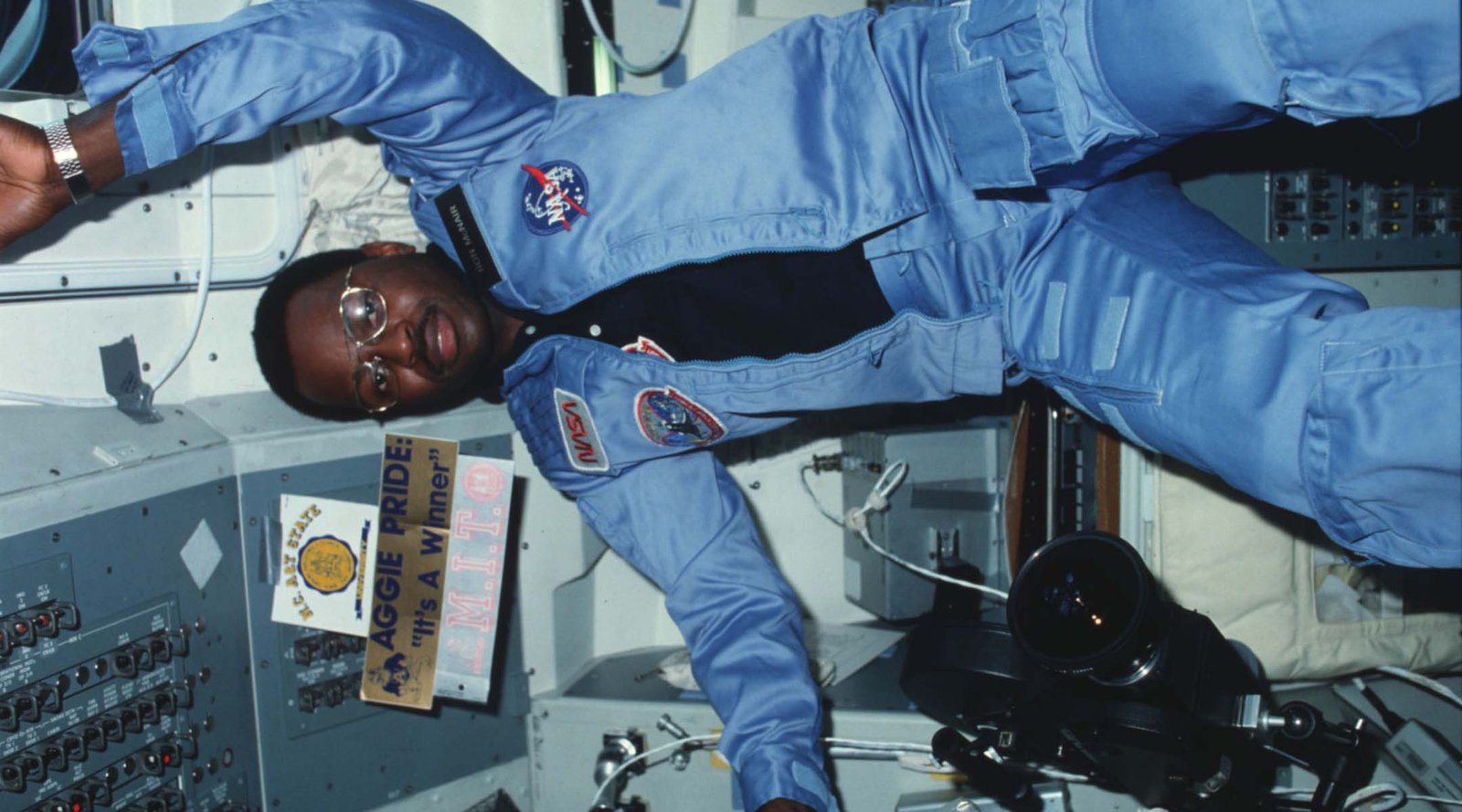
Ronald McNair – Image by The U.S. National Archives

American physicist Ronald McNair became the third Black man to fly in space in 1984. After being selected by NASA as a mission specialist astronaut in 1978, his first spaceflight was on the STS-41B Space Shuttle Challenger mission. On that mission, McNair operated the robotic machinery that allowed an astronaut to perform a spacewalk without being tethered to a spacecraft for the first time ever. This technique was used on future shuttle missions to assemble the ISS and repair vital satellites. In 1968, Ronald was selected to fly on the 25th Space Shuttle mission and the 10th launch of the Space Shuttle Challenger. Tragically, he died during launch in a fatal accident now known as the Space Shuttle Challenger disaster. The shuttle exploded 73 seconds into its flight, killing all seven astronauts on board. This Black History Month, we’re celebrating Ronald McNair’s life and achievements as a true trailblazer and Black space icon.

Jessica Watkins – Image by NASA/Frank Michaux

In April 2022, American engineer and NASA astronaut Jessica Watkins made history as the first Black woman to live and work aboard the ISS for an extended mission. On her ground-breaking mission, Watkins has been studying Earth, space and biological science, as well as the impact of prolonged spaceflight on humans. She has also been monitoring and photographing geological changes on Earth. Jessica’s love for space stems back to childhood when her passion was ignited by an enrichment program at her elementary school. From that point on, she knew she wanted to study the geology of planets.

“I think it’s important to recognize this as a milestone for our agency and for our country, as well, to know that we are building on the foundation that was laid by the Black woman astronauts who’ve come before me,” she commented. “I’m definitely honored to be a small part of that legacy, but ultimately be an equal member of the crew.”

Of the circa 250 people to board the ISS, less than 10 have been Black. Watkins’ space mission is a huge part of Black history that deserves recognition and celebration.

Representation is a crucial part of any industry, especially within STEM fields. The US STEM sector is only 9% Black as of 2022, with Black individuals earning an average of $58,000 in comparison to $71,900 for white individuals. These are shocking demographics within a sector that represents progression and inclusion.

The list of emblematic Black people the space sector is a long one. These individuals forged, and are continuing to forge, a path for a more inclusive industry through representation and inspiration. Space really is for everyone, and the sector needs people from all walks of life in order to progress and develop. Through further representation and celebration of those who came before, we can nurture an industry that will thrive alongside humanity into the future.