It Came from Outer Space! Everyday Items Invented by NASA.

Many of the objects we rely on every day only exist thanks to NASA’s ingenious team of scientists and engineers.

We’re celebrating the brains behind these vital elements of modern life, looking back over NASA’s achievements and exploring the fascinating origins of these everyday items.


Nike Air Trainers

In 1979, NASA aeronautical engineer Frank Rudy decided to take technology originally developed for astronauts’ helmets and apply it to sports shoes. Using ‘blow rubber moulding’, an aeronautics technique used for the Apollo mission helmets, he pumped gas into hollowed-out plastic soles to create a shock-absorbing cushion, reducing the strength of an impact. Rudy pitched this idea to Nike, resulting in the launch of the AIR brand (Tailwind) that is still being used today – we’re quite literally walking on air! Having revolutionised running shoe’s traction, comfort, and lightness, British runner Steve Ovett won a gold medal at the Moscow Olympics a year later in these trainers.


Laptops

The GRiD Compass – the world’s first laptop computer – was initially used on a space shuttle mission flown from the Kennedy Space Center in 1983. With a robust clam shell design, GRiD was about the size of a large ring binder and weighed a hefty 4.5kg. Its 21.6cm plasma screen could display 25 lines of up to 128 characters that could be “viewed from any angle and under any lighting conditions”. The device came with a spreadsheet and text editor, a database manager, a plotter, a terminal emulator and other business software. The Compass was priced at a whopping $8,150 (the equivalent of around $23,000 today), so was understandably not intend for consumers, but for business executives.


Phone Cameras

From digital cameras to Go Pros to phone cameras, NASA was the first to develop the concept of a technology we couldn’t imagine life without today. When they decided to substitute Charged Coupled Device (CCD) sensors for Complimentary Metal-Oxide-Semiconductor (CMOS) sensors in their satellite cameras, they were on to something big. CMOS are much more portable and energy conscious sensors, they also capture higher-quality images. Using this technology, NASA created a camera small enough to fit on a spacecraft without sacrificing quality, maintaining the scientific excellence of image sensors in space. Today, these clever sensors are used in practically every camera.


Super Soakers

The technology behind Super Soakers was accidentally developed by a NASA spacecraft systems engineer and part-time inventor Lonnie Johnson. He was working on a new concept for a heat pump to use in refrigerators, “machining some nozzles and experimenting at home” when he “shot some streams of water into the sink”. Surprised by their power, he thought, “Geez, this would make a neat water gun”. After giving the prototype to his daughter, he soon heard feedback of its success with her friends. He received the patent for his ‘Squirt Gun’ in 1968.


Memory Foam

The memory foam in our mattresses, pillows, and even shoes was created in the 1970s by NASA-funded researchers as padding to keep pilots cushioned during flights. The visco-elastic foam would mould to the astronauts’ bodies during the high forces experienced in take-off and landing, improving crash protection, support and comfort. Today, memory foam mattresses carry a ‘Certified Space Technology’ stamp of approval. TEMPUR is even recognised by NASA and certified by the Space Foundation.


Cordless Vacuums

Cordless vacuums were first developed as a lightweight device to collect samples on the moon. NASA contracted Black & Decker to create the battery-operated vacuum/drill hybrid.  The technology was lightweight, compact and powerful, so was quickly reused in consumer, industrial and medical hand-held cordless vacuums, including the Dustbuster.


Precision GPS

NASA originally developed precision GPS technology to correct errors in the data from their Jet Propulsion Lab’s (JPL) global network of GPS receivers. It was the Sputnik era, and the US Navy was experimenting with satellite navigation to track their submarines with nuclear missiles onboard. Later in the 70s, the Department of Defense (DoD) used these Navy techniques to create a stable satellite navigation system, leading to the first Navigation System with Timing and Ranging (NAVSTAR) satellite.


Enriched Baby Formula

The nutritional enrichment found in enriched baby formula was originally found by experiments conducted by NASA in the early 1980s. Researchers began by exploring the use of algae to create oxygen in outer space using the process of photosynthesis. However, they soon realised that certain types of algae contained some of the essential omega-3 fatty acids that are present in human breast milk. This discovery was then used in baby formulas, enriched with the fatty acids that help babies in their development.


Resistance-Based Workout Machines

NASA engineers created the treadmills and workout machines that are (sometimes reluctantly!) used today. They created workout machines to maintain astronauts’ physical fitness in space because exposure to zero gravity can weaken the body, leading to muscle waste and decreasing bone density. Their Advanced Resistive Exercise Device (ARED) was designed to allow for more intense workouts in zero gravity. This resistance technology was developed further to make fitness and gym training more accessible to everyone.


UV-Blocking Sunglasses

NASA first developed UV-blocking sunglasses to block out harmful wavelengths of solar radiation. The sunlight-filtering lenses protected astronauts’ eyes and enhanced colours. When creating the lenses, JPL scientists James Stephens and Charles Miller studied the eye structure of various birds of prey. Some contain oil droplets that protect from intensely radiated light waves to enhance vision. They took inspiration from nature to create a filtering system using light-filtering dyes and particles of zinc oxide. This same technology is use in sunglasses, safety masks for welding and ski goggles today.

Sustainability and the Space Sector

It’s World Space Week, and this year’s theme is sustainability.

The space sector isn’t just about rockets and astronauts. Ever-evolving space technologies are working hard to make Earth more sustainable today and for future generations.

This week, we’re celebrating space’s relationship with sustainability by exploring some key issues the sector is working to fix.


REUSABLE ROCKETS

Imagine planes weren’t reusable – it just wouldn’t make sense. If we were to build a new aircraft for each flight, it would be an extremely unsustainable way to travel. Why should it be any different with rockets?

Reusability is vital in the space sector because rockets and fuel are expensive. As more organisations invest in multi-use rockets, it’s showing huge potential in driving down the capital cost of each rocket per launch. On top of this, this kind of technology and innovation is making space more accessible for everyone. NASA calculated that the cost of commercial launches to the International Space Station has reduced by four times over the last 20 years.

NASA paved the way for sustainable spacecraft with their Space Shuttle fleet – Columbia, Challenger, Discovery, Atlantis and Endeavour. Their main shuttles were completely reusable, along with their two solid rocket boosters. The crew only  needed to replace the external fuel tank for each new mission. These innovative spacecrafts carried 800 astronauts on a grand total of 135 missions between 1981 and 2011. They inspired a generation of space lovers while playing a key part in constructing the International Space Station.

In more recent news, SpaceX developed Falcon 9, a reusable two-stage rocket. With this rocket’s launch cost once standing at $62 million, reusability has driven this down over 40%. These reduced costs are opening the door to space for more companies, reducing waste and enabling innovation through space exploration.


3D PRINTED ROCKETS

On the subject of reducing launch costs, another hot topic in the industry right now is 3D printed rockets. Construction through 3D printing massively reduces waste and CO2 emissions, enabling sustainable space exploration even further. While it once took thousands of engineers decades to get a rocket into space, 3D printers are now reducing turnaround time to as little as 60 days.

Founded in 2015, California-based startup Relativity Space are making huge waves in the industry with their 3D printed rockets. Terran 1 is a two-stage, 7.5 ft wide and 110ft tall rocket – it’s the largest 3D printed object in existence to attempt spaceflight. In addition to their sustainable manufacturing, all of Relativity Space’s rockets are fuelled by liquid oxygen and liquid natural gas. Aside from being extremely effective fuel sources, they can also be reused for future missions.

As the space sector continues to benefit humanity through threads of innovation, it’s exciting to see companies directing time and money towards more sustainable methods of exploration. With the topic of sustainability in the industry more relevant than ever, we can’t wait to see what the experts will come up with next.


REFORESTATION

Over 420 million hectares of forest have been demolished since 1990, and the problem is getting worse. 25.8 million hectares were lost in 2020, which is double the amount lost in 2001.

It’s estimated that 2,400 trees are cut down every minute, with a forest the size of a football field lost every second. Alongside this, 137 species of animals, birds and plants are lost globally each day.

Satellites play a crucial role in minoring deforestation. Technologies like Synthetic Aperture Radar (SAR) satellites allow us to detect and track deforestation, as well as analyse biomass and forest height. These satellites use radars to map and image the Earth’s surface with day, night and all-weather capabilities. They also allow us to “see” through things like clouds, smoke, vegetation, snow and sand. The ability to repeatedly scan the same area, regardless of atmospheric or weather conditions, makes SAR an incredibly effective tool in measuring changes in the Earth’s landscapes and environment.

Satellites like these enable us to monitor reforestation projects, ensuring transparency and progress in humanity’s fight to protect and rebuild these much-needed forests.

While reforestation starts here on Earth through choosing sustainable products and foods, recycling more and going paperless, space-based technologies are a key component in our shared mission to save planet Earth’s green spaces.


SPACE DEBRIS

Also referred to as space junk, space debris is any man-made object in Earth’s orbit that no longer serves a purpose. It includes items like disused spacecraft, inactive satellites, fragments from explosions and collisions, launch canisters and mission-related objects.

As Earth’s orbit becomes more congested, this debris threatens human spaceflight and robotic missions. It also causes problems for our GPS, weather forecasting and telecommunications systems back on Earth. With an estimated 9,000 metric tons of debris currently in Earth’s orbit, the sector is investing in innovative ways to clean up space.

In March 2021, private orbital debris removal company Astroscale launched its End-of-Life Services by Astroscale-demonstration (ELSA-d) satellite. It consists of two spacecraft – a 175kg chaser and a 17kg target. Using magnets, ELSA-d will capture orbiting junk and pull it out of orbit to burn up in the atmosphere. This innovative craft was awarded the 2021 Satellite Technology of the Year Award.

Astroscale reported ELSA-d’s success in August 2021, giving new hope that the spacecraft will be able to complete this same process to capture pieces of debris.

Many other posed solutions are still in their research phases. The US Defence Advanced Research Project Agency has been investigating a ‘space garbage truck’ equipped with 200 giant nets to catch orbiting debris. The collected junk would either be dragged into lower orbit or brought back to land in the ocean.

Whichever innovative method c gets the go-ahead, one thing is clear – and it’s definitely not space. With the sheer mass of junk orbiting Earth, we need to come up with an effective solution, and fast.

The space sector has come a long way, but our venture beyond the stars has only just begun. The sector will transform our lives in ways we never thought possible, but for the industry to thrive, humanity needs to clean up its act.


CLIMATE CHANGE

While many complex systems contribute to the Earth’s atmosphere, both natural and man-made, the key to fighting climate change is understanding and monitoring its causes. Through space exploration and technologies, we’re able to gain accurate information about changes in the Earth’s atmosphere.

Satellites and other space technologies allow us to monitor and minimise the impact of climate change, protecting Earth’s people, animals and ecosystems. Multiple satellites systems are currently monitoring climate change from space. They track sea levels, greenhouse gas emissions and land surface temperatures.

NASA’s Nimbus-3 satellite, launched in 1969, was the first to offer an accurate measurement of Earth’s atmospheric temperatures. Today, the agency has multiple orbiting satellites in their Earth observation fleet that are producing evolving climate models to help us combat climate change.

Cube satellites (CubeSats) are also being used as remote sensing tools in the fight against climate change. These tiny nanosatellites carry scientific instruments that gather scientific data and conduct experiments from space. They’re widely utilised to track various measures of climate change and are vital in our plight to solve the crisis.

It seems that innovation in the space sector knows no bounds. It’s not just about exploration – the industry’s incredible capabilities can combat everyday issues like climate change that affect each and every one of us. As the climate crisis rages on, space technologies like these will be an integral element of our fight against it.


WATER PURIFICATION

2.2 billion people are currently living with limited access to safe drinking water. By 2025, it’s estimated that half of the world’s population will be living in water-deprived areas.

In the face of this tragedy, space technology supports water purification efforts worldwide. Advanced modern water filtration and purification systems use technology originally developed for the International Space Station.

One of the very first ground-based water systems was installed in northern Iraq in 2006, backed by NASA technology. When a non-profit organisation called Concern for Kids heard about a well failure in the area that left the residents of Kendala, an Iraqi village, without access to drinking water. Tragically, this caused the village’s population to drop from 1,000 to only 150 people. The survivors were forced to live off water from a local creek that was contaminated by livestock.

Another innovative system, The Environmental Control and Life Support System (ECLSS), was created by NASA to recycle water and air aboard the International Space Station. The ECLSS consists of two core systems, The Water Recovery System (WRS) and the Oxygen Generation System (OGS). The OGC creates oxygen while replacing lost oxygen caused by airlock depressurisation, CO2 venting, various experiments and module leakage, while the WRS works to provide clean drinking water through recycled urine, condensation and extra vehicular activity waste. This recycled water provides both the ISS crew and laboratory animals with clean water to sustain prolonged space travel.

These threads of innovation from the space sector are quite literally saving and sustaining lives worldwide. They’re a prime example of ways the industry supports both life in space as well as back on Earth.

DISASTER RESPONSE

The space sector plays a vital role in crisis management and disaster response. Space-based technologies enable us to stay ahead of the curve when disaster strikes, facilitating early warning, prevention and faster response time.

With the frequency and severity of natural disasters rising, the space sector’s capabilities will be critical for disaster response and reconstruction. They will help us to save lives, minimise damage to impacted areas and rebuild communities.

When disaster-prone areas become highly populated, monitoring and early response are crucial. To enable this, systems like the European Union’s Earth observation programme, Copernicus, provide valuable data about our planet and its environment. The Copernicus Emergency Management Service (CEMS) generates geospatial information for emergency response and disaster risk reduction. Using satellites, CEMS continuously monitors the Earth’s environment and creates forecasts for droughts, floods and forest fires through on-demand mapping.

When Hurricane Ian tragically struck parts of the US, devastating homes, businesses and entire communities, the space sector sprung into action. Various satellite constellations provided critical data about the storm’s severity and path of destruction, allowing experts to create disaster response plans. The National Oceanic and Atmospheric Administration (NOAA) even produced publicly available street-by-street satellite maps of affected areas, enabling residents to assess the damage to their homes even if they were unable access them.

The space sector saves lives in the face of disaster. Innovative technologies and systems like these give us a vital advantage against damage and devastation, allowing experts to quickly assess and respond to these life-threatening situations.

Janna Chapman – EVONA Scholar for Diversity in STEM

We recently had the pleasure of catching up with Janna Chapman, winner of the EVONA Scholarship for Diversity in STEM.

Janna is an incredibly talented and passionate young person who wants to use Geospatial Intelligence (GEOINT) to solve real-world environmental problems. We’re thrilled to be partnering with the United States Geospatial Intelligence Foundation (USGIF) to sponsor Janna through her master’s degree in geographical science.

You can check out the original announcement and learn more about the EVONA Scholarship in our recent blog post.

Firstly – congratulations on being awarded the EVONA Scholarship for Diversity in STEM! How are you feeling?

I’m feeling really excited for the school year now! This scholarship takes a huge weight off mine and my parents’ shoulders.

Tell us a bit about yourself.

I’m a senior Geographical Sciences and Environmental Science and Technology dual degree student at the University of Maryland, College Park. My research interests include using GIS to investigate the spatial patterns and inequalities associated with various climate change-induced effects. In my free time, I enjoy going gardening, hiking and reading.

Where does your passion for geospatial intelligence stem from? Are there any specific people who inspire you?

Before geospatial intelligence, I started a huge interest in environmental science thanks to my grandfather when he introduced me to gardening when I was 3 years old. Since then I’ve tried to get more and more knowledge and experience in the environmental sciences. This led me to apply to a first-year research program at my university where I learned how to use the programming language R to investigate environmental issues. While I didn’t know that what I was doing at the time was considered ‘geospatial intelligence’, the data visualizations I made and success after the trial-and-error process made me interested in learning more about how maps and programming can help people and the environment in light of climate change.

Do you have any industry experience so far?

This past spring I was a Global Forest Watch intern at the World Resources Institute. I managed training data collection for machine learning algorithms that were used to classify drivers of deforestation. This included recruiting and training volunteers to collect data and my own data collection.

On campus, I’ve had many different research experiences from mapping poultry farms in Maryland, Delaware, and Virginia for the US Department of Agriculture to using geographic regression to determine the relationship between urban green space accessibility and different demographic groups in New York City.

What are you most looking forward to in this next chapter?

I look forward to developing my technological skills, especially data visualization, in a course I take this fall. I also am looking forward to applying for off-campus experiences for next spring and summer.

What are you hoping to do once you’ve finished your master’s?

After my master’s I’d like to work as an analyst at an environmental organization such as the EPA or the World Resources Institute where I can use and develop the skills I’ve learned in school to help solve real-world environmental problems.

What impact do you want to have on the GEOINT sector?

I’d like to improve general public knowledge about environmental phenomena (environmental literacy) through easy-to-access and understand environmental data. Sometimes this information can be hard to find or can be misinterpreted, which can have a negative impact on policies that can impact real environmental change.

What are your thoughts about diversity in GEOINT/STEM industries?

I think the diversity of the GEOINT/STEM industries can be improved. Diverse perspectives in any sector can provide new avenues of research ideas and potentially decrease the feeling of imposter syndrome. I even feel imposter syndrome in school because I’m usually the only black woman in my classes. Introducing GEOINT concepts early in students’ education can help close these gaps in the industry.

Our entire crew are wishing Janna the best of luck as she enters this next chapter in her GEOINT journey. We’ll be checking in with her each semester to see how she’s getting on, so keep an eye out for updates!

EVONA Welcome Christina Korp as New Strategic Advisor

We’re delighted to introduce EVONA’s newest strategic advisor – Christina Korp.

Christina Korp

Alongside the enormous growth we’ve experienced as a company, Christina’s industry experience and expertise will be instrumental in our mission to shape the space sector one inspired person at a time.

Christina has a wealth of knowledge across many corners of the space sector. She’s a space advisor, astronaut manager and the president of Purpose Entertainment. Impressively, she managed Apollo 11 astronaut Buzz Aldrin and played a vital role in launching his education foundations – ShareSpace and the Aldrin Family Foundation. Christina is even known as an ‘astronaut wrangler’ because of her history of managing and working with high-profile astronauts.

Christina is the founder of SPACE for a Better World, a space education and advocacy organisation that partners with schools, universities, education foundations and space grant consortiums. They create progammes and projects that can be duplicated in any community to inspire, educate and raise awareness of the ways space can be used for good.

“I’m excited about partnering with EVONA because of our shared values and purpose,” Christina commented. “We all came to space from outside of the space ecosystem and I think we see the enormous possibilities with a fresh perspective that is really needed. I look forward to working with the crew at EVONA to inspire more people to want to work in space.“

Before entering the space sector, Christina had a fruitful music career. After being in a family band for 10 years, she moved to LA aged 22 to pursue her dreams of being a rockstar. She went on to produce records, tour the world and even sing backup for legends like Ringo Starr. She eventually took a job working as Buzz Alrdin’s manager, and so begun her incredible journey into the space industry.

“Not only is Christina’s experience incredible, but from the very first meeting it was clear that EVONA’s vision of a more inclusive space sector aligned perfectly with Christina’s. We’re thrilled to be working alongside people that genuinely want to make a difference to our sector and can’t wait to see what the future holds for this partnership,” said Jack Madley, EVONA Co-Founder.

As a lifelong lover of space who took an unconventional route into the sector, Christina provides a fresh perspective that aligns perfectly with our own. She’s a passionate advocate of inspiring people of all ages, genders and backgrounds to get involved in space and other STEM industries. Christina’s mission is to connect the space curious to the space serious, demystifying the sector and increasing awareness of the sector’s incredible work.

We’re both proud and excited to be partnered with such an inspiring member of the space sector. Our crew are very much looking forwards to working with Christina to help people to find their place in space and shape the sector for future generations.

Celebrating 10 Years of the Curiosity Mars Rover

WHEN A JETPACK FIRST LOWERED CURIOSITY ONTO MARS, SHE WAS ONLY SETTING OUT ON A TWO-YEAR MISSION TO DISCOVER WHETHER THE RED PLANET COULD HAVE HOMED ANCIENT MICROBIAL LIFE. FAST FORWARD 10 YEARS – THE CAR-SIZED ROVER IS STILL EXPLORING WITH NO SIGNS OF STOPPING.

Since landing, Curiosity has travelled 17.5 miles and climbed over 2000ft in elevation. You can even track her live location! The rover still has practically full capabilities, with all science instruments said to be working almost just as they were when they landed.

Curiosity has collected 41 material samples, had her data published in 883 scientific papers and captured 494,540 images – including a 1.8-billion-pixel panorama, her largest and highest resolution panorama ever.

A great way to keep up with Curiosity’s adventures is to follow her Twitter account. As of August 2022, she has 4.3 million followers cheering her on.

Launched in November 2011, Curiosity was designed to explore Gale Crater, a 96-mile-wide impact basin with a 3-mile-high rock-layered mountain called Mount Sharp in the centre. This particular landing site was chosen as it has several signs of the historic presence of water. Scientists back on Earth wanted to discover the history of this crater, how it came to be, and what it could teach us about the Red Planet’s history.

After years of exploration, experts concluded the crater was formed around 3.7 billion years ago when a large meteor hit the planet, annihilating the rock below while forming the mountain peak in the middle.

In alignment with NASA’s Mars Exploration Program, Curiosity’s main science goals are divided into four categories:

• determine whether life ever arose on Mars

• characterize the climate of Mars

• characterize the geology of Mars

• prepare for human exploration

To mark 10 incredible years of exploration and discovery, we’re looking back over Curiosity’s achievements as one of the largest and most powerful rovers ever sent to Mars.

DISCOVERING AN ANCIENT STREAMBED

Only seven weeks after landing, Curiosity discovered smooth, rounded pebbles that experts believe likely rolled downstream for miles on an ancient streambed. The varying sizes and shapes of these rocks allowed experts to calculate the speed and depth of the water that once flowed there.

“At a minimum, the stream was flowing at a speed equivalent to a walking pace – a meter, or three feet, per second – and it was ankle-deep to hip-deep,” said Rebecca Williams of the Planetary Science Institute.

Since life thrives around water on Earth, this first discovery suggested that parts of Mars may well have been habitable billions of years ago.

DRILLING SAMPLES FROM MARTIAN ROCK

Curiosity later drilled her first sample from an ancient network of streams flowing from the rim of Gale Crater. Vital chemical ingredients for life such as nitrogen, sulphur, oxygen, carbon, hydrogen and phosphorus were discovered in powder from the sedimentary rock. Layers of mudstone, nodules, and veins were also found in the ancient bedrock, indicating that the planet experienced multiple periods of wet conditions. After studying the sample further, scientists found that clay minerals made up at least 20% of its composition – these minerals form when fresh water reacts with igneous materials. Experts concluded that rivers and lakes existed in Gale Crater for a million years, if not longer.

“The range of chemical ingredients we have identified in the sample is impressive, and it suggests pairings such as sulphates and sulphides that indicate a possible chemical energy source for micro-organisms,” said Paul Mahaffy, principal investigator of the SAM suite of instruments at NASA’s Goddard Space Flight Center.

DETECTING ACTIVE AND ANCIENT ORGANIC CHEMICALS

After discovering the historic presence of water and life-supporting chemistry, Curiosity went on to measure a tenfold increase of methane – an organic chemical – in Mars’ atmosphere over a two-month period. This was a huge discovery as methane is produced both by chemical reactions and by living organisms – this means that present-day Mars is an active environment.

“This temporary increase in methane – sharply up and then back down – tells us there must be some relatively localized source,” commented Sushil Atreya of the University of Michigan, a member of the Curiosity rover science team. “There are many possible sources, biological or non-biological, such as interaction of water and rock.”


ASSESSING RADIATION LEVELS

Aside from discovering about Mars’ past, Curiosity has taught us about our potential future on the planet. The rover has been measuring and assessing the planet’s radiation levels with her Radiation Assessment Detector (RAD), helping scientists understand potential risks to human visitors.
While Earth has a magnetic field to shield it from high-energy particles, Mars does not. This kind of radiation can cause serious problems both for health and for astronaut’s life support systems. However, data from Curiosity’s RAD suggests that natural Martian elements like sediment and rock could shield astronauts from this harmful radiation.

In 2019, Curiosity was parked by a cliff in Murray Buttes from September 9th to 12th. During this time, RAD reported a decrease in overall radiation of 4%, and a decrease in neutral particle radiation of 7.5%. These findings sparked new areas of research, one of which involved Curiosity’s counterpart, Perseverance, being sent to Mars with spacesuit samples to see how they fare against the planet’s radiation.

So, there you have it. After 6686 Martian days, Curiosity’s incredible journey and discoveries like these have led to some ground-breaking conclusions about the Red Planet’s history, as well as our future there.

“A fundamental question for this mission is whether Mars could have supported a habitable environment,” said Michael Meyer, lead scientist for NASA’s Mars Exploration Program at the agency’s headquarters in Washington. “From what we know now, the answer is yes.”

Thanks to Curiosity, scientists have pieced together the history of Mars’ evolution. Now we’ve answered this essential question, it seems we still have a lot to learn.

On her 10th birthday, we’re wishing this curious robot many more on Martian soil as she continues to fuel our understanding of the planet.

EVONA and USGIF Announce STEM Diversity Scholarship Winner

Through the EVONA Scholarship for Diversity in STEM, we’re proud to be sponsoring a talented young person through a multi-year degree, in partnership with the United States Geospatial Intelligence Foundation (USGIF).

Following the scholarship fund’s announcement at last year’s GEOINT Symposium, all 2022 USGIF scholarship winners have now been selected.

“Not only does EVONA share USGIF’s commitment to investing in the future of GEOINT, they also understand the essential need for that future workforce to be equitable and diverse,” commented Christine MacKrell, USGIF Director of Education and Professional Development. “With support from community partners like EVONA, USGIF is better positioned to work toward our goal of diversifying the GEOINT talent pipeline.”

The EVONA Scholarship was created as part of our mission to drive diversity into STEM industries. It was designed to open doors for an undergrad from a diverse gender and racial background pursuing a geospatial, data science, or space-focused degree. We want to inspire someone who may have otherwise faced challenges, or felt it was not possible, to pursue a career in STEM.

Richard Joyce, EVONA Co-Founder, commented, “EVONA are advocates for the benefits that a diverse workforce can bring to any organisation. Like many in our sector, we recognise that there is a lack of diversity in space, aerospace, engineering and STEM as a whole, and we know the industry won’t change unless we begin to address that issue now. We’re looking forward to supporting someone throughout the next stage in their education and beyond into a bright career in STEM.”

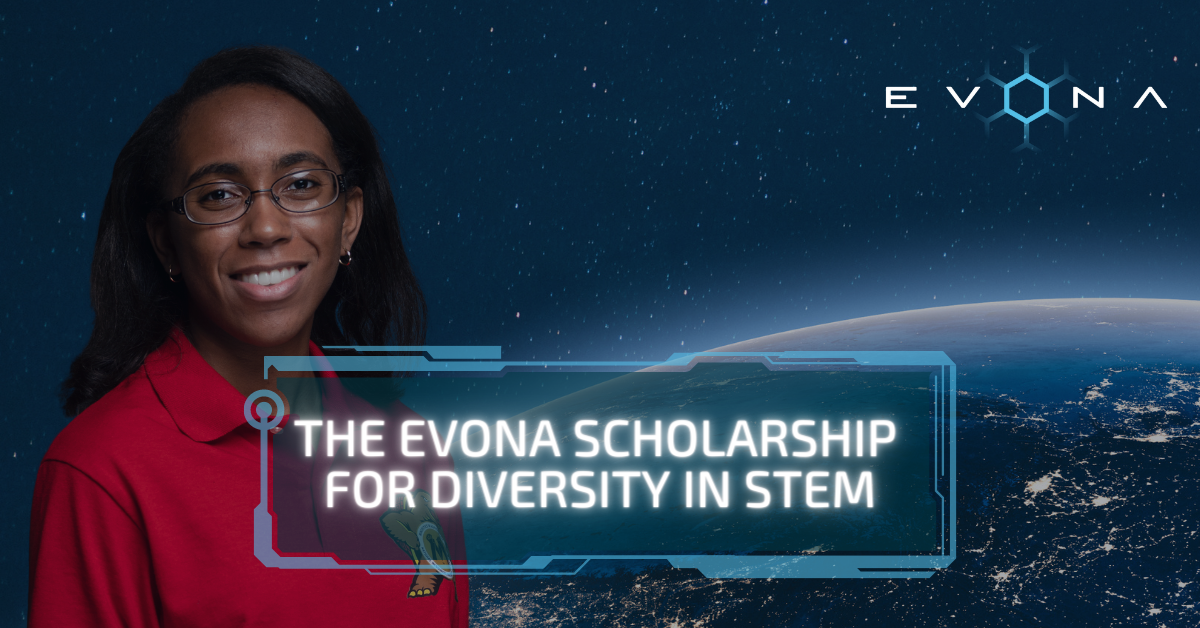
After careful consideration, the winner of the EVONA Scholarship for Diversity in STEM has been selected. We’re thrilled to introduce – Janna Chapman.

Currently studying at the University of Maryland, College Park, Janna is a senior dual degree student majoring in environmental sciences and technology and geographical sciences. Her lifelong interest in environmental science and experience with spatial data manipulation has fuelled her passion for a career in GEOINT.

“Earning the USGIF EVONA Diversity Scholarship solidifies the strength of my knowledge and competence in the geospatial field,” said Janna. “Knowing that top people in the industry feel that I am worthy of this scholarship makes me feel that I will be able to succeed in the future. I also appreciate USGIF and EVONA’s commitment to diversity by supporting underrepresented students. I love the geographical sciences, hope for more people who look like me to feel included in this field in the future. This scholarship will allow me to focus on my school and research work without having to find a part-time job to pay for college.”

Janna has a keen interest in using Geographic Information Systems (GIS) to investigate the spatial patterns and inequalities associated with the effects of climate change. After pursing a master’s in geographical science, she hopes to one day have a career in environmental data science.

EVONA Co-founder Tom Kelly commented, “As a specialist space sector staffing agency, we understand that sustainability of the space sector relies on the next generation. We must act in a pragmatic way now to encourage diversity into the workforce as well as nurture the talent already within. EVONA strive to make a tangible difference to a sector we love, and we’re thrilled to be able to do that in such an impactful way by sponsoring Janna in her undergraduate degree.”

We talk a lot about diversity and inclusion, and we want to lead by example. Through the EVONA Scholarship, we hope to demonstrate exactly how to affect change in the industry – by investing in culture, diversity and inclusion. By creating a diverse sector today, we can shape the future of STEM into one that will progress and thrive.

We’re passionate about driving diversity into the industry and are thrilled to be funding this scholarship in alignment with our mission. Our entire crew are wishing Janna the best of luck in her degree and can’t wait to meet her when she flies to the UK.

Star Trek’s Nichelle Nichols – TV Icon & NASA Recruiter

NICHELLE NICHOLS, MOST FAMOUS FOR HER ICONIC ROLE AS COMMUNICATIONS OFFICER LT. NYOTA UHURA IN THE ORIGINAL STAR TREK SERIES, HAS DIED AT THE AGE OF 89.

Nichelle’s son announced her death on Facebook last Sunday morning,

“I regret to inform you that a great light in the firmament no longer shines for us as it has for so many years. Her light however, like the ancient galaxies now being seen for the first time, will remain for us and future generations to enjoy, learn from and draw inspiration.”

Nichelle was a true pioneer across both the television and space industries. As Lt. Uhura, she pushed boundaries as the first Black actress to be cast in a continuous co-starring role. Not only this, but she featured in US television’s first interracial kiss with William Shatner.

Nichols’ influence spread beyond film and television – she even managed to incorporate her life-long fascination with space travel. She was a passenger on NASA’s C-141 Astronomy Observatory, which conducted an eight-hour high-altitude mission to study the atmospheres of Mars and Saturn. A decade after Star Trek ended, she was even hired by NASA to encourage more women and Black Americans to become astronauts. Check out her 1977 recruitment video.

Many of NASA’s employees referenced Nichols’ performance in Star Trek as their inspiration to join the agency. With her involvement, they went on to recruit Guion Bluford, the first Black American in space, Mae Jemison, the first Black woman in space, and Sally Ride, the first American woman in space.

At Nichols’ 85th birthday party, Jemison recounted seeing Lt. Uhura on her television as a child and knowing her dream was within reach,

“How we think about the world is shaped by our fantasies. Star Trek’ happened to be a really great fantasy. Nichelle represented the fact that we had inclusion everywhere, and it so much has influenced how people think of a hopeful future. What we have to do today is get back to that.”

Following Nichols’ death, Jemison tweeted,

“@NichelleIsUhura is forever for me the embodiment of grace, daring, intelligence, fun, inspiration, beauty, talent & the future. Today I am heart-sad at her passing. I consider our dearest friendship a great treasure & privilege in my life.”

Alongside Jamison, Sally Ride thanked Nichols for inspiring her career,

“I think it’s been one of the most remarkable things in my career … that this one character that was a gift to me … became this iconic image and inspired and impacted so many people’s lives in positive ways.”

Nichelle Nichols’ influence will transcend her lifetime. Her performance fuelled a generation’s fascination with space, standing as testament to the countless influences that have shaped the space sector as we know it. She inspired us to strive for more, regardless of social constructs.

In what was still a segregated time, the representation of a Black female on television – a sci-fi series no less – was groundbreaking. Legends like Nichols paved the way for a more sustainable space industry through diversity, inclusion, and inspiration. As she exemplified so perfectly, space really is for everyone. Representation like this is what will continue to drive the sector into the future, allowing it to progress and thrive alongside humanity.

In light of her passing, the world celebrates the life’s work and accomplishments of a true icon.

Image: Nichelle Nichols speaking at the 2013 Phoenix Comicon at the Phoenix Convention Center in Phoenix, Arizona.

Credit: Gage Skidmore

EVONA Joins the SmallSat Alliance

WE’RE PROUD TO ANNOUNCE THAT EVONA IS THE LATEST MEMBER OF THE SMALLSAT ALLIANCE.

Advocating for increased use of SmallSat technologies, the Alliance unites crucial names across the next generation space economy.

‘SmallSat’ refers to satellites with a small mass, typically the size of a large kitchen fridge. Keep in mind that the International Space Station has a mass of 420,000kg – in comparison, these new technologies are miniscule.

While space infrastructure may seem to be getting larger and more complex, these technologies are blowing the sector wide open. They provide increased opportunities for space exploration, all the while reducing costs.

Small satellites allow us to:

• Make space more accessible

• Reduce the cost of new space missions

• Reduce manufacturing costs

• Enable mass production

• Combine low launch costs with high performance

• Propel industry innovation

• Form large, powerful satellite constellations

• Provide exciting new opportunities for the global workforce and economy

The Small Sat Alliance’s mission is to unify companies developing, producing and operating across all segments of this exciting sector. Through networking, events and conferences, Alliance members are connected with customers, partners and suppliers. Already making individual waves across the sector, these vital institutions are empowered to build connections to drive this ever-evolving industry.

We’re delighted to be collaborating with these like-minded organisations. EVONA will play an integral role in building and facilitating a network of support to drive the small satellite industry. We will continue to service and connect across the sector as we advance the next generation of satellite technology.‍

“The space sector is seeing unprecedented growth and EVONA have a pivotal role to play in delivering on sector objectives. We know the challenge facing space companies as they scale and are delighted to join the SmallSat Alliance who have always been magnet for the most innovative and successful satellite makers, operators, component suppliers, launch and data analytics providers.” Jack Madley, Co-Founder.

In this exciting move, we’re looking forward to aligning our ethos with the SmallSat Alliance’s as we shape the space sector through inspiration and collaboration.

EVONA JOINS THE SATELLITE INDUSTRY ASSOCIATION

We’re delighted to announce that EVONA is the newest affiliate member of The Satellite Industry Association (SIA).Our mission has always been to further the progress of today’s space industry by preparing and sourcing talented members of the space workforce, identifying transferrable skills from outside the sector and championing STEM careers to future generations. Tom Stroup, president of the Satellite Industry Association said:‍

“On behalf of SIA, I am pleased to announce that global space recruitment company EVONA is the newest affiliate member of the Association,”

“The commercial satellite industry continues to grow at an unprecedented rate. In order to sustain that growth, it is imperative that the industry continues to recruit the highly specialized human resources needed to staff the growing numbers of companies entering the commercial space industry. EVONA’s specialized space industry recruitment expertise makes them an ideal member of the Association and we are pleased to welcome them to SIA.”

“The space sector is seeing unprecedented growth and EVONA have a clear role in delivering on workforce objectives. We know the challenge facing space companies as they scale and are delighted to join the SIA who have always been an important voice of advocacy for the satellite industry.” said Richard Joyce, Co-founder of EVONA

Affiliate membership in SIA is open to satellite companies as well as supporting entities that advocate and promote the domestic commercial satellite industry. SIA Affiliate Members receive a number of benefits including attendance at SIA’s Annual Association Meeting, participation in all open SIA meetings and most events (excluding the SIA Leadership Dinner) and SIA Member discounts to industry events.

‍For further details regarding membership in SIA, please see the following link:https://sia.org/membership/membership-applications/.

Collaboration with USGIF to sponsor STEM scholarships

We’ve made no secret of our mission to play a pivotal role in bringing more talent into the GeoIntelligence (GEOINT) and wider space sector. Today that mission took a significant leap in the right direction as we look to sponsor one talented individual through a multi-year degree in collaboration with USGIF.


At the United States Geospatial Intelligence Foundation’s (USGIF) GEOINT Symposium in April, EVONA was announced as sponsor for a multi-year USGIF scholarship designated to increase diversity in the GEOINT sector.


“Doing something pragmatic to engender the change we need to see in the sector shows how passionate we are about solving the talent crisis that we find ourselves in. We know first-hand how hard it is to find amazing talent to expand a sector which contributes directly to the betterment of human kind. We’re hoping that by making this step, other stakeholders in the industry follow suit and together we can create a bright future for not just those who already work in the space sector, but encourage those who never dreamed it possible that anyone can work in space” Richard Joyce, Co-founder of EVONA

 Doing something pragmatic to engender the change we need to see in the sector shows how passionate we are about solving the talent crisis that we find ourselves in. Richard Joyce, EVONA

This announcement came on the final day of USGIF’s annual GEOINT Symposium and reflects a focus throughout the week’s activities related to diversity, inclusion, and belonging in the GEOINT community. The scholarship is designed to support a student who otherwise may be precluded from further education in a STEM subject.

USGIF EVONA Scholarship

The scholarship is currently open to applications but closes on 6th June.

To find out more about how to apply, please keep an eye on this page.

The chosen applicant will be announced in July and EVONA fully intend to make them feel part of the EVONA crew by flying them over to the UK to meet with the team and understand as much about the sector as they can.

Advocating progressive thinking in our industry is essential to its development, which is something we support with great pride. – Tom Kelly, EVONA

Tom Kelly, EVONA Co-Founder explains “With ongoing support pledged by EVONA for the successful applicant throughout their career, we hope to deliver someone with not just the qualifications to succeed, but crucially the soft skills that we see so many of the space community requiring. Advocating progressive thinking in our industry is essential to its development, which is something we support with great pride. We’re excited to make a change in someone’s life; to combine education with our industry insights and connections is a truly unique opportunity. It’s here that EVONA know we can add real value to the USGIF.”

Further to the scholarship announcement EVONA have also begun talks to support USGIF with their Working Group and White Paper initiatives. Occurring every fortnight, EVONA will be offering key advice in the Tradecraft and Professional Development Working Group; a group of representatives, subject matter experts, mentors and professionals who wish to build the community, advance the tradecraft and accelerate innovation of Geospatial Intelligence (GEOINT).  Aiming to equip a workforce of professionals with GEOINT training, knowledge, and skills, EVONA provide a different perspective on the hiring challenges of the space and GEOINT sector.

To find out more on these events, please follow this link.