The disruptors shaping SmallSat technologies

The space industry is undergoing a significant transformation, fueled by advancements in SmallSat technologies. The recent State of the Art Report by NASA for 2023 provides an overview of these advancements and their current development status, utilizing NASA’s Technology Readiness Level (TRL) standard as a benchmark. Companies are categorized by their contributions to Payloads, Power, Propulsion, GNC, Avionics, and Launch sectors. It provides a general exploration of these innovations, setting a pathway for job seekers and companies alike to navigate the expanding space economy. 

Navigating your space in the industry: Why this matters? 

For job seekers: Exploring career opportunities in SmallSat innovations 

The space industry’s expansion, particularly in SmallSat technologies, opens a wealth of career paths. Companies leading in this domain, such as Astranis Space Technologies and Spire Global, are on the lookout for innovative minds to drive their missions forward. If you are looking for a new career in space, understanding the landscape as outlined in NASA’s report is crucial for identifying roles that match your skills and passions. It can offer a unique chance to contribute to the cutting-edge of space exploration.  

For companies: Talent acquisition in the Space Tech arena 

For companies looking to hire top talent in the competitive Space Tech sector, the NASA report not only offers a glimpse into the cutting-edge SmallSat technologies but also paints a clear picture of the competitive landscape. This insight is crucial for companies to position themselves strategically within the industry, ensuring they attract talent with the precise skills. 

You can see the whole list here. 

Some highlighted companies per sector: 

Payloads 

Hosted Payloads: represents a collaborative approach to space missions, where multiple payloads from different customers share a single satellite platform. This model promotes cost-efficiency, resource sharing, and operational flexibility, making space more accessible to a wide range of users. 

  • Astranis Space Technologies Corp. (USA): Specializes in providing broadband connectivity. 
  • Berlin Space Technologies (USA): Offers versatile satellite platforms for various payloads. 
  • EnduroSat (USA): Provides modular satellite solutions for academic, commercial, and research purposes. 
  • Loft Orbital (USA): Delivers a payload hosting service that simplifies access to space. 
  • Spire Global (USA): Focuses on data gathering and analytics through hosted payloads. 

Dedicated Spacecraft Bus: allocates the entire satellite bus to a single customer or mission, offering tailored solutions that cater to specific operational requirements. This approach has seen significant growth, incorporating comprehensive solutions that enhance mission flexibility. 

  • Alba Orbital (UK): Known for pioneering the PocketQube satellite standard for ultra-small satellites. 
  • Blue Canyon Technologies (USA): Provides a range of satellite buses for various mission types. 
  • Orion Space Solutions (USA): Offers customized satellite solutions for dedicated missions. 
  • AAC Clyde Space (Sweden): Specializes in advanced nanosatellite spacecraft for commercial missions. 
  • NanoAvionics (Lithuania): Focuses on mission-agnostic satellite buses with a high degree of customization. 

Power:  

Power generation: is crucial for SmallSats, relying predominantly on solar power technologies. This subsector focuses on companies developing solar cells, panels, and arrays to ensure sustainable energy sources for satellites in orbit. 

  • AZUR Space (Germany): A leader in solar cell manufacturing for space applications. 
  • Rocket Lab (USA): Not only a launch provider but also involved in power solutions for satellites. 
  • SpectroLab (USA): Offers high-efficiency solar cells and panels for space missions. 
  • Airbus Defense and Space (The Netherlands): Provides comprehensive space technology solutions, including power generation. 
  • AAC Clyde Space (Sweden): Known for its advanced solar power systems for CubeSats and SmallSats. 

Energy Storage: Given the intermittent nature of solar energy in space, energy storage plays a critical role in managing power supply during orbit night times and peak load periods. This subsector includes companies specializing in battery technologies for space applications. 

  • EaglePicher Technologies (USA): Offers robust battery solutions for a variety of space missions. 
  • Ibeos (USA): Specializes in high-reliability energy storage systems for spacecraft. 
  • Saft (France): Provides a range of battery technologies for space and other demanding environments. 
  • GomSpace (Germany): Delivers power storage solutions alongside its other nanosatellite components. 
  • AAC Clyde Space (Sweden): Engages in the development of advanced power storage systems for SmallSats. 

Power Management: Power management and distribution (PMAD) systems ensure the efficient use of electrical power within the spacecraft, controlling the flow to various subsystems as required. Companies in this subsector develop technologies that optimize power distribution to maintain satellite functionality. 

  • Bradford Space (USA): A leading provider of space propulsion and power management solutions. 
  • Space Dynamics Laboratory (USA): Develops custom power management systems for satellite missions. 
  • Berlin Space Technologies (Germany): Offers integrated power systems for small satellite platforms. 
  • NanoAvionics (Lithuania): Specializes in modular satellite bus technologies, including power management. 
  • GOMspace (Germany): Provides power management units designed for CubeSats and SmallSats. 

In-Space Propulsion:  

In-Space Chemical Propulsion: Chemical propulsion remains a cornerstone for in-space maneuvering, offering immediate thrust for orbit adjustments and mission-critical maneuvers. These companies have a proven track record or are pioneering new chemical propulsion technologies for small spacecraft: 

  • Aerojet Rocketdyne (USA): A leader in the development of propulsion systems, catering to a wide range of spacecraft sizes. 
  • Northrop Grumman (USA): Provides various propulsion solutions, including chemical propulsion for space missions. 
  • Moog (USA): Specializes in precision control components and systems, including propulsion. 
  • Benchmark Space Systems (USA): Offers innovative propulsion solutions tailored for SmallSats. 
  • Dawn Aerospace (New Zealand): Develops green propulsion technologies that offer both high performance and sustainability. 

In-Space Electric Propulsion: Electric propulsion offers efficiency and longevity for spacecraft, ideal for missions requiring significant delta-V or prolonged station-keeping. The companies listed are at the forefront of developing electric propulsion systems that are reshaping in-space maneuverability: 

  • Busek (USA): Renowned for its electric propulsion solutions, providing a variety of thruster options for SmallSats. 
  • Enpulsion (Austria): Offers highly scalable and modular ion propulsion systems for SmallSats. 
  • ThrustMe (France): Innovates with compact and efficient propulsion systems suitable for a range of satellite sizes. 
  • Northrop Grumman (USA): In addition to chemical, it also offers electric propulsion solutions, underscoring its broad expertise in space technologies. 
  • Exotrail (France): Specializes in electric propulsion systems, enhancing the operational capabilities of SmallSats. 

In-Space Propellant-less Propulsion: such as solar sails and electrodynamic tethers, provide innovative means for spacecraft maneuvering without the need for traditional fuel, opening new possibilities for mission design and sustainability: 

  • Aurora Propulsion Technologies (Finland): Focuses on propulsion solutions that require no traditional propellant. 
  • Tethers Unlimited (USA): Pioneers in developing space tether technologies for propulsion, power generation, and de-orbit mechanisms. 

GNC:  

Subsystems are crucial for the precise control and navigation of spacecraft, encompassing technologies for determining position and managing attitude control. These components ensure that satellites can maintain their intended orbits, align correctly for communications or observations, and execute maneuvers accurately. 

  • Berlin Space Technologies (Germany): Specializes in satellite systems that offer precise GNC capabilities for a variety of missions. 
  • Blue Canyon Technologies (USA): Renowned for its high-performance ADCS solutions, enabling advanced navigation and control for SmallSats. 
  • CubeSpace Satellite Systems (South Africa): Provides ADCS solutions tailored to the needs of CubeSats and SmallSats, emphasizing affordability and reliability. 
  • GomSpace (Denmark): Offers a range of GNC components, including advanced ADCS for precise positioning and maneuvering of nanosatellites. 
  • AAC Clyde Space (Sweden): Known for its expertise in developing robust ADCS solutions that enhance the operational capabilities of SmallSats. 

Avionics:  

Focusing on Data Handling and Flight Software: plays a pivotal role in mission success, ensuring efficient command and data handling, as well as the seamless operation of all onboard systems. The following companies are leading innovations in this sector: 

  • AAC Clyde Space (UK): Known for its expertise in space avionics, offering robust data handling systems for CubeSats and SmallSats. 
  • Aitech Systems Inc. (USA): Specializes in rugged electronic subsystems and components for space applications, including avionics. 
  • Bradford Space (USA): Provides comprehensive avionics solutions, including flight software and data handling systems. 
  • EnduroSat (Bulgaria): Offers modular CubeSat platforms with advanced avionics for academic, commercial, and research missions. 
  • GOMspace (Denmark): Delivers a wide range of avionics solutions, including command and data handling systems for nanosatellites. 

Launch: 

Focusing on Commercial Orbital Transfer: these services are essential for the final stage of satellite deployment, ensuring that payloads reach their intended orbits efficiently and accurately. Here are some of the leading companies in this sector: 

  • Moog (USA): Offers a variety of propulsion systems and components for satellite deployment and maneuvering. 
  • Momentus (USA): Specializes in in-space transportation services for satellites, leveraging innovative propulsion technology. 
  • Blue Origin (USA): Known for its reusable launch vehicles, also provides orbital transfer services to deploy satellites. 
  • D-Orbit (Italy): Focuses on satellite deployment and in-space transportation, offering precise orbital insertion. 
  • Rocket Lab (USA/New Zealand): Not only provides launch services but also orbital transfer capabilities with its Photon platform. 

The future of SmallSat, where talent meets technology.  

The SmallSat industry is undergoing rapid transformation, characterized by innovative mission designs, an expanding range of satellite platforms up to 16U, and a surge in launch options including rideshares and dedicated services. These advancements are not only enhancing mission capabilities but also addressing sustainability with policies like the FCC’s “5-year” rule to mitigate space debris. As significant missions like Starling and CAPSTONE demonstrate the sector’s potential, the industry’s evolution signals vast opportunities for innovation and collaboration.  

This dynamic environment underscores the critical need for skilled professionals and forward-thinking companies to drive future space exploration, emphasizing our role in connecting talent with pioneering firms in the SmallSat sector. 

Whether you’re a job seeker looking for new opportunities in this thrilling sector or a company looking for the best SmallSat talent, we are here to bridge the gap between visionary companies and the skilled professionals who will drive the next wave of space innovation.  

Looking for jobs? Explore our job board  

Looking for talent? Contact us  

 

Empower your job search with AI   

In today’s competitive job market, harnessing the power of AI can be the key to securing your dream job, starting with crafting the perfect resume and cover letter. AI tools are revolutionizing the job search process, offering assistance at every step, from creating polished resumes to acing interviews. We will explore how AI can be your trusted ally in navigating the job market. 

Utilizing AI to optimize your job search efforts is nothing to be ashamed of. According to a February survey from ResumeBuilder.com of 1,000 current and recent job hunters, nearly half (46%) use the ChatGPT to craft their resumes or cover letters. What’s more, 70% of respondents reported a higher response rate when using ChatGPT, and 78% of candidates who used ChatGPT secured interviews. Ultimately, nearly 6 out of 10 job hunters were hired after leveraging AI tools during their application process.  

Delve deeper into how mastering resumes and cover letters with AI assistance can pave the way to successful job interviews and, ultimately, landing your ideal position. 

AI-Powered resume writers: Overcoming your writer’s block 

Writing resumes can be a daunting task for many, but it is the first step toward opening doors to potential job opportunities and making a strong first impression. AI-powered resume writers can come to the rescue by streamlining the process and generating tailored content quickly. These tools, often based on advanced models like OpenAI’s GPT-3, can analyze your job title and produce relevant bullet points for your work experience section.

Tips for writing the best resume with AI:  

  • Introduce yourself clearly: Provide clear context about your background and achievements. Pretend you are introducing yourself just as you would do at a job interview, and emphasize your skills and experiences that align with the job role.
  • Highlight education and work experience: Share essential details about your education and work history. Summarize your most significant achievements and skills to ensure the AI generates relevant content.
  • Align it with the job description: Paste the job description into the text field to guide the AI in tailoring your resume to the specific role. Try and use ‘buzz terms’ listed on the job description when listing your responsibilities and achievements on your resume.
  • Request multiple versions: If the initial response does not meet your expectations, do not hesitate to reprompt. Ask for variations that highlight different skills or experiences to find the best fit for the job application. 

Master the prompts to get the best results:  

  • Job title: Provide your current or desired job title to the AI. For example: “I am a software engineer with over 5 years of experience.” 
  • Work experience: Outline your previous roles, responsibilities, and accomplishments. For example: “In my previous role as a project manager, I successfully led a team of 10 members to complete a critical project ahead of schedule and achieved X, Y and Z….”. 
  • Skills: List relevant skills and areas of expertise. For example: “I possess strong communication skills, proficiency in Python programming, and experience with project management tools such as JIRA, Asana, etc.” 
  • Education: Provide details about your educational background and qualifications. For example: “I hold a Bachelor’s degree in Marketing from XYZ University, with a focus on digital marketing strategies.” 
  • Career goals: Share your career aspirations and objectives. For example: “I am seeking a challenging role that allows me to utilize my analytical skills and contribute to innovative projects in the tech industry.” 
  • Additional information: Include any additional information or specific requirements. For example: “Please emphasize my experience in customer relationship management for the sales manager position.”

AI cover letter writers: Crafting compelling introductions 

Being real –  cover letters are often a required element of job applications, pushing applicants to craft one even though not every recruiter or employer may give them thorough attention or have the time to read them properly. This reality underscores the importance of being as succinct as possible, ensuring your resume shines brightest. 

Despite the mixed feelings surrounding their necessity, cover letters remain a staple in the job-hunting process, serving as a platform to introduce oneself. They present an opportunity to make a memorable impact, provided they are well-composed and to the point.  

For those daunted by the prospect of writing one, AI cover letter writers offer a solution. These tools can generate a compelling introduction tailored to both the job at hand and the applicants’ experiences. This initial draft, while a solid foundation, benefits greatly from further refinement to enhance its accuracy and inject a personal touch.  

Here are some prompts you can use to draft an initial version of your cover letter: 

  • Prompt 1: Using my resume as a guide, please write a cover letter for the [insert job title] position at [insert company name].
  • Prompt 2: Could you create a cover letter that emphasizes my experience in [specific field or skill] for the job role of [insert job title]?
  • Prompt 3: Please draft a cover letter that aligns with the key requirements mentioned in this job description. [paste job description].
  • Prompt 4: Write a cover letter highlighting my transferable skills for a career switch to [insert job title].

Nevertheless, you should use any AI-powered cover letter writers with a pinch of salt. Why? Well, artificial intelligence does not know you. It only knows the data you feed it. Hence it cannot tell your full story. Despite these limitations, it can still produce a decent cover letter that you can use as your first draft and edit it to make it more “you”. 

AI Resume checkers & reviewers: Optimizing your resume 

Ensuring your resume stands out amidst the competition is vital. AI checkers analyze your resume against industry standards and provide feedback on its suitability for the role/sector/industry you are applying for. Some options are:   

Kickresume’s AI Resume Checker: 

  • Kickresume offers a checker that evaluates your resume based on three different criteria widely searched for by recruiters. This tool provides personalized tips on how to improve your resume’s content, structure, and suitability. 
  • Availability: A free version of its AI Checker is offered with basic analysis and feedback. Premium plans start at $29 per month for additional features such as unlimited resume checks, cover letter creation, and more. 
  • Reviews: Popular for its user-friendly interface and helpful feedback.  

Jobscan’s AI Resume Scanner: 

  • Jobscan’s AI scanner analyzes your resume against a specific job description to ensure it matches the desired keywords and requirements. It provides a match rate percentage and suggests alternations to improve your resume’s relevance. 
  • Availability: A free trial is offered with limited scans and features. Subscription plans start at $49.95 per month for unlimited scans, resume optimization tools, and ATS tips. 
  • Reviews: Popular for its accuracy in matching resumes to job descriptions and providing actionable suggestions for improvement.

Rezi’s AI Resume Reviewer: 

  • Rezi’s AI reviewer assesses your resume by analyzing its content and structure. It identifies areas for improvement and provides actionable feedback to optimize your resume for applicant tracking systems (ATS) and recruiters. 
  • Availability: A free version of its AI is offered with basic functionality. Premium plans start at $3.75 per month for additional features such as unlimited resume reviews, ATS optimization, and personalized feedback. 
  • Reviews: Popular for its comprehensive analysis and detailed feedback on resume content and formatting. 

ResyMatch’s AI Resume Scanner: 

  • ResyMatch’s AI scanner evaluates your resume’s suitability to a specific job posting by comparing keywords, skills, and other criteria. It highlights areas of strength and weakness, helping you tailor your resume for better results. 
  • Availability: A free trial is offered for limited scans and features. Premium plans start at $19.95 per month for unlimited scans, keyword optimization, and resume-tracking capabilities. 
  • Reviews: Has received positive reviews for its intuitive interface and accurate resume analysis. 

Zety’s AI Resume Review: 

  • Zety’s AI review tool analyzes your resume for readability, relevance, and overall quality. It provides detailed feedback on formatting, use of language, and content organization to improve your resume’s impact. 
  • Availability: A free trial is offered with basic features. Premium plans start at $14.99 per month for full access to AI resume review, resume-building tools, and other services. 
  • Reviews: Users appreciate Zety’s AI Resume Review for its thorough evaluation of resume content and structure. 

Meet Theo Borek-Higgins, our Principal Recruiter and fervent advocate for integrating AI into the recruitment process.

His passion for leveraging technology has not only streamlined our hiring practices but also empowered numerous candidates to put their best foot forward with AI-crafted materials.

“Remember, AI is the tool that can enhance your job search, but it is crucial to review the generate output. AI complements your writing skills but should not be seen as a substitute for them. Always ensure that the final content reflects your unique voice and experiences.”


At EVONA, we believe that by leveraging AI tools effectively, you can increase your chances of standing out to employers and securing the job opportunities you deserve. 

Ready to take the next step in your job search journey? Explore our latest job openings and apply with confidence, knowing that you have the support of AI to help you craft application materials.  

Spotlight On Theo Borek Higgins

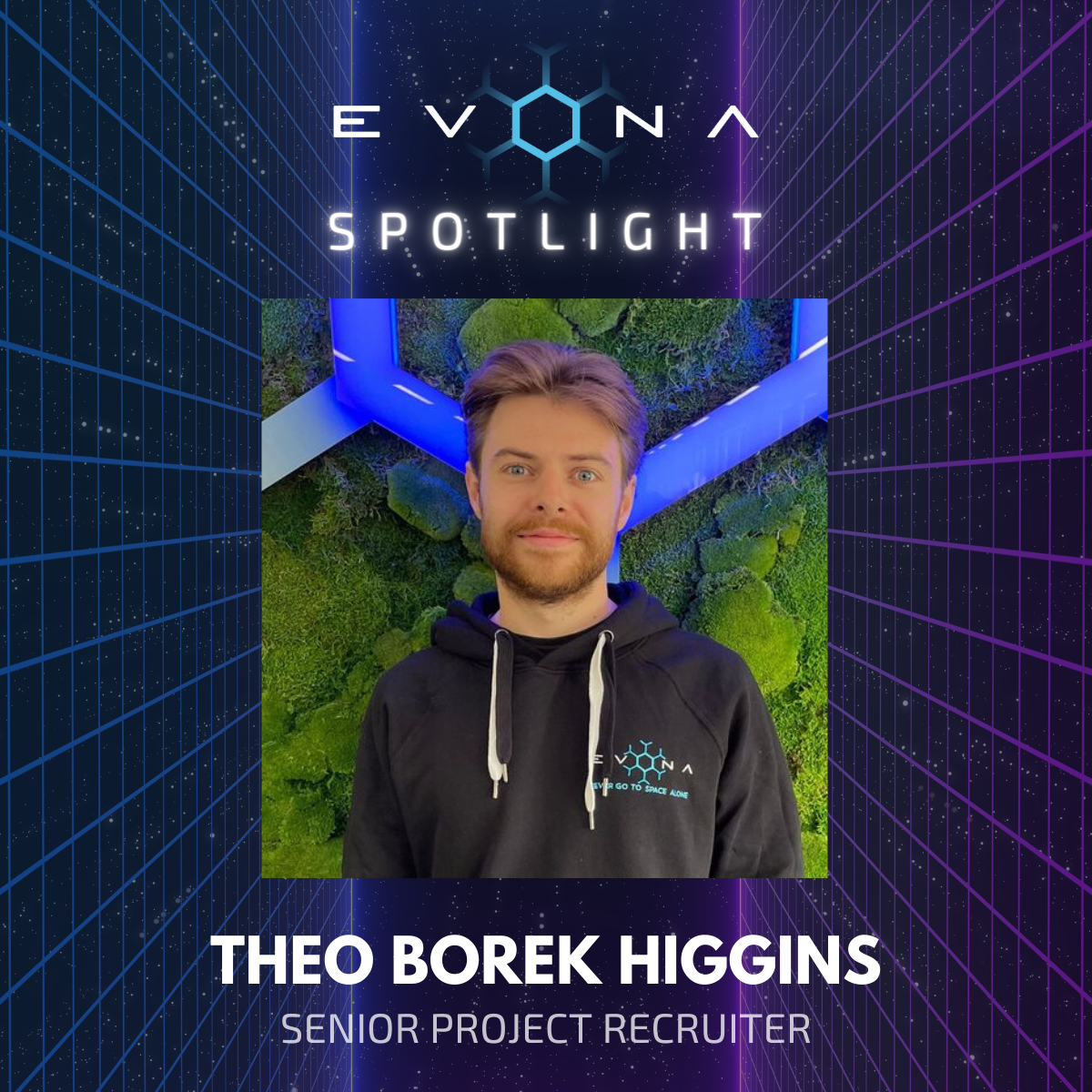
In our latest “Spotlight On” series, we delve into the world of recruitment through the eyes of Theo Borek Higgins, our Senior Project Recruiter at EVONA, who has been with the company for nearly two years. With a background as diverse as being a secondary school science teacher to working in recruitment, Theo brings a unique perspective to the space sector, driven by a passion for disrupting the industry norms.

Join us as Theo shares his insights on making a meaningful impact in the space industry, breaking stereotypes, and finding a supportive environment that champions the unique contributions of every individual.

What led you to join EVONA?

I sought out companies disrupting the industry. I wanted to work for a recruitment company that had a clear purpose and clear pillars, including non-changing flexibility, trust in its employees, and a lack of micromanagement that had become rife in the mainstream recruitment industry. As a neurodivergent individual, a company with this sort of ethos was of paramount importance to me and my personal wellbeing, and essential for my ability to excel at what I do in an environment I feel comfortable in and enjoy.

What did you do before working at EVONA?

I was a secondary school science teacher, and before that, I worked in another recruitment company in the UK.

What motivates you to continue your career with EVONA?

The most significant factors are the flexibility and trust that management places in its employees. I firmly believe that employees who feel trusted and valued by their employers work harder in a more committed and motivated fashion than employees who do not feel trusted by their employers and are not given the flexibility and freedom to excel in their job. I feel like I get this from EVONA, and that is deeply valuable to me.

What fuels your passion within your specific area of the space industry?

I find the space sector inherently fascinating and always have. I deeply enjoy the nature of the work and speaking to candidates and clients working on such incredible projects that can change the way we see our world.

I think the space sector is often misunderstood and seen through a narrow focus of astronauts and billionaire space races to Mars; however, there is so much more to the space sector than many realize. I find the less well-known areas of the sector, particularly around the area of earth observation and geospatial data, incredibly progressive and fascinating. It fills me with hope about how technologies in space can, in real-time, make our world a better place.


What strengths help you succeed in recruitment?

My strengths lie in my meticulous attention to detail and my commitment to high standards, adherence to process, logic and reason, and a keen interest in efficiency bolstered by recent AI technology advancements. I am incredibly grateful to be part of a company that supports and provides resources for my approach, enabling me to excel and make a significant impact in recruitment.

Looking for new opportunities? Explore our job board

Empower your job search with AI   

In today’s competitive job market, harnessing the power of AI can be the key to securing your dream job, starting with crafting the perfect CV and cover letter. AI tools are revolutionizing the job search process, offering assistance at every step, from creating polished resumes to acing interviews. We will explore how AI can be your trusted ally in navigating the job market. 

Utilizing AI to optimize your job search efforts is nothing to be ashamed of. According to a February survey from ResumeBuilder.com of 1,000 current and recent job hunters, nearly half (46%) use the ChatGPT chatbot to craft their resumes or cover letters. What’s more, 70% of respondents reported a higher response rate when using ChatGPT, and 78% of candidates who used ChatGPT secured interviews. Ultimately, nearly 6 out of 10 job hunters were hired after leveraging AI tools during their application process.  

Delve deeper into how mastering resumes and cover letters with AI assistance can pave the way to successful job interviews and, ultimately, land your ideal position. 

AI-Powered resume writers: Overcoming your writer’s block 

Writing resumes can be a daunting task for many, but it is the first step toward opening doors to potential job opportunities and making a strong first impression. AI-powered resume writers can come to the rescue by streamlining the process and generating tailored content quickly. These tools, often based on advanced models like OpenAI’s GPT-3, can analyze your job title and produce relevant bullet points for your work experience section. Platforms like Kickresume’s AI Resume Writer offer intuitive interfaces where you can customize generated content to reflect your unique achievements and skills. 

Tips for writing the best resume with AI:  

  • Introduce yourself clearly: Provide clear context about your background and achievements. Pretend you are introducing yourself just as you would do at a job interview, and emphasize your skills and experiences that align with the job role. 
  • Highlight education and work experience: Share essential details about your education and work history. Summarize your most significant achievements and skills to ensure the AI generates relevant content. 
  • Align with the job description: Paste the job description into the text field to guide the AI in tailoring your resume to the specific role. Try and use ‘buzz terms’ listed on the job description when listing your responsibilities and achievements on your resume.
  • Request multiple versions: If the initial response does not meet your expectations, do not hesitate to reprompt. Ask for variations that highlight different skills or experiences to find the best fit for the job application. 

Master the prompts to get the best results:  

  • Job title: Provide your current or desired job title to the AI. For example: “I am a software engineer with 5 years of experience.” 
  • Work experience: Outline your previous roles, responsibilities, and accomplishments. For example: “In my previous role as a project manager, I successfully led a team of 10 members to complete a critical project ahead of schedule. 
  • Skills: List relevant skills and areas of expertise. For example: “I possess strong communication skills, proficiency in Python programming, and experience with project management tools such as Jira.” 
  • Education: Provide details about your educational background and qualifications. For example: “I hold a Bachelor’s degree in Marketing from XYZ University, with a focus on digital marketing strategies.” 
  • Career goals: Share your career aspirations and objectives. For example: “I am seeking a challenging role that allows me to utilize my analytical skills and contribute to innovative projects in the tech industry.” 
  • Additional information: Include any additional information or specific requirements. For example: “Please emphasize my experience in customer relationship management for the sales manager position.”

AI cover letter writers: Crafting compelling introductions 

Being real, cover letters are often a required element of job applications, pushing applicants to craft one even though not every recruiter or employer may give them thorough attention or have the time to read them properly. This reality underscores the importance of being as succinct as possible, ensuring your resume shines brightest. 

Despite the mixed feelings surrounding their necessity, cover letters remain a staple in the job-hunting process, serving as a platform to introduce oneself. They present an opportunity to make a memorable impact, provided they are well-composed and to the point.  For those daunted by the prospect of writing one, AI cover letter writers offer a solution. These tools can generate a compelling introduction tailored to both the job at hand and the applicants’ experiences. This initial draft, while a solid foundation, benefits greatly from further refinement to enhance its accuracy and inject a personal touch.  

Here are some prompts you can use to draft an initial version of your cover letter: 

  • Prompt 1: Using my resume as a guide, please write a cover letter for the [insert job title] position at [insert company name]. 
  • Prompt 2: Could you create a cover letter that emphasizes my experience in [specific field or skill] for the job role of [insert job title]? 
  • Prompt 3: Please draft a cover letter that aligns with the key requirements mentioned in this job description. [paste job description] 
  • Prompt 4: Write a cover letter highlighting my transferable skills for a career switch to [insert job title]. 

Nevertheless, you should use any AI-powered cover letter writers with caution. Why? Well, artificial intelligence does not know you. It only knows the data you feed it. Hence it cannot tell your full story. Despite these limitations, it can still produce a decent cover letter that you can use as your first draft and edit to make it more “you”. 

AI Resume checkers & reviewers: Optimizing your resume 

Ensuring your resume stands out amidst the competition is vital. AI checkers analyze your resume against industry standards and provide feedback on its suitability for the role/sector/industry you are applying for. Some options are:   

Kickresume’s AI Resume Checker: 

  • Kickresume AI evaluates your resume based on three different criteria widely searched for by recruiters. This tool provides personalized tips on how to improve your resume’s content, structure, and suitability. 
  • Availability: A free version of its AI Resume Checker is offered with basic analysis and feedback. Premium plans start at $29 per month for additional features such as unlimited resume checks, cover letter creation, and more. 
  • Reviews: popular for its user-friendly interface and helpful feedback.  

Jobscan’s AI Resume Scanner: 

  • Jobscan’s AI analyzes your resume against a specific job description to ensure it matches the desired keywords and requirements. It provides a match rate percentage and suggests alternations to improve your resume’s relevance. 
  • Availability: a free trial is offered with limited scans and features. Subscription plans start at $49.95 per month for unlimited scans, resume optimization tools, and ATS tips. 
  • Reviews: popular for its accuracy in matching resumes to job descriptions and providing actionable suggestions for improvement.  

Rezi’s AI Resume Reviewer: 

  • Rezi’s AI assesses your resume by analyzing its content and structure. It identifies areas for improvement and provides actionable feedback to optimize your resume for applicant tracking systems (ATS) and recruiters. 
  • Availability: A free version of its AI Resume Reviewer is offered with basic functionality. Premium plans start at $3.75 per month for additional features such as unlimited resume reviews, ATS optimization, and personalized feedback. 
  • Reviews: popular for its comprehensive analysis and detailed feedback on resume content and formatting. 

ResyMatch’s AI Resume Scanner: 

  • ResyMatch’s AI evaluates your resume’s suitability to a specific job posting by comparing keywords, skills, and other criteria. It highlights areas of strength and weakness, helping you tailor your resume for better results. 
  • Availability: A trial is offered for limited scans and features. Premium plans start at $19.95 per month for unlimited scans, keyword optimization, and resume-tracking capabilities. 
  • Reviews: Has received positive reviews for its intuitive interface and accurate resume analysis. 

Zety’s AI Resume Review: 

  • Zety’s AI tool analyzes your resume for readability, relevance, and overall quality. It provides detailed feedback on formatting, use of language, and content organization to improve your resume’s impact. 
  • Availability: A free trial is offered with basic features. Premium plans start at $14.99 per month for full access to AI resume review, resume-building tools, and other services. 
  • Reviews: Users appreciate Zety’s AI Resume Review for its thorough evaluation of resume content and structure. 


Meet Theo Borek-Higgins, our Senior Technical Recruitment Specialist and fervent advocate for integrating AI into the recruitment process. His passion for leveraging technology has not only streamlined our hiring practices but also empowered numerous candidates to put their best foot forward with AI-crafted materials. 

“AI is a critical ally in the job search journey, it enables you to showcase your skills and experiences more effectively. I encourage candidates to embrace AI for optimizing your resumes and preparing for interviews, ensuring they stand out. It is about using technology to amplify your professional story and secure your dream job.

Remember, AI is the tool that can enhance your job search, but it is crucial to review the generate output. AI complements your writing skills but should not be seen as a substitute for them. Always ensure that the final content reflects your unique voice and experiences. At EVONA, we believe that by leveraging AI tools effectively, you can increase your chances of standing out to employers and securing the job opportunities you deserve. 

Ready to take the next step in your job search journey? Explore our latest job openings and apply with confidence, knowing that you have the support of AI to help you craft application materials.  

Unveiling the Benefits and Top Salaries of Joining the Space Sector in 2024

Embarking on a career in the space sector in 2024 offers unparalleled opportunities for innovation, above-average salaries, and a chance to contribute to cutting-edge projects.  

We’re shedding light on the compelling benefits and competitive salaries that make a career in the space sector a top choice. 

In the Space Workforce: Analyzing Key Data Points for Career Growth

The U.S. Bureau of Labor Statistics reports that aerospace engineers in the United States earn a median annual wage that is significantly higher than the national average. In addition to competitive salaries, it’s evident that the industry not only offers competitive salaries but also serves as a breeding ground for professional advancement across a spectrum of roles—from engineering to data science, sales, project management, and beyond. This unprecedented growth not only highlights the sector’s dynamism but also emphasizes its capacity to foster innovation and career progression.

Unveiling Career Insights in the 2024 Space Industry Landscape 

As we delve into our placement data from June 2023 to January 2024, the top roles commanding the highest salaries range from leadership positions like VP of Space Vehicles and Sales Directors to specialized technical roles in areas such as 3D Printing and Systems Engineering. This diversification reflects the multidisciplinary nature of the industry, offering opportunities for professionals with varied expertise.  

Additionally, a breakdown by department reveals demand for skills in sales, engineering, AI/Deep Learning, and more, emphasizing the industry’s holistic approach to innovation.  

Want to access our full PowerBI report? Register to unlock the full report.


Our highest placement salaries 

  • VP of Space Vehicles
  • VP of Sales and Marketing
  • VP of 3D Print
  • VP of Business Development
  • Technical Director… sign up to unlock the full breakdown 

Breakdown by most common department

  • Sales and Business Development  
  • Systems Engineering  
  • AI/Deep learning… sign up to unlock the full breakdown 

Notably, the prevalence of remote and hybrid working arrangements, accounting for 70% of the agreed terms, speaks to the sector’s adaptability to a global talent pool.

Agreed on location terms

  • Remote working: 55%…sign up to unlock the full breakdown 

With California, and Colorado as the key hubs, the space industry is not only expanding its economic impact but also becoming more accessible geographically.  

Most common location by state  

  • California: 30% 
  • Colorado: 25%… sign up to unlock the full breakdown 

To align with this growth, companies are recognizing the need to provide competitive perks, making it a compelling moment for both employers and job seekers to embark on a mutually beneficial journey in the space sector.


In this dynamic landscape, where the race for top talent becomes increasingly competitive, companies need to future-proof their talent acquisition strategy. By EVONA you not only gain access to valuable data insights but also ensure that your organization remains at the forefront of industry standards. Elevate your recruitment strategy, attract the best candidates, and secure the future success of your team. Contact us.

Are you ready to launch your career in the space sector or want to have a peek view? Explore opportunities on our job board.

Don’t forget to register to access our full report. 

Overcoming Aerospace and Defense Industry’s Staffing Hurdles

The United States Aerospace & Defense industry is at a crossroads, grappling with workforce challenges and critical talent gaps. Learn how EVONA can secure your A&D top talent with confidence. 

The US Aerospace & Defense industry, a cornerstone of technological advancement, is facing unprecedented challenges in its workforce dynamics. Reports such as 2024 aerospace and defense industry outlook, by Deloitte, or On the radar: Evolving workforce issues and strategies for aerospace and defense firms by PWC, shed light on the pressing issues ranging from skills gaps to talent shortages. We address and dissect these challenges with you.  

Key A&D Staffing Challenges in 2024:  

  • Skills Gaps: As technological advancements continue to accelerate, the demand for individuals with expertise in areas such as artificial intelligence, cyber-security, and advanced manufacturing is outpacing the supply. This skills gap poses a substantial threat to the industry’s ability to stay at the forefront of innovation.
  • Talent Shortages: The demographic shift and impending retirement wave are exacerbating the talent shortages. The loss of seasoned professionals with years of industry experience, coupled with a struggle to attract and retain new talent, are creating a vacuum that impedes the industry’s growth and responsiveness.
  • Recruitment and Retention Challenges: The competition for top-tier talent in the A&D sector is fierce. A limited pool of candidates with the requisite skills, coupled with the allure of opportunities in emerging industries, makes it difficult for companies to secure and keep the talent needed for sustained success.
  • Demographic Shifts: The industry is witnessing a significant demographic shift, with an aging workforce and a shortage of younger professionals entering the field. The industry must actively address this demographic challenge to ensure a smooth transition and continuity in operations.

How to stay ahead and navigate the talent shortage landscape 

As the A&D sector continues to evolve, staying ahead requires not just reacting to challenges but proactively engaging with partners who understand the intricacies of the industry’s workforce dynamics. 

Embracing the expertise of recruitment and staffing companies is a strategic move that allows organizations to focus on their core competencies while leveraging specialized resources to fulfill their workforce needs.  

One of the key requirements is identifying and hiring candidates with an active clearance. EVONA has a comprehensive and accurate search technique to identify these individuals. 

By partnering with us, you can tap into a vast network of qualified space professionals, leverage our industry talent strategy expertise and benefit from industry insights that ensure a competitive edge in identifying, attracting and securing elite talent.  

Whether your requirements involve TS/SCI cleared candidates, Systems Engineering, Software Development, Program Management, Electrical Engineering, GNC, AI and Machine Learning or Sales and Business Development, EVONA ensures a streamlined process, aligning your company with the skilled professionals vital to your success. 

Find out more about our models

Contacts us now 


Top 28 Roles Filled Under 30 Days by Evona in 2023

In the dynamic realm of the space economy, time is of the essence. As we bid farewell to 2023, at Evona we’re proud to showcase our top 28 lightning-filled placements that soared from vacancy to occupation in under 30 days.

From Senior Flight Software Engineers in Denver to Full Stack Developers in Bethesda, these rapid resourcing triumphs spanned the globe, reinforcing Evona’s commitment to swift, efficient, and effective talent acquisition.

The Top 28 roles by Evona in 2023 list 

  • Senior Flight Software Engineer
    Sector: Aerospace manufacturer and satellite service provider
    Location: Denver, Colorado
  • Business Development Manager
    Sector: Satellite Constellation
    Location: Orange County, California
  • TS Cleared Aerospace Engineer
    Sector: EO and Comms Satellites
    Location: Denver, Colorado
  • Software QA Manager
    Sector: Next Gen Ground Station Services
    Location: Seattle, Washington
  • First Line IT Support
    Sector: Propulsion
    Location: Dresden, Germany
  • Mechanical Engineer
    Sector: Space Tourism
    Location: Houston, Texas
  • Lead Flight Software Engineer (SPEC)
    Sector: Aerospace manufacturer and satellite service provider
    Location: Denver, Colorado
  • Test Pilot
    Sector: Space Tourism
    Location: Fort Lauderdale, Florida
  • Satellite Operations
    Sector: GEOINT
    Location: Orange County, California
  • Software Engineer
    Sector: Aerospace solutions and manufacturing company
    Location: Boulder, Colorado
  • DevOps Engineer
    Sector: GEOINT
    Location: Orange County, California
  • TS Cleared Quality Inspector
    Sector: Developer of high-reliability satellite systems and electronics
    Location: San Diego, California
  • Satellite Operator
    Sector: GEOINT
    Location: Los Angeles, California
  • Avionics Hardware Engineer
    Sector: Space Tourism
    Location: Houston, Texas
  • Operations Manager
    Sector: In Space Services
    Location: Virginia
  • Customer Operations & Satellite Planning Specialist
    Sector: GEOINT
    Location: Los Angeles, California
  • Information Security Specialist
    Sector: Global satellite communications service provider
    Location: McLean, Virginia
  • Master Scheduler
    Sector: Aerospace solutions and manufacturing company
    Location: Boulder, Colorado
  • Quality Engineer
    Sector: SatCom
    Location: Dallas, Texas
  • Systems Engineer
    Sector: Aerospace vehicle and component manufacturing company
    Location: Bethesda, Maryland

Whether you’re a client seeking industry trends or a candidate eager to explore new opportunities, connect with us if you’re hiring these roles or if you’d like to explore fresh opportunities on our job board for 2024.

EVONA Receives DEI Trailblazer Award 2023!

We are delighted to announce that we have received the Corporate Impact Award for WGIC’s (World Geospatial Industry Council) prestigious DEI Trailblazer Award for 2023.

This remarkable recognition underscores our commitment to fostering an inclusive workplace and reaffirms our dedication to making the space industry more inclusive, equitable, and accessible for all. We firmly believe that a diverse workforce and an inclusive environment foster innovation, creativity, and a stronger sense of belonging. These principles enrich our organization and have a profound impact on the space industry as a whole.


Inclusivity Drives Diversity: The White House Edition

A significant highlight of our commitment includes the privilege of presenting Project IDD at the White House during the Space STEM Forum. This exceptional opportunity allowed us to share our vision of space sector equality with industry leaders, showcasing our pioneering work in the field of DEI.

EVONA’s Project Inclusivity Drives Diversity (IDD) is a ground-breaking series that tackles the most pressing diversity and inclusion challenges faced by the space sector. By addressing company culture, which is often the primary driver behind 62% of employees leaving their organizations, this initiative becomes an essential tool for space organizations striving to become more inclusive, diverse, and ultimately successful.

The trilogy comprising Project IDD delves into three key areas:

  • Gender Diversity
  • Visible Diversity
  • Invisible Diversity

By providing real-life case studies, expert insights, and personal experiences, EVONA equips organizations with the necessary guidance to foster a sense of belonging, boost employee retention, and promote job satisfaction.

Download the entire project for free, here.


Shaping a Brighter Future for STEM

Our dedication to DEI extends beyond the workplace and into the heart of the STEM (Science, Technology, Engineering, and Mathematics) community. At EVONA, we recognize that true progress in the space sector, and STEM fields in general, begins with fostering diversity and inclusion at the grassroots level.

Our commitment to DEI in STEM is a heartfelt belief that nurturing inclusivity at the grassroots level is essential for the future of the STEM industry as a whole. That’s why all EVONA employees are STEM ambassadors, inspiring the next generation at schools across the country, breaking down barriers and showcasing the boundless opportunities within the space industry and STEM fields. Furthermore, we proudly sponsor the Scholarship for Diversity in STEM, providing financial support to promising students facing economic challenges, ensuring that STEM education is accessible to all.

We firmly believe that fostering inclusivity today will shape a better future for the STEM industry as a whole.


Thank You to WGIC!

Thank you, WGIC, for this incredible honor, and thank you to our dedicated EVONA team, partners, and supporters.

We would also like to congratulate WGIC’s DEI Individual Champion, Olivia Powell.

As Co-founder and Ambassador of Women+ in Geospatial , Olivia’s relentless pursuit of driving diversity and inclusion has led her to forge strategic alliances with sister organizations such as GeoChicas and Women in Copernicus. Olivia has ushered in a new era of awareness, representation, and empowerment for women and other underrepresented genders in the geospatial sector. – WGIC.


Find out more information on the awards here.

Bridging the STEM Gender Gap: An Urgent Task for Our Future

In today’s tech-centric world, the fields of Science, Technology, Engineering, and Mathematics (STEM) hold more sway than ever. Not only are these fields transforming our everyday existence, but they’re also sculpting our future by being at the forefront of major industry advancements.

Sadly, the glaring gender imbalance in these essential fields raises a critical concern that could inhibit our prospects for holistic and inclusive progression. 

gender gap in STEMSeveral studies, including a Microsoft-commissioned survey, pinpoint a critical period in children’s interest in STEM. Both boys and girls typically start showing an inclination towards these subjects around the age of 11. Unfortunately, this is where the paths tend to branch off – the research observes a decline in girls’ interest by the age of 15, whereas boys’ interest generally holds steady. This early departure in enthusiasm carries on into higher education and subsequently the professional sphere. Data from The National Girls Collaborative Project illustrates this stark disparity, showing that while women constitute half of the total U.S. college-educated workforce, they fill merely 28% of positions in science and engineering sectors. 

Alarmingly, this imbalance surpasses national confines. A UNESCO report reveals that women make up less than 30% of researchers globally, spotlighting the undeniable and universal nature of the problem. 


To tackle this issue effectively, it’s vital to understand its deep-rooted and complex causes. One significant factor orbits around the architecture of our educational systems. Historically, academic practices, particularly in STEM subjects, have lacked gender inclusivity. This absence of a balanced, welcoming learning atmosphere can make these settings appear daunting or discriminatory to girls. Additionally, a considerable shortage of female educators in STEM subjects can unintentionally portray these fields as male-centric territories, further dissuading girls from engaging. 

gender gap in STEMBeyond educational institutions, societal perceptions and stereotypes aggravate the issue. The outdated but stubbornly persistent stereotype that girls are inherently less proficient in maths and science than boys persists, despite ample evidence to the contrary. These detrimental stereotypes cast a long, unhelpful shadow over girls’ pursuit of STEM subjects, affecting their self-image, confidence, and eventually their career decisions. 

The bottom line is: societal expectations and gender roles subtly, and sometimes not so subtly, steer girls away from STEM. In their early years, girls are often encouraged to pursue more ‘feminine’ fields, such as the arts and humanities. This societal shaping of what girls are ‘destined’ to do has a profound impact on their career choices later in life. 


This issue isn’t only about girls missing out on opportunities. The gender divide in STEM is indicative of a wider societal shortfall:

we are failing to tap into the full breadth of human talent and insight. This lack of diversity in turn stifles the richness of creativity, innovation, and problem-solving that balanced gender representation could bring to these fields. 


gender gap in STEMDespite this daunting reality, certain statistics hint at hope. They underscore a crucial window – between the ages of 11 and 15 – where targeted intervention could significantly impact girls’ engagement with STEM. If we can foster and cultivate their interest during this phase, we hold a potent chance to enable a new generation of women to thrive in domains historically monopolized by men. 

Addressing this challenge calls for a coordinated effort from all stakeholders – parents, educators, policymakers, and media. We need to create environments that dismantle stereotypes, stimulate intellectual curiosity, encourage learning, and present strong female role models in STEM. This comprehensive strategy can help shape a new narrative, where STEM fields are perceived as equally enticing and accessible for all genders. 

Equipped with the right tools, support, and encouragement, there’s no reason why girls can’t navigate a STEM trajectory as enthusiastically and successfully as boys. The potential benefits of bridging this gender gap are enormous. The World Economic Forum proposes that achieving gender equality could bolster global GDP by an astounding $12-28 trillion by 2025. 


To chart a course towards a future where STEM fields are as diverse as the challenges they aim to solve, we need to identify when and why girls’ interest in these subjects diminishes and take decisive action to invert this trend.

By outnumbering discouraging statistics with inspiring narratives of accomplishment, we can envisage a new storyline where every child, regardless of gender, has an equal opportunity to excel in STEM. Our collective progress and the future of innovation rest on embracing this pivotal shift. 

CompassCom Unveils Game-Changing CompassLDE Connectors

CompassCom Software has unveiled its cutting-edge CompassLDE Connectors, designed to integrate seamlessly with Esri ArcGIS solutions.

These connectors empower users to access real-time location and status data for their assets within their ArcGIS maps, as well as conduct in-depth analysis of operational data.

The CompassLDE Connectors significantly enhance personnel safety, increase operational efficiency, and support the achievement of sustainability targets.

CompassCom CEO W. Brant Howard explained, “Our innovative plug-and-play CompassLDE Connectors now enable Esri users at all ArcGIS product levels to visualize live location and status information for their vehicles, staff, and equipment on their GIS displays. Advanced Esri users can leverage CompassLDE telemetry data with their big data analytics applications to gain valuable insights into their operations.”

CompassCom has developed CompassLDE Connectors for three Esri products:

  • ArcGIS Online
  • ArcGIS GeoEvent Processor
  • ArcGIS Velocity

Widely adopted across North America by public works, public safety, street maintenance, and transportation departments at both state and local government levels, CompassLDE (Location Data Engine) was initially created as an Automated Vehicle Location (AVL) data engine. It subsequently evolved into a mobile resource management solution capable of tracking any GPS-enabled device. Today, CompassLDE serves as a versatile on-premises or cloud-based server that can monitor thousands of assets across multiple fleets and various wireless communication networks.

In its latest iteration, CompassCom has expanded CompassLDE’s capabilities to collect an almost infinite range of sensor inputs, or telemetry, from field assets. Predominantly associated with vehicle activities, this data encompasses Ignition On/Off, Engine Diagnostics, Idle Time, Material Spreader On/Off, Plow Up/Down, Miles Traveled, and other data points. The server can even monitor the amount of sand or chemicals dispensed by a snowplow, as an example.

The groundbreaking CompassLDE Connectors by CompassCom Software represent a significant leap forward in asset tracking and management. By seamlessly integrating with Esri ArcGIS solutions, users can now access a wealth of real-time data and insights, optimizing decision-making processes and resource allocation. The potential applications of this technology extend across various industries and sectors, promising a brighter future of increased safety, operational efficiency, and sustainability.