EVONA Pledges in Action – Making a difference

This year we Pledged to ‘Make A Difference’…

Pledges timeline


January 2021 – Paperless Pledge

EVONA announce our pledges to use 2021 to #MakeADifference

EVONA have committed to maintaining a paper free office and this initiative has been in place since moving to our new office in October. Going paper free was really important too us for many reasons; the environment, the current Covid-19 situation, employee accessibility and digitising the company.

So far, the effort from our team has been fantastic and our paper usage is now next to none! If you’re wondering how we’ve managed to achieve this over the past year – these are some of the things we have introduced to make this possible

  • Documents are created as PDF’s
  • Everything is signed digitally
  • We use a cloud to store and share documents
  • Moved to online accounting software – meaning no paper payslips
  • Hot desking policy only means each space needs to be kept tidy, so it encourages only having a laptop and no extra mess
  • Employees use email calendars
  • Companywide no printing policy
  • Paper coffee cups have been banned and staff have been provided with a reusable EVONA coffee cup (pictured above) which can be taken to local coffee shops
  • No paper CV’s any applicants must submit these online
  • Company intranet to share company news/data/information rather than handouts and lengthy handbooks

February 2021 – Young Minds pledge to raise £1,000

We announce our official charity as YoungMinds

Mental health is a big issue. Roughly 3 children in every classroom has a diagnosable mental health disorder and as half of all mental health problems manifest by the age of 14, acting fast and giving young people the support they need will make a remarkable difference to the overall mental health of the population. We have the power to help change the stigma surrounding mental health issues, but with less than 1% of NHS budget attributed to children’s and young people’s mental health, more must be done to help.

How can you help?

CLICK HERE TO DONATE

March 2021 – Family Food For Free Easter Donations

This month EVONA have focussed on what we can do to help our local community.

As proud Bristolians, we love the city we live in but we know that lockdown measures and furlough schemes have hit our community hard, so we set about trying to make a difference. We spoke to our local food bank in Bristol, Family Food 4 Free (FF4F), to see what we could do to help and the response was that they were desperate for Easter Eggs.

Challenge accepted…

Family Food 4 Free are a registered food bank supporting Bristol and surrounding areas since March 2020

Throughout both lockdowns FF4F, lead by Aimee and Daniel Waters, have served the local community with emergency food parcels, freshly made meals and charitable donations.

Knowing they wanted to bring a little extra joy to the people of Bristol and surrounding area with chocolate egg-shaped happiness, the EVONA crew initially set ourselves a target to donate 300 Easter eggs, agreeing we would each add a few to our weekly shop or donate cash so we could coordinate discounts to buy in bulk.

We raised over £250 between us and purchased 346 Easter Eggs and 150 Creme Eggs! Which is enough if you put them end-to-end to stretch the length of a full-sized football pitch or the width of the International Space Station. It was so much, that FF4F had to come and pick them up in a van!

Aimee from FF4F said “Massive thank you for your Easter donations, we are now able to help local families, elderly, hostels support services and even young youth groups.”

Head of Marketing, Adele Fox hands over the Easter Eggs to Daniel Waters of Family Food 4 Free
Family food 4 Free an boot loaded with Easter eggs!
EVONA donated 346 Easter Eggs and 150 Creme Eggs

The team did an amazing job coming together to make this happen. Well done, crew!

April 2021 – Carbon Neutral pledge

Tree-Nation are a reforestation initiative tackling climate change

As Earth day takes place in April we knew how important it was to action the commitments we have make to the environment in our pledges this month…

The serious of the climate crisis is continuously escalating but as we grow, we are becoming more aware of our own impact on the environment. EVONA are continuously looking for ways to incorporate greener strategies into our business and that’s why this year we have pledged to reduce our carbon footprint.

In true EVONA style we not only set out to reduce our carbon footprint, but we wanted to achieve net-zero… completely carbon neutral

This month with the help of Tree-Nation, a fantastic reforestation initiative aiming to stop climate change by planting trees.

We have now begun growing the EVONA forest – planting 2 trees per employee per month.

SEE THE IMPACT OUR FOREST IS MAKING

‍You may have also noticed this little icon below on our website, not only have Tree-Nation helped us offset our internal carbon emissions but that of our website too (who would have guessed that in reading this article you are helping offset carbon on our website)

Carbon neutral website tag

DONATE TREES TO THE EVONA FOREST HERE

May 2021 – Everest Challenge

Headed up by our Marketing Exec Danni, in May we kicked off our campaign to support Young Minds by taking part in the Everest Challenge. To raise money for Young Minds our whole team is tackled the Everest Challenge  – walking the equivalent steps from base camp to the summit and back within the month.

The challenges of fighting mental health can feel like having a mountain to climb and no child or young person should have to fight this battle alone, which is why we wanted to take on the biggest mountain of all!

We raised over £1,250 from donations.

EVONA take on the Everest Challenge

July 2021 – South West STEM Fest & Webinars

EVONA are all STEM Ambassadors, doing what we can to get more young children into STEM careers and lifting the curtain on the space sector so everyone knows they can have a role in space. In July, we teamed up with South West STEM Fest creating a presentation resource for KS4 and KS5 pupils to help demystify the sector for the next generation.

August 2021 – Octopus Electric Cars Initiative launched

This month we introduced a salary sacrifice benefit available to all our employees – it’s like a ‘cycle to work scheme’ but for electric cars. Working with Octopus Electric Cars, the scheme means we could help our crew save up to 40% on a brand new electric car – great for the team, good for the business and kind to the planet.

October 2021 – Hello Yellow Day

EVONA went yellow for a whole day and hosted our own Hello Yellow event raising over £250 for Young Minds. We sold cupcakes, decorated faces, turned the office into a homage too all things yellow as well as giving our employees top tips on how to look after their own mental health.

November 2021 – Winning Awards and donating over £11,000 to Charities

On the 9th November we attended the Lloyds Bank Business Excellence Award ceremony as finalists in the New Business of the Year category. Not only did we walk away with the award, coming first in our category and winning the accolade but also this (right) equally impressive status symbol from the nights’ charity auction supporting the excellent work of mental health charity, Mind.

For those unfamiliar, this is a photo from one of the episodes of comedy show ‘Only Fools and Horses’ shot in the centre of Bristol – the home of EVONA. Fuelled by one or two glasses of champagne, Ryan (co-founder) might have been pressured into the buy by our Head of Marketing, Adele – who mainly fell in love with it as a Bristolian child of the 80s. The things we do for our crew!

In addition to this piece of Bristol history, EVONA also chose to support Mind UK with a second sizable donation on the night. It’s our belief that no one should face a mental health issue alone and it’s why we’ve chosen to support such charities this year.

This same month, our Principal Consultant Sam also raised £150 during Movember for men’s health charities by growing a moustache that even Tom Selleck was jealous of (not really, but close!)

December 2021 – St Mungo’s Donation

It’s St Mungo’s vision that everyone should have a place to call home and can fulfil their hopes and ambitions. Despite best efforts, homelessness has continued to rise in the UK with the number of people sleeping rough ever increasing. The global pandemic exacerbated the precarious housing ad financial situation of many people n the UK who had no other choice but to abandon their homes.

In December we donated hundreds of goods in the fight to stop homelessness in support of St Mungo’s work in a drive headed up by our Account Manager, Glen.

We donated:

  • 18 Bags of groceries – including biscuits, chocolates, pasta, crisps, cereals, rice, noodles, tea, coffee, sugar, dried milk, and tins and tins of food!
  • 3 Bags of toiletries – including deodorant, shower gel, toothpaste, towels, shampoo and soap
  • 40kg of quality second-hand clothes
STEM resources

STEM RESOURCES

From websites to blog and vlogs, here’s an ever-growing collection of great resources in STEM. Links will open in a new window.

(Also see our collection of 25 STEM books for kids here >)

  • Data Science: A Comprehensive Career Guide – discussing the skills, education, and experience needed for a career in data science.
  • STEMNET – A network of ambassadors working to encourage young people who are under-represented within women in STEM subjects and careers to pursue their interests in Science, Technology, Engineering and Maths.
  • Neon – Bringing STEM to life through real-world engineering. Neon brings together the UK’s best engineering experiences and inspiring careers resources to help teachers bring STEM to life with real-world examples of engineering.
  • Vivify STEM – passionate about increasing access to quality STEM education.
  • Telescope guide – Astronomy for Kids: Teaching Space Science to Young Stargazers (Free Booklet)
  • Columbia Engineering Boot Camps – How coding provides skills that help children cope with distress

WOMEN IN STEM RESOURCES

  • The WISE campaign – For gender balance in STEM, from the classroom to the boardroom.
  • STEMettes – Showing the next generation that girls do Science, Technology, Engineering & Maths (STEM) at their free, fun, food-filled experiences.
  • Women’s Engineering Society – A network of female engineers, technologists and scientists offering both support and professional development opportunities.
  • Women in Technology – An information resource aimed to promote female employment within IT and technology.
  • ScienceGrrl – A grassroots network who are passionate about celebrating women in science and passing on our love of science to the next generation.
  • Tipalti – A financial technology business offering career resources for women in tech and finance.
ScienceGrrl – celebrating women in science
  • CodeFirst:Girls – Code First Girls are dedicated to transforming tech by providing the skills, space and     inspiration for women to become kick-ass developers and future leaders.
  • Sparxx – As a socially focused learning technology company, Sparx has been reimagining the way maths is     taught and learnt in schools since 2010.
  • BCSWomen – A specialist group aligned to the Chartered Institute for IT, providing a networking platform     for professional women in IT.
  • STEM Women – A blog which aims to promote careers for women in STEM whilst highlighting issues of gender     inequality.
  •  STEMinist – Featuring case studies of women within Science, Technology, Engineering and Mathematics.

SPACE STUDENT CAREER RESOURCES

  • UKSEDS – UK Students for the Exploration and Development of Space
  • Space     Spectra – EVONA’s own You Tube series to help demystify the sector for the next space entrepreneurs
  • SEDS USA

  • Space for Humanity – Helps cultivate the passion for space through speaking at events. Also invites SEDS to events and connects SEDS members to relative Space for     Humanity Network.
  • Space Station Explorers
  • Future Space Leaders – The Future Space Leaders Foundation is a non-profit dedicated to the career development of young space and satellite industry professionals.
  • International Space University – The International Space University develops the future leaders of the world space community by providing interdisciplinary educational programs to students and space professionals in an international, intercultural environment.

Women in the New Space Sector – A Recruitment Insight

Equality for Women in New Space

Valentina Tereshkova – First Woman in Space (Photo: Alexander Mokletsov)

As responsible recruiters for the Space Sector, EVONA believe in equality. We are in the privileged position to work with inspirational brilliant women all over the globe as they pursue their next career move in the Space sector. We’re also pivotal to changing the conversations around gender parity in the New Space sector and influential in positioning the BEST candidates into the most exciting roles that Space has to offer.

To date, only 566 people have ever travelled to space. Only sixty-five of them, or about 11.5 %, were women.

Whilst it’s true that the space sector and aerospace industry boasts a number of women in high-ranking positions, including: Leanne Caret, Executive Vice President of the Boeing Company as well as President and CEO Defense Space & Security; Gwynne Shotwell, engineer, president and COO of SpaceX; and Ellen Stofan, the head of the National Air and Space Museum who previously served as NASA’s chief scientist – women still remain in the minority among the wider industry.

Historically, space has been a very male-dominated sector. For example, women make up only about a third of NASA’s workforce and only 16 percent of senior employees. As the industry evolves, we’ve seen the emergence of the New Space sector. So, have traditional mindsets also renewed to allow women more space?

What’s the New Space sector?

The government used to have majority control over the direction of the space sector, but private companies and investors have moved in and now play a valuable role in fuelling innovation, diversification and change. It is this increased commercialisation and diversification of skills that has earned it the title ‘The New Space’ sector.

You can only effect change by providing solutions

The % of women EVONA place in senior level positions in the New Space sector.

Analysing our own data within the New Space sector, as the below infographic shows, only 17% of C-level and senior positions (including founders, owners and entrepreneurs) are held by women – a statistic mirrored globally with only 18% of women in positions of power throughout the workforce.

12% of the founders, owners or entrepreneurs in the New Space market identify as female. That means that 7 out of 10 of the women in positions of power have put themselves there by owning or founding their own Space business.

EVONA are proud that we’re trying to push the needle on these statistics and can boast that despite only 17% of senior executives in New Space identifying as female, nearly 2/5 (38%) of our placements into these positions are women. We recognise that this isn’t 50/50 yet, but we’ll always strive to deliver the best candidate to our clients and challenge outdated perceptions.

Women in the New Space Sector EVONA Infographic – March 2021

The company of women

When EVONA analysed the senior positions of women within the New Space sector we saw that there is a preference for women to go into Data Application or Earth Observation organisations. 29% of the women in a position of power (c-level or above) worked within Earth Observation companies.

When we compare this to the whole of market statistics issues by Morgan Stanley in 2017, it’s interesting to note that Earth Observation companies occupy only 14% of the sector, representing the 3rd largest segment. Earth Observation companies therefore seem to be the kinds of companies where women feel most affinity. Research sectors also seem like popular companies for women to move into. Anecdotally, this is also a trend that EVONA sees amongst the candidates applying for positions within these companies. In general we seem to see a more equal number of both men and women apply for roles in Earth Observation.

However, it’s not true to say women will represent a majority of any of these segments, making up only 17% of the whole senior workforce, so why are women still so under represented?

The solution lies in education

It is widely known that there is a shortfall of women studying STEM subjects.  So part of this issue comes from a lack of supply. Stereotypical norms and cultural beliefs dampen the desire for girls to study STEM subjects and graduate into STEM careers. Only 31% of engineer graduates in 2020 were women with only 24% of individuals in an engineering profession as of last year identifying as female. Part of the solution is to inspire future generations into STEM subjects and show young girls they will have a place in the sector.

Chart: (c) Morgan Stanley 2017 research of Private Space Economy

We can do more as recruiters

We also know that the barriers facing young women won’t stop when they enter the sector. We require strong female role models for our younger generations to follow. That’s why we’ve approached some of the most inspirational women in the sector to share their career journeys.

Until articles like this become archived for irrelevance, or women achieving ‘firsts’ in the sector is no longer worth notoriety, there will still be a way to go but we can help by being part of the solution. Our thanks to the following inspirational women in our network for providing their story on their journey ‘into space’.

Portia Bowman

UK Innovation Manager at D-Orbit

“I have worked on hardware that is or soon will be on the moon, on Mars and in Earth Orbit!”

D-Orbit
  • What you do?

I am UK Innovation Manager at D-Orbit. I sit between customer and technical to come up with new ideas for product and services that are driven by market needs. This involves a lot of talking to lots of different types of people, identifying and following up with new opportunities, and planning for the future.”

  • How did you get into the space sector?

I did a placement during my Masters degree and got offered a job there after I graduated. In hindsight it all looks very planned, but at each stage I had no idea what the next step was going to be and just said yes to opportunities that came my way and tried to make the most out of them. Volunteering for UKSEDS, the national student space society, definitely helped!

  • What did you study?

I studied Physics with Astrophysics and did a Masters in Space Exploration Systems at the University of Leicester. At school I studied Maths Physics and Chemistry A-Levels.

  • What do you regard as your best professional achievement?

I have worked on hardware that is or soon will be on the moon, on Mars and in Earth Orbit!

  • What single piece of advice to you give the next generation who want to pursue a career like yours?

I would say there isn’t one career path and you can take many different routes to get somewhere, so just follow what you are passionate about and communicate that passion to whoever will listen!

  • Any women in the sector that inspired you personally?

There are many! A particular mention to Claire Parfitt and Lucy Berthoud who befriended and mentored me when I first joined the sector.

  • How has EVONA helped?

EVONA’s passion and enthusiasm is extremely motivating, and I am impressed at your outreach efforts and helping the next generation


Bianca Cefalo

Founder of Cosmica Space Consulting and Director of Business Development at Carbice Corporation

“Feed your thirst for curiosity and learning new things. Being underestimated is a superpower”

Bianca Cefalo of Carbice corporation and Cosmica Space Consulting
  • What do you do?

As Director of International Business Development at Carbice Corporation – Atlanta-based Deep Tech Startup – I help International Customers in the Aerospace, Space, Defence & Semiconductors industry choosing the most revolutionary nanotechnology as thermal management solution for their high-performance systems.
As Founder of Cosmica Space Consulting Ltd, I advocate for Equality & Humankind Evolution through Conscious Space Exploration and Exponential Technological Advancement in the New Space Age. Promoting international projects and collaborations that foster education in STEM, Space & Aerospace subjects; as well as mentoring programs dedicated primarily to women and girls, with a particular focus on activism for women’s human rights, and inclusion and integration of ethnic, social and gender minorities.

  • How did you get into the space sector?

A nerd since I was 7yo. I loved robots, cars, typing machines & philosophy. I was obsessed with aerodynamics for Formula 1 Cars, which during my university years escalated to obsession for hypersonic Space Capsules and aero-thermo-fluid dynamics of Interplanetary Missions. So, when I was 23yo I packed my bags, flew from Naples to Berlin, and fell into Space Science – having being selected as the youngest Italian analyst assigned to the HP3 Instrument on the NASA/JPL Insight Mars Mission, developed as a collaboration between Active Space Technologies GmbH & the German Space Agency (DLR).

  • What did you study?

In Italy went to the ‘Liceo Scientifico Sperimentale’, which equals the UK STEM A-Levels, with focus on Maths, Physics, Chemistry, Science, Astronomy & Languages. Then I graduated in Aerospace and Astronautical Engineering at the University of Naples ‘Federico II’, with focus on Spacecraft Systems, Hypersonic Aerodynamics, Microgravity and Synthetic Aperture Radars.

  • What single piece of advice do you give the next generation who want to pursue a career like yours?

Most probably there will be people telling you ‘You can’t do it’, that is too difficult and unconventional for a girl. Especially if you’re a first-gen graduate and you come from an unprivileged & dysfunctional family background – as I do. Use that as a motivation to get better and better every day. Feed your thirst for curiosity and learning new things. Being underestimated is a superpower. Also, don’t be shy about your talents and ambitions, share them with your support network, your teachers and peers and ask for what you want, always. Do the ask, be specific, be annoying, and you’ll see how many doors will open up!

Lisa Thomas – Honeybee Robotics

“Take chances on yourself and start taking action, even when it’s scary.”

Lisa Thomas of Honeybee Robotics
  • What you do?

I manage space exploration projects for Honeybee Robotics. That means I organize and manage teams of engineers who are building new technologies to collect planetary samples, such as dirt and ice from places like the Moon or Mars!

  • How did you get into the space sector?

I got into the space sector because I took a chance at the right time. I saw that a job was available at a space company and, even though I didn’t have space-related experience at the time, I gave it a try anyway. I was hired and I never looked back. I decided space was the place for me.

  • What did you study?

I studied a STEM subject – I have a Bachelor’s and a Master’s degree in Mechanical Engineering. It was a real challenge sometimes, but I’m glad every day that I did it.

  • What do you regard as your best professional achievement

I helped to build and launch a module called BEAM to the International Space Station. I was even able to watch the astronauts go inside our module and talk to us about it. It was the adventure of a lifetime!

  • What single piece of advice to you give the next generation who want to pursue a career like yours?

You will never feel “ready” to make big moves in your career or to take on challenges, so courage is important. Take chances on yourself and start taking action, even when it’s scary. I’ve learned the most over the years by just giving new things a try! Give every effort your best, ask for help (asking for help is brave!), and be prepared to make mistakes and learn from them.

  • Any great stories about your career that you can share

I had the chance to meet and talk with Astronaut Scott Kelly after his year in space. What impacted me most about him was his passion for his job. Even after a year away from his family and a lot of physical pain from the trip, he expressed only love and gratitude for the opportunity to be a space pioneer.

  • Any women in the sector that inspired you personally

There is an outstanding NASA manager at Johnson Space Center, named Sharon Conover, who has been an inspiration to me for many years. She taught me to always take time to share what you learn with others.

  • How has EVONA helped?

EVONA has helped my team grow! A project’s success is determined by the quality of the team, so this contribution is extremely important to us reaching our goals.

Estee Lauder to Red Bull – Brands That Have Been to Space

Why are brands sending things to space?

In the age of the NewSpace race; the future of space exploration is no longer limited to government backed space forces and politics. The rise of innovative private companies, commercialisation and huge developments in space tourism means the sector is now open to everyone… including you.

Even brands that we are used to seeing on earth are beginning to see the benefits space can offer and whilst sending branded products into space is not a new idea, many companies are yet to expand their horizons further than earth.

You might be thinking isn’t it too expensive to send things to space?  However, many forward-thinking companies would disagree and are seeing the benefit that marketing in space offers (plus it is just as expensive for a big influencer to promote your product anyway). That being said, this opportunity is a unique way for a brand to reimagine themselves outside earth and prepare for the future of humanity.

Recent years have also seen a huge shift in what people want to consume; Millennials, Gen-Z, and even younger generations now value experiences over physical objects. The shift is fuelled by the type of content being produced on social media through sites like Instagram and the rise of influencers. There is increased pressure for many to take beautiful photos of them out and about, on trips, experiencing the most amazing things, which means that people are willing to pay more for a lifestyle over materialistic things than they would have before. Brands are now under increased pressure to replicate the types of things their consumers dream of doing, it makes them recognisable, aspirational and allows them to resonate and align with the lifestyles and values of their customers.

This is why Brands are sending things to SPACE!

What is low earth orbit space economy? Why will it be important for brands?

NASA defines the Low-Earth Orbit (LEO)economy as:

“The production, distribution, and trade of goods and services within low-Earth orbit. As technology progresses, this economic space will grow to include more groups (including but not limited to governmental, commercial, and academic) that will contribute to the LEO economy’s continued expansion and support future sustainable space enterprises”.

Currently there are more than 50 companies already conducting commercial research and development on the space station as part of the effort intended to broaden the scope of commercial activity on the space station. Before recent years all activities taking place onboard were limited to research and development only but there are still a few requirements brands need to meet to undertake any work aboard.

In order for brands to qualify to conduct any work aboard the ISS they need to fulfil one of these requirements:

  • Require the unique microgravity environment to enable manufacturing, production, or development of a commercial application
  • Have a connection to NASA’s mission
  • Support the development of a sustainable low-Earth orbit economy.

Which brands have already been to space?

Omega – The Moonwatch (the first brand in space)

Buzz Aldrin wearing an Omega Speedmaster watch on the Moon – Credit NASA

The Speedmaster aka ‘Moonwatch’ is probably one of the most important and historic products in the history of brands in space. Whilst many brands to follow paid to be in space, Omega were part of something bigger, they designed for space. Undergoing what were labelled the ‘torture trials’ against Rolex and Longines-Wittnauer, all the watches were put to the test through extreme temperatures, high pressure, humidity, gravity, acceleration and deceleration to decide which would win the partnership for the Apollo programme. The results were in…and on the 1stof March 1965 the Omega Speedmaster was going to be the watch of Astronauts. A clear winner: only losing 15 minutes during acceleration tests, gaining 21 minutes on the deceleration tests and the luminous material on the face was destroyed. In comparison the Rolex stopped running on two occasions during the relative humidity test and failed one of the temperature tests and The Longines-Wittnauer also failed one of the temperature tests as well as the decompression test.

After the watch was selected to partner with NASA it underwent a few modifications by them to include more robust build with a thicker and larger 42mm case construction, crown guards and wider-set pushers and then joined the Apollo crew to the moon. The Speedmaster’s role in the space program did not end after the monumental Apollo 11 mission. The model went on to be used in the later Apollo missions, including the last flight, Apollo 17, which marked the sixth lunar landing in 1972. Even after the Apollo program ended, Omega’s work with NASA and other space programs continued.

Este Lauder – Serum in Space

The Cupola Window

As part of NASA’s efforts to promote business opportunities on the ISS, global beauty brand Estee Lauder has sent their newest skincare formula ‘Advanced night serum’ up to space. It hitched a ride to the ISS aboard a resupply mission, paying NASA $128K for the whole project, including the astronauts doing a four-and-a-half-hour photoshoot of the product. Whilst to some this may seem like a huge price tag, paying big influencers for a few Instagram posts cost roughly the same amount… and we have got to admit we think space marketing is much more exciting (although we might be bias). The serum will be photographed in the iconic cupola window, the ultimate room with a view however we do not yet know how the brand plans to use these images.

This is not the only part of Estee Lauders project that is important, there is a certain allure and value to products that have been to space, which is why Estee Lauder have decided to auction off one of the space bottles for charity. The 10bottles are planned to return to Earth sometime in spring 2021.

Phil McAlister (Director of commercial spaceflight development at NASA Headquarters) commented on the project saying, “We need to expand people’s perspective on what we can accomplish in space,”. There is hope that these kinds of activities will be a catalyst for many businesses to expand into space and exploration – no matter their current industry.

Tesla – Roadster in Space

Starman in Space

On the 6th of February 2018 aboard the Falcon heavy’s maiden flight, Founder of SpaceX, Elon Musk launched his personal Tesla Roadster into space as a payload. Not only was the car launched into orbit around the sun, aboard it was a dummy wearing a SpaceX suit nicknamed ‘Starman’, a reference to the David Bowie classic hit. Elon Musk shared several reasons why they chose to send the car up with the rocket, “It’s kind of silly and fun, but silly and fun things are important…Life cannot just be about solving one sad problem after another,” he said. “There need to be things that inspire you, that make you glad to wake up in the morning and be part of humanity. That is why we did it.”

Whilst it was an extraordinary marketing stunt from Tesla and SpaceX due to the sheer size of the payload and the trip it is undertaking, the link to the Space Sector through Elon Musk founding the two companies, made it slightly easier to do. However, as we see in a shift in focus towards space exploration over the next few years this sort of connection is likely to be increasingly more common, much like Jeff Bezos founding Blue Origin might create a link for Amazon to outer space.

The intrigue surrounding the ‘Starman’ did not just stop at the launch, many have spent time calculating and tracking where he could be in Space. We are told the next time we might get a glimpse of him close to Earth is the 1st of January 2085. See you soon Starman!

Red bull – Skydive from space

Smithsonian Institution, Public domain, via Wikimedia Commons

39km above the earth’s surface – the edge of space, a height that would make your stomach drop, but not for Austrian skydiver Felix Baumgartner. In what is potentially the biggest and most successful marketing stunt to date, Red Bull brought together world leading experts in medicine, science, and engineering to break three world records when Baumgartner completed a freefall from space. Beginning in 2005, the project took 8 years of hard work, innovation, research, and testing until the jump took place on the 14th of October 2012 only lasting10 minutes. In this time, he managed to break the speed of sound, travelling at a velocity of 833.9mph, break the record for the highest ever freefall and the longest ever freefall. After the jump Felix Baumgartner said “Let me tell you – when I was standing there on top of the world, you become so humble. You don’t think about breaking records anymore, you don’t think about gaining scientific data – the only thing that you want is to come back alive”.

Called the Red Bull Stratos project, not only did the jump receive 8 million concurrent views on YouTube live, but it also provided valuable research on improving aerospace safety, the use of helium balloons and parachute systems which set a new standard in payload recovery. Red Bull proved you do not have to be a company solely based in the space sector to innovate and achieve, their skills in extreme sports and event planning helped them make the impossible possible… as they say Red Bull gives you wings.

Kit-Kat – KitKat in space (nearly)

It was not just 8 million viewers that wanted to support Felix Baumgartner, KitKat also decided to send one of their iconic bars up to space strapped to a weather balloon and a go pro just hours before he was scheduled to jump. Using their iconic tagline, the stunt was called #breakfromgravity and the footage filmed via the go pro was released as a video on YouTube. The idea was an intuitive piece of reactive marketing done in the spur of the moment for the company by their marketing agency JWL London, taking just 24 hours from the idea being put forward to then being executed. The Kit Kat started its ascent from Cambridgeshire (UK) at 11:20am and rose to a height of 35.5km, just shy of the 39km Felix Baumgartner jumped from, that is one big step for a chocolate bar although it is not quite space, we had to include it!

EVONA’s Big Pledges 2021

At EVONA, we want to run our business differently.

From the Geospatial organisations we work with that helped track the COVID pandemic, predict natural disasters, and keep us safe, to propulsion companies that launch those satellites, push the forefront of space exploration and tourism as well as robotic companies that make the once impossible, possible…

We’re constantly inspired by the space sector we work in.

We work alongside inspirational businesses day in and day out; enabling the growth of the space sector through its workforce. Their achievements inspire us to be better, and work harder at trying to make a difference –  not only to the planet that we live on, but the communities we live and work in.

That’s why this year, we’ve decided to put our money where our mouth is, push our bodies to the limit, give back to our community, strive to be environmentally friendly, raise as much money as we can for our chosen charity and make 3 pledges to run our business differently to make a difference.

EVONA’s Pledges

How we’ll be making a difference

As part of these pledges we’ve identified a few key ways we can achieve our objectives:

EVONA pledge to help reduce our carbon emissions and clean up our oceans

Reduce and offset our carbon emissions

The science is now clearer than ever; our world is getting warmer. We all know the reason: the emission of greenhouse gases (the main contributor of which is Carbon Dioxide) creating an atmospheric layer which allows the suns rays to enter but prevents it from escape.  Without real efforts to reduce carbon emission, the globe is not only in danger of irreversible damage, but life will struggle against increased natural disasters, poor crop yields, species extinction, slower economic growth and more. It’s our responsibility to reuse, recycle and reduce. We’re going to commit to:

  • Planting trees in our own grove to help offset carbon emissions
  • Banning disposable coffee cups in the office
  • Going paperless in the office
  • Using energy saving lights to light the office
  • Encouraging our team to ditch the car at least once a week
  • Recycle all relevant waste from the office

Help clean up our oceans

No one in the UK is more than 75 miles away from a beach and as an island nation we have a hefty responsibility to our shores as well as the world’s oceans. The amount of litter found on UK beaches has risen year on year for the last 20 years. 8 million pieces of marine litter enter the seas every single day causing an estimated 1 million sea birds and 100,000 mammals to perish annually from ingestion of entanglement. Avoiding single use plastics and being responsible with our waste will make the difference. We’ll pledge to help clean up our oceans. We’re going to commit to:

  • 100 hours of beach cleaning
  • Consciously reducing our reliance on single use plastics

Announcing Young Minds as our official charity

Mental health is a big issue. Roughly 3 children in every classroom has a diagnosable mental health disorder and as half of all mental health problems manifest by the age of 14, acting fast and giving young people the support they need will make a remarkable difference to the overall mental health of the population. We have the power to help change the stigma surrounding mental health issues, but with less than 1% of NHS budget attributed to children’s and young people’s mental health, more must be done to help.  We’re going to commit to:

  • Raising as much money as we can for this worthy cause and have already signed up as a team to attend Tough Mudder. More on how to support us later!

Help those in poverty

Food poverty and homelessness is on the rise, with charities stating that this is likely to soar in the coming months due to the pandemic. With an estimated 8.4million people in the UK living in food poverty, and one in 200 people in England without a home, campaigners have said without urgent action we’ll soon find ourselves unable to support the people who need it. We’re in the privileged position to be able to help so we commit to:

Use our expertise to benefit the community

We’re experts in our field. What we know, is recruitment. As passionate STEM ambassadors it’s important to us that we lift the curtain on where a STEM career can take you (spoiler – into space and beyond!) We commit to:

  • Dedicate our time to helping serve job-hunters
  • Continue to support STEM initiatives

The Space Sector to Be Bigger Than the Oil Industry

The Rising Value of the Space Industry: Unveiling the Future of the Sector

Innovation, commercialisation and the dawn of the New Space era has meant more than ever before: space is big bucks.

Pump-jack mining crude oil with the sunset – Photo by Zbynek Burival on Unsplash

The oil industry currently contributes just under 4% of the global economy. In 2019, the total revenues for the oil and gas drilling sectors came to approximately $3.3 trillion. In less than 30 years, the space sector is estimated to rival that figure and be worth over $3 trillion by 2050.

Space has proven to be one of very few industries where growth has remained resilient through the world-wide recession.

Like the oil industry, the space sector is segmented into ‘upstream’ and ‘downstream’. Within both industries, ‘upstream’ deals with exploration. With oil that’s finding, drilling and extracting, in space it’s exploring the outer regions of the universe and innovating more economic ways to propel ourselves beyond our Earth’s atmosphere.

‘Downstream’ deals with refining and marketing the final product. The ‘final product’ in oil can be anything from plastics to petrochemicals. In the space industry, it’s the refinement and utilisation of data, research and information. Both exploration and refinement drive these industries forward, however only one of them is part of an industry that is ever expanding.

Oil is one of the most important finite resources in the world. When refined, it’s the main energy source used in cars, planes, heating and electricity. Used in plastics, paints, chemicals, tape and so much more, our lives are made much easier with this refined product… now consider – how much has satellite data improved our daily lives?  From location data to television channels, weather data to GPS, communications, forestry planning, natural disaster prevention, security and more, our everyday lives use space technology contstantly, and we don’t even think about it.

Space Industry Trends

The media darling of the space industry is space tourism. Enjoying more column space on average than any other part of the sector, everyone from Prince William to Bill Gates have aired their opinion on the value or disadvantages therein, but in reality, this forms a very small part of the industry. It receives such a focus because of the high profile nature of those funding it, primarily Musk, Branson and Bezos: founders of the New Space market.

For the most part, tourism is a means to fund other more humanly beneficial parts of the sector, and as a whole is the driving force for sector growth. It garners attention form some very wealthy investors providing a gateway to other investment opportunities – but it’s not the be-all and end-all of space industry…

The New Space Market

The term ‘New Space’ refers to the increasing commercialisation of space and the privatised funding of organisations with an interest in space and space technologies. The days of governments underwriting space efforts, at least in the US, ended largely in the 1970s. Money from government space agencies like NASA will however continue to play a part through SBIR grants, contracts to small suppliers and direct investments.

For example, SpaceX launched astronauts to the International Space Station last year in a world first, providing the service as a private company, while NASA has previously organized its own astronaut launches.

“One day, space travel will be as everyday as the weather report.” – Jeff Bezos, Blue Origin Founder

Making space travel an everyday occurrence is the goal of Blue Origin Founder Jeff Bezos. Alongside rival Richard Branson, Bezos took to the skies in 2021 in their own supersonic sub-orbital private rockets. It ushered in a new era of space travel in which billionaire-backed companies offer the high-flying excursions to anyone who can afford it.

Passenger flights are without a doubt moving ahead quickly, but with far smaller, non-human payloads, the stakes are smaller and the path easier to tread. The SmallSat launch arena has dozens of companies looking to launch small payloads at reduced prices, alongside easier regulations and insurance costs, the barriers to entry are lower and attractive to new entrepreneurs – and private investors.

The global propulsion market is expected to more than double in size by 2025 to an estimated 14.2 billion. None of this would be possible without the technological advancements necessary to take these objects into Low Earth Orbit (LEO) and beyond. Companies from Scotland to New Zealand are developing and launching rockets that can send small satellites into orbit. Among them are companies such as:

  • Firefly Aerospace who are developing a rocket capable of orbiting 2,000lb to LEO*
  • Rocket Lab developing an electron rocket to reduce payload costs*
  • Vector Launch developing technology to travel to LEO every few days*

Likewise, we see the rise of other companies developing solutions to expedite the progress of the industry.

  • NanoRacks have developed a standardised interface between satellites and the rockets they travel on.*
  • Made In Space are developing 3D printers to print habitats and components in space utilising materials found on the lunar or asteroid surface.*
  • Kymetra have pioneered radio technology to communicate more efficiently and reliably with satellites*

The Urgent Need for Space Data

The demand for data has reached unprecedented levels, with the space industry playing a significant role in meeting this need. Over the past 55 years, satellite ownership and operation have expanded from just 8 countries in 1966 to more than two-thirds of the world’s nations today, as showcased in the video comparing satellite ownership in 1966 and 2020.

As of Apr 2023, there are over 8,261 satellites orbiting the Earth, and in the last 5 years we’ve sent more satellites up into space than the preceding 32 years. As it stands, the majority of those have been for the commercial sector and their purpose has been largely to better communications. The US, Russia and China are currently the major owners of these satellites, accounting for nearly 3/4 of the equipment in orbit.

Satellite miniaturization has fueled this exponential growth, as devices have evolved from bus-sized behemoths to objects as small as a loaf of bread or a mobile phone. This reduction in size has dramatically decreased launch costs, propelling the satellite industry forward.

However, the space industry is not solely defined by satellites and their earthbound observations. The way satellite data is retrieved and processed has also evolved over the decades, and with it the potential roles available.

Ground stations, which connect spacecraft to global telecommunication networks, are continually advancing in technology as the number of satellites in orbit keeps growing. Over the next decade, the volume of data generated by satellites is expected to increase significantly. To manage this surge, companies will need to develop innovative methods for quickly transferring data from space.

Simultaneously supporting multiple communication links will help reduce data transfer costs, making it more affordable for businesses and individuals. Additionally, advancements in efficient propulsion techniques, lighter and smaller payloads, and reusable technology will contribute to the financial viability of space missions.

As these innovations drive down costs, our ability to explore the universe will become more efficient, making access to space increasingly attainable for a broader range of people and organizations.

The Space Race Timeline

Beyond the long-standing space faring nations of the USA and Russia, China now boasts human spaceflight capabilities and India has taken an active interest in planetary exploration. Countries such as the United Arab Emirates are also investing heavily in space development technologies. It goes to show, you don’t have to live in the USA to have an outstanding career in the space sector. The UAE, where 30% of their GDP is contributed from the oil industry, are now actively looking to diversify into space technology to help shred the hydrocarbon dependence.

(c) EuroConsult Profiles of Government Space Programs – All Rights Reserved

If you weren’t already aware of the UAE’s ambitious space plans, you soon will be. Hot on the heels of their Astronaut Programme, which saw the launch of their first Emirati Astronaut to the ISS in 2019, the country launched the Hope probe the following year, a project six-years in the making.

At the same time, the country set up the Middle East’s first space research centre and announced the ‘Arab Space Pioneers’ programme. Overseen by the UAE Space Agency, the programme equips talent with the skills and expertise required to expand career prospects in the growing space sector to actively contribute to the global space community. The programme highlights the importance of investing in the multi-faceted space technology as a major driver of the future knowledge-based economy as they actively look to ease their economic dependence on oil.

In 2020/21, the UK space industry experienced a significant increase in income, rising by 5.1% in real terms to reach £17.5 billion. This growth rate marked the second-fastest annual expansion in the industry over the past seven years. Britain has some serious plans to become a significant global player in the years to come, aiming for a market worth of $100billion by 2030, or 10% of the global market.

With a notable foothold in the satellite manufacturing industries, the UK has invested £40 million to grow its spaceflight capabilities and is funding vertical launches from a spaceport in Scotland and horizontal launches from Spaceport Cornwall. Watch this space.

What Jobs Are There in the Space Industry?

The anticipated growth of the space sector, projected to surpass the oil industry in value, hinges on attracting individuals with transferable skills from various backgrounds, nurturing existing talent, and making the sector more appealing to the future workforce. Space industry staffing specialists, like EVONA, are working diligently to connect these elements and facilitate the sustainable, rapid growth of the sector.

The space industry requires individuals who are passionate about making the world a better place, as they will be working on software-enabled services processing data, developing spacecraft, and collaborating with launch companies to orbit satellites. Opportunities abound in various fields, from studying imagery sent by spacecraft and overseeing data quality systems to advancing propulsion technology, making satellites lighter and smaller, and exploring new satellite service applications.

Contrary to the historical perception of the space industry as a domain reserved for individuals in white coats, your skills are more transferable than you think. Seize the opportunity that many have not yet realized is possible. Careers in marketing, team building, international cooperation, negotiation, design, communication, simulation, and production await those who explore the space sector’s offerings.

As the industry continues to grow, many of us who have never considered a career in space may soon discover that our skills are in high demand by various space corporations. Could the next small step in your career actually be a giant leap? EVONA believes so, and they are already scouting for your next job opportunity in the space industry.

What was once deemed beyond the capabilities of your career are now well within your reach – EVONA can get you there. Launch your career into space and go further than you ever imagined.


Sources:

* Valuation of the Oil industry at 3.3 trillion USD from source Investopedia – According to market research by IBISWorld, a leading business intelligence firm published Feb 2020.

* Analysts at the Bank of America Merrill Lynch predict the sector will surpass $3 trillion in 30 years.

* Q4 2020 Space Investment Quarterly – $141.6B private investment in application technology since 2011.

* United Nations Office of Outer Space Affairs

* EcoConsult 2019

Celebrating Black History in STEM – Black History Month

Celebrating Black History in Space and STEM – Black History Month

October in the UK and February in the US marks the celebration of Black History Month which gives us an incredible opportunity to recognise and celebrate the achievements and contributions of influential Black figures within the Space Industry and the STEM sectors. Whilst there are so many people that have made incredible contributions in the sector we have picked some of our favourite stories to tell and hope we can share more for years to come. Black people have been continuously underrepresented in STEM and to this day more still needs to be done to influence more diversity in these sectors. We hope that knowing more about role models in this sector can inspire generations of prospective STEM students and contribute to building a more inclusive society.

At EVONA we are right in the centre of Bristol and are proud to be located in the heart of a city that supports diversity and culture. Speaking to the values of our city we know the importance of educating not only others but ourselves on Black History. May 2020 saw the resurgence of the Black Lives Matter movement and here in Bristol we learnt a lot about the city’s past involvement in the Slave Trade and significant amounts of discrimination which lead to the removal of statues and the renaming of a number of buildings. Whilst there’s still so much more to do we continue to keep the conversation surrounding Black lives going and would like to celebrate the lives and the achievements of…

Mae Jemison an American engineer, physician and NASA astronaut and American engineer, physician and NASA astronaut

Mae Jemison: The First Black Woman in Space

A Doctor, Engineer and NASA Astronaut, Mae Jemison became the first black woman in space on September the 12th 1992 aboard the space shuttle Endeavor. She served in the Peace Corps before submitting a successful application to join the astronaut corps in 1987. Although her initial application was sent in 1985 after being inspired by Sally Ride (Read more about Sally Ride here: Women in Space Article), the first American Woman in Space, due to the Challenger explosion in 1986 NASA halted applications until the following year. During her first mission she was selected to join the STS-47 crew as a Mission Specialist and the team made 127 orbits around the Earth and returned to the Kennedy Space Centre in Florida on September 20, 1992. Jemison is now responsible for leading the 100 Year Starship project through the United States Defense Advanced Research Projects Agency (DARPA), the project is working to ensure human space travel to another star is possible within the next 100 years.


Katherine Johnson, Dorothy Vaughn & Mary Jackson: Hidden Figures

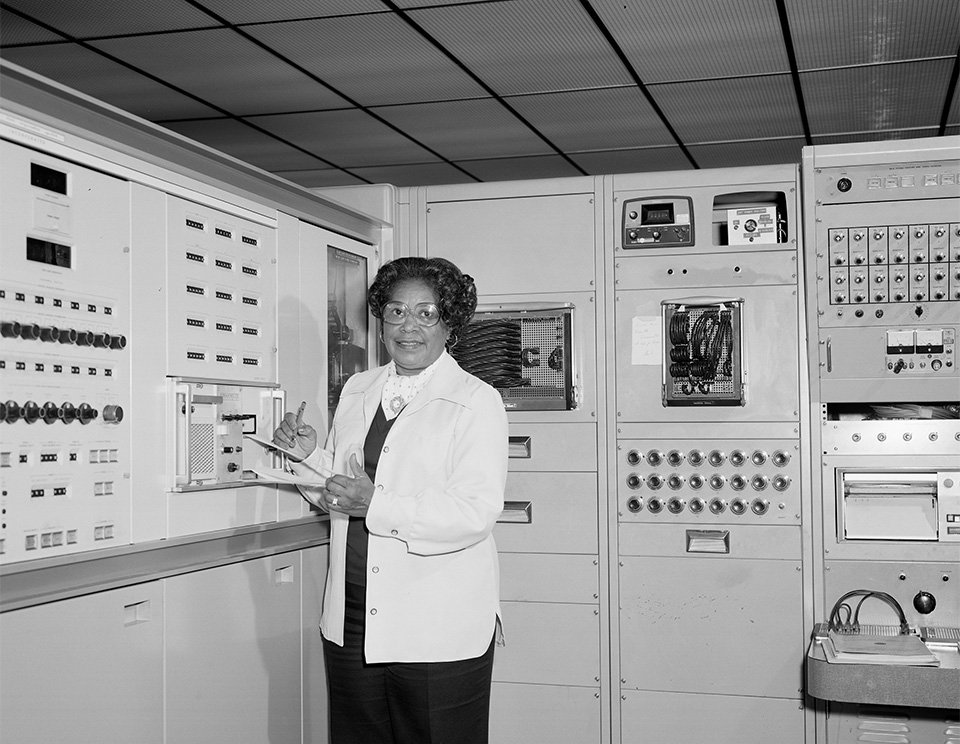
Mary Jackson working at NASA’s Langley Research Centre

Katharine Johnson, Dorothy Vaughn and Mary Jackson are three African-American mathematicians who worked at NASA in the 1950s. Also known as ‘Computers in Skirts’, these three women were placed in the highly segregated West Area Computer division of Langley Research Centre. The skills of Johnson, Vaughn & Jackson were widely responsible for putting the first American man into orbit, John Glenn, this being a significant win for the U.S during the Space Race against the Soviet Union after World war II.  Whilst their story is now more familiar thanks to the release of hit film ‘Hidden Figures’ in 2017, up until that point the contributions they made were pretty much non-existent in any history books. The incredible stories of these women creates a feeling of hope conflicted with anger. Hope due to astonishing power of education, self-belief and tenacity reflected in their insurmountable successes despite being faced with horrific amounts of racial and gender discrimination which were prominent mid-20thcentury in  America.

Maj. Robert H. Lawrence Jr. in 1967

Maj. Robert H. Lawrence Jr: First Black Astronaut

Maj. Robert H. Lawrence Jr. was the first black person to be selected as an astronaut by any national space programme after becoming a member of the their group of aerospace research pilots for the MOL Programme. Initially he studied at Bradley University gaining a bachelor’s degree in chemistry at the age of 20 and then went on to become an Air Force officer and pilot. Holding over 2,500 flying hours in 2000 jets he completed US Air Force Test Pilot school in June 1967 which is when he was immediately assigned to the MOL Programme. However, a fatal crash after ejecting from AF-104 Starfighter supersonic jet on December 8th 1967, meant Lawrence never made it to space. This doesn’t mean his work was not significant as the work he did as a pilot in the programme contributed to the development of the manoeuvre that would become a critical part of space shuttle landing techniques called flare. Furthermore, after the cancellation of the MOL programme seven of the astronauts were transferred over to NASA and were all flown on the Space Shuttle in the 1980’s and the likelihood of Lawrence piloting one of the early missions is a high possibility.


Shirley Ann Jackson: Chair of the US Nuclear Regulatory Commission

Shirley Ann Jackson Receiving Medal of Science – Rensselaer Polytechnic Institute (RPI) Creative CommonsAttribution-Share Alike 4.0 International

Shirley Ann Jackson has become an influential figure within the physics field after becoming the 18th president of Rensselaer Polytechnic Institute on July 1st 1999 and the first African-American woman to lead a national research university. Not only has she achieved getting this prestigious position, she was also the first Black Woman to receive a PHD from MIT, which she got in theoretical elementary particle physics. Her career between graduating from MIT and becoming Rensselaer President has been full of successes. President Clinton appointed Dr. Jackson as the  Chair of the U.S. Nuclear Regulatory Commission (NRC) in 1995, the first woman and African-American to hold this position. Jackson was also a professor of physics at Rutgers University, conducted research in theoretical physics, solid state and quantum physics, and optical physics at AT&T Bell Laboratories and became president of the American Association for the Advancement of Science (AAAS). Being named the Top 50 Women in Science in 2002 her career in STEM has been nothing short of inspirational.


George Robert Carruthers: Pioneer of Ultra-violet astronomy

George Carruthers and the Lunar Surface Ultra-Violet Camera

George Carruthers was a pioneer in the use of ultra-violet astronomy for studying the earth, he spent his career in the Space Science Division of the Naval Research Laboratory developing space telescopes in collaboration with NASA. Responsible for the creation of the lunar surface ultra-violet camera which was flown to the moon aboard the Apollo 16 mission to obtain images of Earth and Outer space. However,  this same invention was aboard a1970 rocket flight, where the image converter was able to provide the first proof of molecular hydrogen existence in interstellar space. Carruthers was awarded the Exceptional Scientific Achievement Medal by NASA for his work on the project. From a young age Carruthers had an affinity towards science and built his first telescope when he was just 12 years old.  Continuing to pursue science through his education, he received a Bachelor of Science in aeronautical engineering, a Masters in nuclear engineering and a PHD aeronautical and astronautical engineering.

Talent in the Post-COVID World

What does our Post-COVID future look like?

We conducted research amongst C-Level executives from tens of Space companies to understand the impact of COVID on the sector.

Utilising case studies and insights from the hundreds of people we work with and talk to every day, we’ve provided a comprehensive look of life after COVID. Plus, some great hints and tips  for best practices as we move into a new post-COVID world.

Download Talent in the Post COVID World here >

Women in Space

Women in Space: What you Need to Know

Space Exploration and life beyond earth have excited people for centuries, however, did not become possible until after WW2. There was significant technological and engineering advancement during the war, which led to the production of the German-made V-2 rocket in 1942-1945. V-2 became the first artificial object to travel into space by crossing the Kármán line on 20 June 1944 which eventually led the way to space flight and exploration later on in the Century.

The story of the first man on the moon is one that many know after Neil Armstrong took the first human steps on the moon in 1969.  Yet to this day the first woman has still not landed on the moon, however, after NASA published plans for the Artemis mission in 2024 we are seeing the likelihood of this first becoming a reality 55 years later. Hiring for Space and the space sector becoming more inclusive than it has ever been, we take a look back at the history of women in space and the contributions made to the sector by influential women.

Women In Space

At this time traditional gender roles and conformity governed the way a woman lived in the 1950s with the Cold War ideal of domesticity being reinforced in messages produced by the media. Whilst there was advocacy for change stemming from the suffragette movement in 1903 and a growing disdain for compliance to traditional gender stereotypes, this was still not reflected widely in society, the Space Sector included. All areas of the industry had a limited representation of women, even though the first woman launched into space took place in 1963, the progression after this point was slow. To this day only 11 percent of all people that have been to Space are women and beyond that, the representation of women in STEM (Science, Technology, Engineering, and Maths) which is a vital part of the sector still only sits at 22 percent.

Valentina Tereshkova (RIA Novosti archive, image #612748 / Alexander Mokletsov / CC-BY-SA 3.0)

Regardless of cultural norms at the time, many would be surprised to know that consideration for women to be involved in the space sector was prominent right from the beginning. Even before the Apollo launch, a New Mexico physician called William Randolph Lovelace II suggested that women would be good candidates for space travel. These ideas however were not back by the feminist ideals we now have in place today and were more so fuelled by the suggestion that aboard these space stations there would be a need for pink-collar jobs. Lovelace’s vision of human societies in space saw women in roles such as a telephone operator, nurse, or laboratory assistant, therefore, making his suggestion less visionary and more in accordance with his time, unlike the space job opportunities available to women now.

Lovelace, as a physician, oversaw the psychological and physical testing for the first corps of astronauts. Thirteen female pilots underwent Lovelace’s testing to become potential astronauts, including accomplished pilot Jerrie Cobb. Cobb held world records for flying and argued that there was no reason women should not be allowed into the astronaut corps, she went on to testify this before Congress in 1961. However, the ambitious timeline to get a man on the moon due to the USA’s involvement in the Space Race against the USSR meant the speed required could only allow for already trained pilots to be involved, all of which were men. With women nowhere near the astronaut corps by 1961 and any focus on including women in spaceflight were put on a backbench by NASA.

Who was the First Woman in Space?

NASA’s Challenger STS-7 crew: Robert L. Crippen, Frederick H. Hauck, John M. Fabian, Sally K. Ride, Norman E. Thagard.

The 16th of June 1963 marks the day the first female made it to space, the 24-year-old Soviet cosmonaut was Valentina Tereshkova. As a skilled skydiver and parachutist, completing 126 jumps, she was selected from over 400 other candidates to undertake the 70-hour solo mission aboard the spacecraft Vostok 6. Following selection, Tereshkova and four other female cosmonauts underwent 18 months of gruelling training with the Soviet Air Force before the expedition. During this time she participated in several tests including those that determined how she would react to extreme gravity conditions, zero-gravity conditions, and long periods of isolation. Of the five women in training, only Valentine Tereshkova made it into space.

The expedition itself was a dual mission and two days before Tereshkova launched, fellow cosmonaut Valeriy Bykovsky set off in Vostok 5. Each spacecraft took a different orbit path and they actually came within 5kmof each other at one point in the flight. During the 70 hours spent in space, she orbited the earth 48 times. However, the flight was not as smooth sailing as previously thought, classified information was kept secret till 30 years after the flight and documented an error in the spacecraft’s automatic navigation software which could have ended in tragedy. The error in the re-entry settings would have caused the ship to begin moving away from the earth instead of re-entry to earth, luckily Tereshkova alerted soviet scientists in time and they were able to develop anew landing algorithm.

Who was the first American Woman in Space?

Female Scientists: Lucille Coltrane, Jean Clark Keating, Katherine Cullie Speegle, Doris ‘Dot’ Lee, Ruth Whitman, and Emily Stephens Mueller, Lucille Coltrane is at the far left

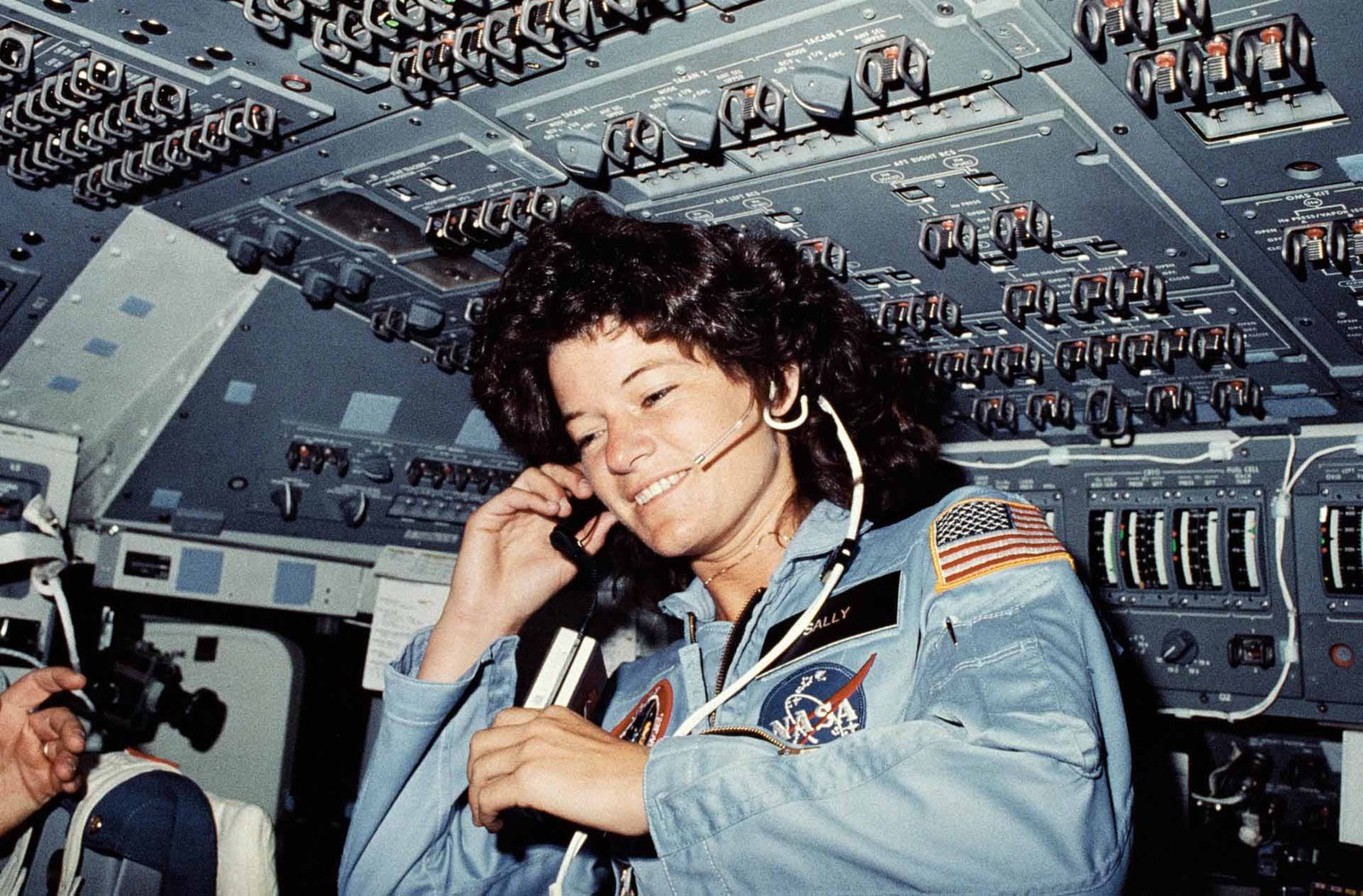
Sally Ride was the first American woman to travel to space, furthermore, she was also the first American woman to travel to space for a second time. After completing a physics degree, an English degree, a master’s in science, and a Ph.D. in physics at Stanford University, she saw an article in the newspaper inviting women to apply for NASA’s 1978 class and due to this, she decided to apply to NASA. Ride was selected as one of NASA’s first six female astronauts, she then began her spaceflight training in 1978. Initially working from the ground as a capsule communicator in 1981 and 1982, Ride then boarded her first spaceflight aboard the Challenger on June 18th, 1983.

The entire flight lasted six days and was the seventh shuttle mission for NASA. As a mission specialist aboard the STS-7, she was in charge of the operation of a robotic arm which helped launch satellites as whilst aboard the shuttle the crew’s main focus was to launch two communication satellites. The satellites were ANIK C-2 for TELESAT Canada and PALAPA-B1 for Indonesia and both attached to Payload Assist Module-D (PAM-D) motors.

Women in Space: The Journey so Far

Thinking about women in the space sector, a great deal of attention is focused on the astronauts that make it to outer space, however, influential women in the sector also populate several jobs behind the scenes from as far back as 1940.

Kitty O’Brien Joyner joined NASA in 1939 as their first female engineer working on wind tunnels and researching supersonic flight. O’Brien Joyner was also the first woman to graduate from the University of Virginia’s Engineering program after wining a lawsuit to study there amongst her all-male counterparts.

Kitty Joyner Electrical Engineering

The story of Edith Gustan and her near non-existence in the history of the space sector is one that is common for women in space. Whilst you might see her name in aerospace and engineering industry journals for papers that examine subjects such as closed ecological life-support systems, in mainstream media the only appearance she makes is in the fourth paragraph of a Seattle Times article from 1970. The minuscule chunk of text is sat above a nearly full-page ad for Sears’ Mother’s Day sale advert for “incontestably female cardigans!” Despite this, Edith Gustan was a Boeing employee and biologist and was responsible for extensive research on the viability of a space-station greenhouse alongside many other collaborative projects between Boeing and NASA. Early relationships between the two companies supported by research by influential women like Edith have may have allowed Boeing to expand into the space sector. Their more recent achievements include building the Boeing X-37B military plane, which is an unmanned, reusable spacecraft with its first orbital mission being launched in April 2010 by Space Force.

Kathryn Johnson was known as a ‘human computer’ and began a career with NASA in 1953. She calculated trajectories for Alan Shepard, the first man in space, and Apollo 11’s flight to the moon in 1969. Johnson received a Presidential Medal of Freedom in 2015 honouring her accomplishments in paving the way for gender and racial equality as a black woman in STEM. She passed away at 101 years of age in 2020.

Kathryn Johnson – NASA

Shortly before Johnson’s career began in 1953, Mary Jackson joined NASA and was also classed a s a ‘human computer’. Jackson began her engineering career when female engineers of any background were a rarity and may have been the only black female aeronautical engineer in the field. In 1958, she was promoted from mathematician to NASA’s first black female engineer. She later became the Langley Research Center’s Federal Women’s Program Manager, leading efforts to hire and promote more women at NASA. In 2020, NASA named its Washington, DC, headquarters the Mary W. Jackson NASA Headquarters building, located on the renamed street Hidden Figures Way.

In 1958 Nancy Roman joined NASA as their chief astronomer and the ‘Mother of Hubble’ in recognition of her work to bring the vision on the space-based telescope a reality.

Christa McAuliffe also made an honourable contribution to women’s role within the space sector, being selected as the first teacher to go to space. The plan was for McAuliffe to film demonstrations aboard the mission which would be used in educational packages for students and teachers across the globe as part of NASA’s Teacher in Space project. Launched on January 28th, 1986, McAuliffe was killed in a tragic accident along with the rest of the crew aboard the Space Shuttle Challenger, after the orbiter broke apart just 73 seconds after the launch. The heart-breaking story of the accident has recently been transformed into a Netflix documentary which sits at number one on our Top 5 list of Space themed shows on Netflix, you can find out more about Christa McAuliffe and her contribution to Space by watching Challenger: The Final Flight.

Some other notable achievements from Women in Space include:

  • Mae Jemison – The first African American woman in space.
  • Elllen Ochoa – The first Hispanic woman in space.
  • Kalpana Chawla – The first Indian woman in space.
  • Eileen Collins – The first female shuttle pilot and first female shuttle commander for NASA
  • Susan Helms holds the record for the longest spacewalk.
  • Kathryn Sullivan – The first woman to walk in space.
  • Peggy Whitson the first female Space Station commander has spent more than a year of her life in space and to this day has spent more time in space than anyone else.
  • Whitson and South Korean astronaut Soyeon Yi flew the first spacecraft re-entry within a crew where women outnumbered men.
  • Jessica Meir and Christina Koch performed the first all female space walk in 2019 replacing a broken battery on the ISS.

The Top 5 Space Themed shows on Netflix.

The unsolved mystery of space has captured many of our imaginations from a young age with huge Sci-fi franchises like Star wars and Star Trek dominating the screens from 1966. Here at EVONA we know a lot about space and whilst it’s not just about astronauts and aliens, isn’t it nice to pretend for a while until we really do find life on Mars.

From fantasy sci-fi thrillers to documentaries on real life NASA missions, here’s the Top 5 Space themed shows on Netflix you need to be watching right now!

Challenger: The Final Flight

First up we have the gripping docuseries following the disaster of the challenger flight which killed five US astronauts on-board the Space Shuttle after it fell apart 73 seconds after launching. The crew selected for the mission was one of the most diverse crews in NASA’s history, including high school teacher Christa McAuliffe, who was selected to go on-board as the first private citizen in space. Retelling the story of tragedy in 1986,Challenger: The Final Flight highlights the incredible lives of all who died through heart-breaking family interviews and first-hand accounts from NASA decisionmakers.

Lost in Space

Next we have the reimagination of the 1965 series ‘Lost in Space’ based on the classic novel The Swiss Family Robinson. Set in the future, the show sees colonists on earth sent to the planet Alpha Prime to establish a new home for humanity. The Robinson family are selected for the 24th mission and the series follows the adventures the family undergo after their spaceship is veered off-course.

If you can’t get enough of Lost In Space after the first two epic seasons, you’ll be happy to know the final one is coming out in 2021 and is a must see on Netflix.

Space Force

The newest space themed programme in this list , Space Force, stars legendary funny man Steve Carell. With nowhere to go but up, this workplace comedy sees a group of people tasked with creating the sixth branch of the United States Armed Forces, the United States Space Force. After uprooting his family to Colorado General Mark R. Naird(Steve Carell) is put in charge of the mission and works to get the US Space Force back on the moon as quickly as possible.

Away

Away is another 2020 contender on the list, leaving her husband and daughter behind leading lady Emma Green embarks on a three year mission to Mars. Previously a Navy pilot, Emma has been chosen as the commander for the mission however there are technical difficulties early on in the mission. Despite this, the series main focus is to highlights the emotional turmoil of the crew due to leaving their families behind and how they maintain their connection to life on earth. Emma’s own life on earth is shown through flashbacks to happy memories with husband Matt and teenage daughter Alexis.

Mars

Set in 2033, a group of six astronauts embark on a journey to be the first people to set foot on Mars. A hybrid between drama and documentary is originally based on the 2015 book How We’ll Live on Mars by Stephen Petranek. Alternating between 2016 and 2033, the narrative through the show is supported by real interviews with to explain events happening as the story unfolds. Produced by the National Geographic the TV Show embraces the reality of a manned mission to Mars happening within our lifetime and  illuminates the incredible research and development in space technology which will enable our first attempt at a mission to Mars.

Still excited by the possibility of life on Mars? Read our article on the missions that have been shooting for Mars this year taking us a step closer to this reality. Although, you may even be so excited about the endless possibilities and excitement of space that you’d like to find a job in the sector! Luckily for you all of our current job vacancies in the space sector are listed here.