Why Space Companies Hire for the Role They Need Today and Lose the Person in 12 Months

There’s a pattern that shows up regularly across growth-stage space companies, and it rarely gets diagnosed correctly.

A company hires a strong systems engineer. The person is exactly what the team needs – technically sharp, experienced with the relevant subsystems, capable of working autonomously in a fast-moving environment. Six months in, the company has doubled its engineering headcount. Twelve months in, the engineer is spending most of their time in program reviews, managing subcontractors, and writing documentation. The spacecraft design work that drew them to the role has been handed to the junior engineers they helped bring on board.

By month 14, they’re interviewing elsewhere. By month 18, they’re gone.

The company restarts the search – for the same role, at a higher salary, in a market that’s gotten more competitive since the last time they hired.

The Role Evolved. The Conversation Didn’t

This isn’t a story about bad hires. The engineer was the right person for the role as it existed when they joined. The problem is that in a scaling space company, roles don’t stay the same for long. A 30-person company that grows to 80 in 18 months has fundamentally different needs at every level. The systems engineer who was hands-on-keyboard designing architecture is now, whether anyone planned it or not, functioning as a technical program manager.

That evolution is natural and often necessary. Someone has to manage the complexity that comes with growth. But when the transition happens by default rather than by design – when the engineer realizes they’ve drifted into a different job without anyone acknowledging it – the result is disengagement followed by departure.

The cost in the space sector is higher than in most industries. Replacing a mid-to-senior engineer takes three to six months when you factor in the search, the clearance timeline if applicable, and the onboarding period before the new hire is contributing at full capacity. The institutional knowledge that walks out the door – understanding of the mission architecture, relationships with the team, context on design decisions that were never fully documented – doesn’t come back.

Why This Happens More in Space

Every growing company deals with role evolution. What makes it more acute in the space sector is the nature of the people and the work.

Engineers who choose space tend to be mission-driven. They joined because they want to build spacecraft, design propulsion systems, write flight software, or solve GNC problems. The technical work isn’t just their job – it’s their identity. When that work gets replaced by management overhead, the loss feels personal in a way it might not for an engineer in a less mission-connected industry.

The technical complexity of space programs also makes the transition harder to manage gracefully. In a SaaS company, you can promote a senior engineer to engineering manager and their direct reports can largely self-direct their technical work. In a space company, the technical decisions are higher-stakes, the regulatory requirements are more demanding, and the consequences of getting something wrong are more severe. The temptation is always to keep the most experienced person close to the decisions – which means close to the meetings, the reviews, and the vendor calls, and further from the engineering.

And because the candidate pool for experienced space engineers is small, the cost of losing someone and replacing them is disproportionately high compared to other sectors.

What the Companies That Retain Do Differently

The space companies with the strongest retention – the ones where senior engineers stay for three, four, five years – tend to do a few things that others don’t.

They have the 12-month conversation at the point of hire.

During the interview process, they’re transparent about what the role looks like today and what it’s likely to look like in a year. They describe the growth trajectory honestly: “Right now, you’ll be hands-on designing the thermal subsystem. In 12 months, if we’ve grown the way we plan to, you’ll probably be leading a team of three and spending more time on program integration. Is that a path you want?” The engineer who says yes to that question with full information is far more likely to stay than the one who discovers it by surprise.

They build technical tracks alongside management tracks.

The assumption that the only way to advance as an engineer is to manage people is what causes the most preventable attrition. Companies that create principal engineer, technical fellow, or chief engineer roles – positions with seniority, compensation, and influence that don’t require managing direct reports – give their best technical people a reason to stay. The GNC engineer who wants to spend the next five years solving increasingly complex navigation problems shouldn’t have to become a people manager to get promoted.

They audit role drift proactively.

Every six months, someone – a manager, a founder, an HR lead – should be asking: is this person still doing the job they were hired for? If the answer is no, is the new version of the role something they want? If it’s not, what can be restructured before they start looking elsewhere? This conversation is cheap. The replacement search is not.

They compensate for scope changes.

When a role expands significantly – when the engineer who was hired as an individual contributor is now effectively managing a program – the compensation should reflect that. Companies that let scope creep happen without adjusting the title or pay are telling the engineer that their expanded contribution isn’t valued. That message gets received clearly, even if it’s never said out loud.

The Takeaway

Losing a strong engineer after 12-18 months is one of the most expensive and preventable problems in the space sector. It’s rarely caused by compensation alone, and it’s rarely caused by the market offering something better. It’s caused by a gap between what the person signed up for and what the role became.

The companies that close that gap – with honest conversations, parallel career tracks, and proactive check-ins – keep their best people. The ones that let roles evolve by default and hope the engineer will adapt keep restarting searches they shouldn’t have to run.

Where Space Finds Its People: EVONA Rebrands for the Next Era of the Space Economy

EVONA, the specialist talent partner to the space industry, has launched a new brand identity under the tagline “Where Space Finds Its People” – reflecting its evolution into an operator enabling growth, scale, and investor outcomes across the sector.

The rebrand follows EVONA’s strongest revenue year in 2025 and continued expansion across its talent solutions. As the space economy matures and the demands on scaling companies intensify, EVONA has focused on building the talent infrastructure that ensures people don’t become the limiting factor as companies grow.

Built for Space From Day One

EVONA didn’t pivot into space. The company was founded in 2018 with a single focus – space, and nothing else. Since inception, EVONA has generated more than $30 million in revenue and has worked closely with companies shaping the space economy, including AST SpaceMobile, ICEYE, Voyager, and teams within the Space Capital portfolio.

The company has scaled over 300 space companies, placed more than 2,000 people into the sector, and supported 12 clients through to IPO.

A Long-Term Talent Ecosystem

EVONA’s ambition extends beyond individual placements. The company has set an objective to support the next generation of space unicorns and place 50,000 people into space roles – focusing on execution and outcomes rather than volume hiring.

Tom Kelly, CEO of EVONA, said:

“As the space economy matures, capital and technology are no longer the major bottlenecks – although they remain extremely challenging to master. The real challenge is execution. Talent provides the infrastructure needed to execute on capital and technology, and as an operator embedded in the space economy, we take that responsibility seriously.

The companies being built today will define how the world communicates, monitors climate, and defends critical infrastructure for decades. The people inside those companies are making that happen. The space race won’t be won by rockets; it will be won by people. That belief sits at the heart of our rebrand. We are charging toward finding 50,000 people their place in the space economy.”

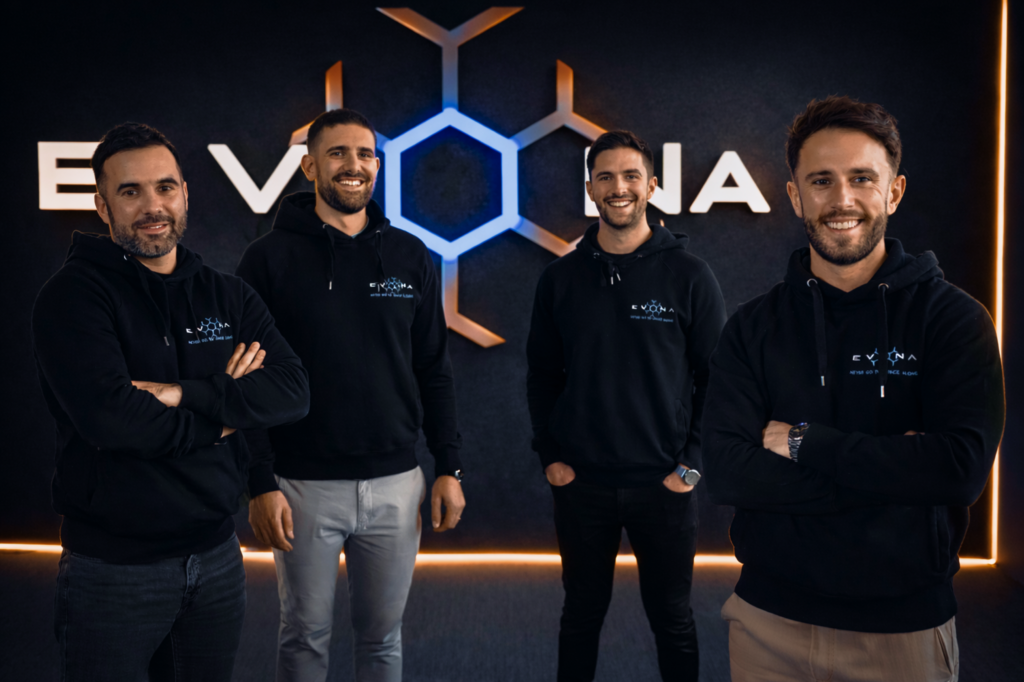
EVONA's Founders

Right to left: Ryan Hill, Jack Madley, Richard Joyce, Tom Kelly

Global Presence, Sector Commitment

Launched in Bristol, UK, EVONA expanded to Florida in 2023 and has since made its mark at the highest levels, including an invitation to speak at the White House.

Beyond commercial outcomes, EVONA is committed to raising awareness of careers in the space sector through outreach to students, showcasing STEM and the wide range of skills – technical and non-technical – needed to build the space economy.

Explore the new EVONA at evona.com

The 5 Most In-Demand Space Engineering Roles in 2026 (And Why They’re So Hard to Fill)

Across more than 3,000 searches tracked in the US space sector since 2024, one pattern is consistent: demand for certain engineering disciplines is growing faster than the candidate pool can keep up.

That’s not a generic talent shortage. It’s a concentration problem – too many well-funded companies hiring for the same specialized roles at the same time, in a sector where the candidate pool for each discipline is measured in hundreds, not thousands.

Here are the five roles that space companies are struggling to fill right now, and what’s driving the constraint in each.

1. Flight Software Engineers

Flight software is the single most frequently posted technical role across our searches, with 46 open positions tracked over the past year. These engineers build the software that controls spacecraft in real time – attitude determination, command sequencing, autonomous operations, fault management. The environment is safety-critical, the latency tolerance is zero, and the testing requirements are far more rigorous than anything in commercial software.

The constraint: most software engineers in the US work in web, cloud, or enterprise environments. The number who have hands-on experience writing real-time embedded software for spacecraft – in C or C++, running on radiation-hardened processors, subject to DO-178C or equivalent standards – is a fraction of the broader software market. And the companies that have these engineers (SpaceX, JPL, Lockheed Martin, Northrop Grumman) are not losing them quickly.

For growth-stage space companies, this means competing against both primes and other startups for a pool that was built over decades at a handful of organizations. The candidate who can write flight software for your mission is also being recruited for Artemis, for commercial station programs, and for defense constellation builds.

2. GNC Engineers

Guidance, navigation, and control – the discipline that determines whether a spacecraft can get where it needs to go, maintain its orientation, and execute maneuvers autonomously – generated 26 tracked searches in the past year. But the difficulty of filling these roles far exceeds what that number suggests.

GNC engineering sits at the intersection of applied mathematics, orbital mechanics, and control systems theory. The candidates who can design algorithms for autonomous rendezvous and proximity operations, or build guidance solutions for lunar landing trajectories, have typically spent years in academic research or at organizations like NASA, JPL, or Draper before they’re operationally ready.

The Artemis acceleration is making this worse. As NASA’s mission cadence increases and commercial lunar programs scale alongside it, GNC engineers with deep space experience are among the most contested profiles in the sector. Companies building satellite servicing vehicles, space stations, and lunar landers are all hiring for the same skillset.

3. Power Electronics / EPS Engineers

This is the role that surprises people outside the sector. Electrical power systems – the engineers who design how a spacecraft generates, stores, distributes, and manages power – are quietly one of the hardest hires in space.

Across our searches, power electronics and EPS roles consistently take longer to fill than mechanical or software positions. The reason is structural: power electronics engineering has a much smaller academic pipeline than other electrical engineering subdisciplines. Most EE graduates specialize in signal processing, communications, or digital design. The subset who specialize in power conversion, battery management, solar array regulation, and high-voltage distribution for space applications is genuinely small.

And unlike software, where transferable skills from adjacent industries can bridge the gap, power electronics for spacecraft is technically distinct enough that a power engineer from automotive or industrial applications needs significant ramp-up time. The thermal environment, the radiation constraints, and the reliability requirements are different in ways that matter.

4. Thermal Engineers

With 34 open positions tracked in the past year, thermal engineering is the fourth most frequently posted technical role – and one of the least visible to people outside the industry.

Every spacecraft generates heat and operates in an environment where thermal management is existential. Too hot and components fail. Too cold and batteries die. The thermal engineer designs the systems that keep everything within operating range – heat pipes, radiators, thermal coatings, heaters, and the analytical models that predict how the spacecraft will behave across its orbital profile.

The constraint is similar to power electronics: the academic pipeline is thin. Thermal engineering is often a subdiscipline within mechanical engineering programs, and relatively few graduates specialize deeply enough to be immediately useful on a spacecraft program. The experienced thermal engineers who exist tend to be well-compensated and embedded in programs they’re unlikely to leave without a compelling reason.

5. Propulsion Engineers

Propulsion generated 19 tracked searches in the past year – a smaller number than the other four, but the fill rate is among the lowest. These are the engineers who design, test, and qualify the systems that actually move spacecraft: chemical thrusters, electric propulsion, cold gas systems, and increasingly, novel approaches like nuclear thermal propulsion.

The constraint here is both supply and geography. Propulsion work requires physical test infrastructure – vacuum chambers, thrust stands, propellant handling facilities – which concentrates the work at specific locations. Companies in New Mexico, Colorado, and parts of California dominate propulsion hiring, and candidates must be willing to work on-site at facilities that may be in less urbanized areas.

The Artemis program’s expansion and the growing interest in in-space propulsion for satellite servicing and orbital transfer vehicles are driving new demand. At the same time, the experienced propulsion engineers at Aerojet Rocketdyne, Blue Origin, and SpaceX are locked into multi-year programs and not actively looking.

What Connects These Five

The common thread across all five roles isn’t just scarcity. It’s that the candidate pools were built over decades by a small number of organizations – primarily NASA, its prime contractors, and a handful of defense companies – and the commercial space sector’s explosive growth over the past five years has created demand that this pipeline was never designed to support.

Every one of these disciplines has the same structural challenge: the number of companies hiring has grown much faster than the number of qualified engineers entering the market. And because these roles require years of specialized experience that can’t be shortcutted through bootcamps or cross-training programs, the supply constraint isn’t resolving quickly.

For companies hiring in any of these five areas, the implications are practical. The search will take longer than you expect. The compensation will be higher than your internal benchmarks suggest. And the candidate you want is almost certainly talking to someone else. The companies that plan for that reality – by building a pipeline early, pricing roles accurately, and moving fast when they find the right person – are the ones that fill these positions. The ones that treat them like any other engineering hire are the ones still searching six months later.

Blue Origin Just Reused an Orbital Rocket for the First Time. Here’s Why That Matters for Space Hiring.

Blue Origin launched its New Glenn rocket for the third time, and for the first time, it did so with a previously flown booster. The first stage – named “Never Tell Me the Odds” – lifted off from Cape Canaveral, separated from the upper stage, and landed on a drone ship in the Atlantic Ocean. The booster reuse worked.

The upper stage didn’t. The AST SpaceMobile satellite it was carrying ended up in an off-nominal orbit, meaning something went wrong after stage separation. The payload is likely a loss. For Blue Origin, it’s a mixed result.

For the space sector’s talent market, the booster reuse is the story that matters.

Why Reuse Changes the Workforce Equation

SpaceX has been reusing Falcon 9 boosters for nearly a decade. It’s the primary reason SpaceX dominates the global launch market – reuse brings the cost per kilogram to orbit down dramatically, which brings the cost of everything else down with it.

Blue Origin achieving booster reuse on New Glenn means there is now a second company capable of operating a reusable heavy-lift rocket. That’s not a small thing. A second reusable launch provider means more launch capacity, more competition on price, and more customers who can afford to put payloads in orbit.

Each of those dynamics creates hiring demand.

More launch capacity means more missions, which means more launch operations staff – the pad technicians, the mission integration engineers, the range safety officers, the logistics coordinators who make each flight happen. Blue Origin’s VP of New Glenn mission management said in March that the company is focused on “increasing resources, tooling, and processes” to scale its flight rate. That’s a hiring statement.

More competition on price means more satellite companies can afford to launch, which means more spacecraft need to be built, tested, and operated. The downstream hiring effect of cheaper access to orbit touches every segment of the space economy – from EO startups to constellation operators to in-space manufacturing companies.

And more customers means Blue Origin itself needs to scale its commercial operations. The company’s manifest already includes missions for AST SpaceMobile, Amazon’s Kuiper constellation, and NASA’s lunar programs. Reuse is what makes that manifest economically viable. Without it, each New Glenn flight costs over $100 million to manufacture. With it, Blue Origin can begin approaching the flight economics that have made SpaceX’s model work.

The Talent Blue Origin Needs

Blue Origin is in the middle of a transition that has direct parallels to where SpaceX was seven or eight years ago: moving from a development company that builds and tests rockets to an operational company that launches them regularly. The company’s VP of New Glenn mission management said at Satellite 2026 that the focus is on “increasing resources, tooling, and processes” to scale flight rate.

That transition requires a different kind of workforce. Development-phase companies are dominated by design engineers – the people who figure out how to make things work. Operational-phase companies need a growing proportion of manufacturing engineers, operations staff, quality assurance specialists, and program managers who can keep a production line running while simultaneously supporting a launch cadence.

Blue Origin is hiring across all of these categories. The company has positions open at its facilities in Kent, Washington (manufacturing), Cape Canaveral (launch operations), and Huntsville, Alabama (engine production). As New Glenn’s flight rate increases – which reuse now makes possible – the headcount at each of those sites will need to grow.

The challenge is that many of the people Blue Origin needs are the same people every other space company wants. An operations engineer with launch vehicle experience can work at SpaceX, at ULA, at Rocket Lab, or at Blue Origin. A manufacturing engineer who knows how to build rocket engines at scale is relevant to Aerojet Rocketdyne’s RS-25 production line for Artemis as much as to Blue Origin’s BE-4 line.

The AST SpaceMobile Dimension

It’s worth noting what was on this particular rocket: a BlueBird 7 satellite for AST SpaceMobile, one of EVONA’s clients and one of the most ambitious companies in the space sector. AST SpaceMobile is building a network that delivers broadband connectivity directly to unmodified mobile phones from space. The BlueBird satellites are among the largest commercial spacecraft ever deployed, with antenna arrays spanning over 2,400 square feet.

The satellite ending up in the wrong orbit is a setback for AST SpaceMobile’s constellation buildout. But it’s also a reminder of the stakes involved when commercial space companies depend on launch providers. When a payload is lost or degraded, the hiring impact cascades – the satellite company may need to accelerate production of a replacement, which requires manufacturing and integration engineers, while simultaneously adjusting its operational timeline, which affects mission operations and ground segment staffing.

This interdependency between launch providers and their customers is one of the features of the space economy that makes the talent market so interconnected. A problem at one company creates ripple effects across several others.

What This Means for the Market

Blue Origin’s booster reuse milestone confirms what the market has been anticipating: there will be two major reusable launch providers operating at commercial scale. SpaceX is approaching its 600th Falcon booster landing. Blue Origin is at its first. But the trajectory is clear, and the hiring implications follow.

For companies that use launch services, a second competitive option is a positive development. It means more flexibility on timing, potentially lower costs, and reduced dependence on a single provider. But it also means another major employer absorbing engineers from an already constrained market.

For candidates, Blue Origin’s transition to operational reuse makes it a more compelling employer than it was a year ago. A company that is launching regularly is a company where your work ships. For engineers who want to see their designs fly rather than sit in testing cycles, that’s a meaningful shift.

And for every other company hiring in the space sector, Blue Origin’s growth adds one more competitor to a talent market that is already stretched. The GNC engineer, the propulsion specialist, the launch operations lead — these people have more options than ever. The companies that win their attention will be the ones that move fastest, offer the clearest growth path, and understand that in this market, hiring is as much a competitive capability as the technology itself.

Voyager Just Signed Its Seventh Private Astronaut Mission. The Workforce Behind It Is the Real Story.

Last week, NASA and Voyager Technologies signed an order for the seventh private astronaut mission to the International Space Station, targeted for no earlier than 2028. It’s Voyager’s first selection for a private astronaut mission – joining Axiom Space, which flew the first five, and Vast, which won the sixth earlier this year.

The press coverage focused on the milestone: three companies now selected to fly private crews to the ISS. But the workforce story underneath is the one that matters for anyone hiring in the space sector.

From One-Offs to Operations

The first private astronaut mission to the ISS launched in 2022. It was treated as an event. Each subsequent mission was covered the same way: another private crew goes to space, another milestone for commercial spaceflight.

But seven missions across three providers is no longer a series of events. It’s a program. And programs require a fundamentally different workforce model than one-off missions.

When a company flies a single mission, the work can be managed by a small core team supplemented by contractors and consultants. The mission planners, flight directors, crew trainers, and operations specialists come together, execute, and disperse. It’s project-based work.

When that same company is responsible for recurring missions – with crew selection, training cycles, payload integration, and mission operations running in parallel rather than in sequence – the workforce model has to shift. You need people who stay. People who build institutional knowledge. People who can run the second mission more efficiently than the first because they were there for everything that came before.

That transition – from project-based to program-based hiring – is happening right now across the commercial human spaceflight sector. And it’s creating demand for roles that barely existed in the private sector three years ago.

The Roles That Didn’t Exist

Private astronaut missions require capabilities that have historically lived almost entirely within NASA and its prime contractors. Mission planning. Crew training. Flight operations. EVA preparation. Life support management. Payload integration for a microgravity research environment.

As Axiom, Vast, and now Voyager build out their capabilities, they need people who can do this work independently of NASA’s infrastructure – or at a minimum, who can interface with NASA’s systems while operating as a commercial entity with its own processes and standards.

The talent pool for these roles is extraordinarily small. The people who have hands-on experience in crew operations, mission control, and human spaceflight logistics have spent their careers at NASA, at the prime contractors supporting ISS operations, or at SpaceX’s crew program. There are perhaps a few hundred people in the US with the depth of experience that these commercial programs need at the leadership level.

And all three private astronaut mission providers — plus the companies building commercial space stations — are trying to hire from that same pool simultaneously.

The ISS Transition Accelerates This

The private astronaut mission program isn’t happening in isolation. It’s part of NASA’s broader strategy to transition low Earth orbit operations to the commercial sector. The ISS is approaching the end of its operational life, and NASA’s plan is for commercial stations to take over.

Axiom is building modules that will attach to the ISS before separating to form an independent station. Vast is developing Haven-1, a free-flying station targeting a 2027 launch. Voyager’s CEO described the ISS infrastructure as “the launchpad for humanity’s future in deep space.”

Each of these programs requires not just the engineering talent to build the hardware, but the operations talent to run it once it’s in orbit. Station operations is a 24/7 function – mission control, environmental monitoring, crew support, logistics, maintenance planning. When it was just the ISS, that workforce lived within NASA and its contractors. As commercial stations come online, that expertise needs to be replicated across multiple private operators.

The workforce implications are significant. NASA currently spends approximately $3 billion per year on ISS operations. The people who do that work – the flight controllers, the systems engineers, the logistics planners – represent decades of accumulated knowledge about how to keep humans alive in space. As the transition unfolds, commercial companies will need to absorb or replicate that knowledge base. Some of those people will move to commercial operators. Others will retire. The gap between what leaves NASA and what arrives at the commercial programs will define whether the transition succeeds on schedule.

What This Means for Companies Hiring Now

The Voyager selection is one more data point in a pattern that’s been building for two years: commercial human spaceflight is moving from aspiration to operation, and the workforce demands are growing faster than the talent supply.

For companies in the commercial station, private astronaut, or human spaceflight support ecosystem, three things are worth thinking about.

The experience requirements are specific and non-negotiable

You cannot train someone into crew operations expertise from scratch in six months. The people who can do this work have been doing it for years, often decades. If your program needs this expertise, the hiring timeline is longer than you think, and the relationship-building needs to start before the position opens.

Second, the competition is intensifying, not stabilizing

With three private astronaut mission providers, multiple commercial station programs, and NASA’s own workforce needs (including the new NASA Force initiative), the demand for human spaceflight operations talent is at its highest point in the commercial era. Every month that passes without building your team is a month where the market gets tighter.

The ISS transition creates both risk and opportunity.

As NASA’s operations workforce begins to shift, experienced people will become available – but only if your company is positioned to attract them. That means being visible in the market, having a clear mission narrative, and offering compensation and stability that justifies leaving a decades-long career in government-adjacent spaceflight.

The Takeaway

Seven private astronaut missions, three providers, multiple commercial stations in development. The infrastructure for commercial human spaceflight is being built right now, and the limiting factor isn’t technology or capital. It’s the people who know how to operate spacecraft with humans aboard.

The companies that secure that talent early will be the ones that deliver. The ones that assume the workforce will materialize when the hardware is ready are making a bet that the market doesn’t support.

The Government Sales Hire That Space Companies Keep Getting Wrong

Across our government-focused searches this quarter, the same pattern keeps surfacing. A space company needs someone who can sell to DARPA, the Space Force, or the DoD. They write a strong job description, set a competitive-looking salary, and start the search. Three months later, they’ve either hired the wrong person or they haven’t hired anyone at all.

The government BD and sales market in space is one of the most misunderstood hiring challenges in the sector. And the mistakes companies make are consistent enough to be worth naming.

The Adjacent Industry Trap

The most common mistake is hiring someone from a neighboring sector – government IT, cyber, or traditional defense contracting – and expecting them to sell space.

On paper, these candidates look right. They’ve sold to the same agencies. They understand the procurement process. They know how government contracting works. But what they don’t have is context for how space programs are structured, how the contracts differ, and how relationships in the space community operate.

What we see across our client base is that these hires tend to last six to twelve months. The person comes in, struggles to build traction because they don’t understand the industry dynamics, and is eventually let go. The company then restarts the search – having lost time, budget, and credibility with the candidates who were watching.

The industry experience piece isn’t a nice-to-have at this level. A VP of Business Development who has successfully closed contracts with the Space Systems Command or built a pipeline through Congressional relationships brings a network and an understanding that cannot be replicated by someone who sold cybersecurity solutions to the same agencies.

The Compensation Disconnect

The second pattern is underpricing the role. Government BD and sales talent in space is expensive. These are people who, if they’re performing, are directly responsible for contract wins worth millions. They know their value, and they’re often already in roles where their compensation reflects it.

When a company sets compensation at $200,000 for a role that the market prices at $240,000 to $250,000, they’re not saving money. They’re filtering out the people they actually want. The candidates who accept the lower number tend to be the ones who couldn’t command the higher one – and the search ends up where it started, with an underperforming hire and a reopened role.

The math on this is straightforward. If the person you’re hiring is expected to close deals worth $10 million or more, the difference between the right candidate and the wrong one is measured in contract wins, not salary savings.

The Equity Gap

There’s a third factor that’s increasingly shaping outcomes at this level: equity.

Mid-career to senior BD candidates – particularly those in the 30 to 45 age range – are weighing long-term upside against short-term compensation more carefully than they were two years ago. They’ve watched companies in the sector go from Series A to IPO. They want to be part of that trajectory, and equity is how they participate.

The problem arises when a company wants to offer equity but can’t get internal sign-off. We’ve seen two offers declined in the last three months specifically because the company couldn’t deliver on an equity component. In both cases, the US hiring manager understood the market reality, but approval had to come from a European parent company’s global leadership — and the timeline simply didn’t match the candidate’s decision window.

For companies where equity is structurally difficult to offer – whether due to corporate structure, board restrictions, or international complexity – this needs to be identified and addressed before the search begins, not after the preferred candidate is already evaluating an offer.

The Takeaway

Government sales hiring in space is niche within a niche. The candidate pool is small, the experience requirements are specific, and the best people are rarely looking. Companies that approach this hire the same way they’d approach a commercial sales search – broad job descriptions, mid-market compensation, and a reactive sourcing strategy – will consistently end up with the wrong person or no person at all.

The companies that get it right are the ones that accept the timeline, price the role accurately, and understand that in this market, the story you tell about the opportunity matters as much as the offer itself. The best candidates in government BD aren’t moving for a salary bump. They’re moving for a company they believe will win.

NASA Just Launched a Hiring Initiative Called NASA Force. Here’s What It Means for the Rest of the Sector.

On April 17, NASA and the US Office of Personnel Management launched a website called NASA Force. It’s a hiring initiative designed to recruit early-to-mid-career engineers and technologists into two-year term positions at NASA, with the possibility of extension. Starting salaries range from $150,000 to $200,000. The first open roles are for aerospace engineers.

The language around it is deliberate. NASA Administrator Jared Isaacman called it a way to attract “the next generation of innovators and technical experts.” OPM described it as part of a broader US Tech Force initiative aimed at embedding elite technical talent across federal agencies.

For anyone hiring engineers in the space sector right now, this isn’t a feel-good workforce development story. It’s a direct competitive move – and it changes the math on every offer you’re putting in front of a candidate.

What NASA Force Actually Is

NASA Force is part of the US Tech Force initiative, which aims to recruit approximately 1,000 technologists for its initial cohort across multiple federal agencies. The NASA track specifically targets people with aerospace engineering, software development, and advanced technology skills – the same profiles that growth-stage space companies, defense contractors, and commercial station programs are all competing for.

The positions are term appointments, typically one to two years. That means they’re designed to attract people who might not want a permanent government career but are willing to commit to a focused stint on a high-profile mission. It’s a model that looks more like a fellowship or a tech company rotation program than a traditional civil service job.

For candidates, the pitch is compelling: work on Artemis, contribute to lunar exploration or Mars preparation, earn $150,000 to $200,000, and build a resume line that no startup can match. The government is essentially offering a credibility accelerator with a built-in exit after two years.

Why This Matters for Commercial Space Companies

The space sector already has a structural talent constraint. Experienced engineers with clearances, relevant program experience, and the ability to operate in mission-critical environments are in short supply. Every employer in the sector – from prime contractors to Series A startups – is drawing from the same candidate pool.

NASA Force adds another competitor to that pool. And it’s not a minor one. The federal government can offer things that most commercial companies cannot: near-absolute job security during the term, a mission narrative that resonates deeply with engineers who got into this field because they cared about space exploration, and a brand that carries weight in every subsequent job interview.

For mid-career engineers who are weighing their options – stay at a startup, join a defense contractor, or do something else entirely – NASA Force introduces a third path that didn’t exist six months ago. A two-year commitment to work directly on NASA’s highest-profile programs, at compensation that’s competitive with the commercial market, with none of the equity risk that comes with a startup.

That’s a real threat to any company that’s relying on mission and purpose as part of their hiring pitch. If NASA itself is actively recruiting with the same message, the commercial company needs to offer something NASA doesn’t – ownership, speed of impact, equity upside, or a trajectory that the government track can’t match.

The Contradiction Nobody Is Talking About

Here’s the part that should make space companies pay attention. The same week NASA Force opened applications, the White House proposed cutting NASA’s overall budget by 23% and its science directorate by 47%. More than 40 missions face termination. STEM education funding would be eliminated entirely.

NASA is simultaneously trying to hire the best engineers in the country and facing a budget proposal that would gut the programs many of those engineers would work on.

This creates a specific kind of uncertainty in the talent market. Candidates evaluating a NASA Force role will ask: is this a two-year position on a program that’s growing, or a two-year position on a program that might get defunded? Congress rejected similar cuts last year, but the uncertainty itself affects decision-making. Some candidates will see NASA Force as an incredible opportunity. Others will see it as a risk they’d rather not take when a well-funded commercial company is offering equity and a five-year roadmap.

For commercial space companies, the contradiction is actually a differentiator – if you know how to use it. A company that can say “our funding is secured, our roadmap is clear, and your work ships into production” is offering something that a government program under annual budget threat cannot guarantee.

What Candidates Are Actually Weighing

Based on what we see across active searches in the US space sector, mid-career engineers are evaluating opportunities across four dimensions: mission quality, compensation, stability, and long-term upside.

NASA Force scores highly on mission quality and stability (during the term). It’s competitive on compensation. Where it falls short is long-term upside – a two-year term appointment doesn’t build equity, doesn’t come with a promotion trajectory, and doesn’t offer the financial upside of being early at a company that reaches a significant valuation.

Commercial space companies score differently. Mission quality depends on the company – some can compete with NASA, most can’t on narrative alone. Compensation varies widely. Stability is lower at the startup level. But the long-term upside – equity, leadership trajectory, the chance to build something from the ground up – is where commercial companies have an advantage that NASA structurally cannot offer.

The companies that win in this environment are the ones that understand what they’re competing against and position accordingly. If your pitch to a mid-career engineer is “come work on cool space stuff,” you’re now directly competing with the agency that defines cool space stuff. You need a sharper answer than that.

The Takeaway

NASA Force is a signal that the federal government recognizes what the rest of the sector already knows: there aren’t enough experienced space engineers to go around. The government’s response is to compete for them directly, with compelling compensation and an unmatched mission narrative.

For commercial space companies, this isn’t a reason to panic. It’s a reason to get sharper about what you offer that NASA doesn’t – and to make sure candidates hear that message before they see the NASA Force application page.

What Computational Engineers Actually Want From Their Next Role

If you’re a computational engineer working in AI-driven simulation and design, there’s something you should know: the market has shifted in your favor, and it happened faster than most people in your field realize.

Two years ago, many of the engineers doing this work were in research environments – building simulation models, running design optimization tools, and producing outputs that frequently never made it into production. The work was interesting but often theoretical. The career path was uncertain.

That’s changed. Space companies are now restructuring entire engineering workflows around AI-led processes, moving from traditional design-test-iterate cycles to simulation-first approaches that compress months of work into days. And the engineers who can build those tools are in demand at a level that most of them haven’t fully registered.

Production, Not Research

The single biggest motivator we hear from computational engineers who are open to moving is the desire to see their work used.

Many of the candidates we speak to have spent years building sophisticated models in academic or R&D settings. They’ve published papers. They’ve developed frameworks that could transform how hardware gets designed. But a significant portion of that work never reached production – it was research that stayed in the lab.

The companies hiring right now are offering something different. They’re not looking for people to run theoretical simulations; they’re investing in computational engineering as the foundation of their design process. The tools you build will be used to design thrusters, satellite components, and spacecraft systems that go into production and eventually into orbit.

For engineers who’ve spent their careers wondering whether their work would ever leave the research environment, that shift is the thing that gets them to take the call.

The Skill That Sets You Apart

Here’s something that might surprise you: the hiring managers we work with are not primarily screening for technical perfection.

Obviously, the technical baseline matters. You need to be able to build functional simulation tools and work with the relevant frameworks. But in a market where multiple candidates can meet that threshold, the differentiator is your ability to communicate your approach.

Space companies hiring at the lead or principal level are looking for engineers who can break down a complex problem, map out a structured approach, build a solution, and then present it back to people who aren’t from a computational background. The mechanical engineer who needs to use your tool, the program manager who needs to understand your timeline, the VP who needs to justify the investment — all of them need you to explain what you’ve built and why it works.

We’ve seen candidates from major tech companies – people with impressive technical credentials – fail interviews at space companies because they built a strong solution but couldn’t articulate their reasoning. And we’ve seen hiring managers extend offers to candidates whose code wasn’t perfect but whose problem-solving framework and communication were exceptional.

As one hiring manager put it: if the approach is right, the specific tooling can be taught. The inverse isn’t true.

The Onsite Question

There’s a friction point in this market that’s worth understanding if you’re evaluating roles. Many of the companies hiring computational engineers are hardware-first companies – they build satellites, spacecraft, or rocket components. Their mechanical, thermal, and electrical engineers are on-site by necessity.

Some of these companies apply blanket onsite policies that don’t distinguish between roles that need physical presence and roles that don’t. A computational engineer who works entirely in software, building simulation tools that run on cloud infrastructure, doesn’t have the same need to be in the building as the engineer assembling hardware on the shop floor.

The companies that understand this distinction are more competitive for computational talent. The ones that don’t — the ones that require five days onsite for a software-focused role because that’s the policy for everyone — are losing candidates to organizations that offer more flexibility.

If you’re interviating and this comes up, it’s worth asking how the company differentiates between roles that require physical presence and roles that don’t. The answer tells you a lot about how well the organization understands the people it’s trying to hire.

The Bottom Line

The computational engineering market in space is at an inflection point. The demand is real, the compensation is rising, and the companies hiring are offering something that didn’t exist at scale two years ago: the chance to build tools that go directly into production.

If you’ve been in a research-heavy environment and wondering whether the industry has caught up to your skillset – it has. The question now is which companies are investing in this work at a level that matches your ambition, and which ones are still treating it as an experiment.

What Space Companies Misunderstand About Equity When Hiring Senior Talent

Two years ago, equity was a secondary consideration for most candidates evaluating roles at space companies. The conversation started and ended with base salary, bonus structure, and whether the role required relocation. Equity came up occasionally, usually late in the process, and usually as an upside rather than a deciding factor.

That has changed. Across the mid-to-senior talent market in the US space sector, equity is increasingly the variable that determines whether a candidate says yes or walks away.

Why Equity Moved to the Center

The shift isn’t arbitrary. It’s driven by what candidates have watched happen over the past three to four years.

They’ve seen companies in the sector go from Series A to IPO. They’ve watched colleagues at early-stage space companies accumulate equity that turned into real wealth. And they’ve done the mental math: a VP of Business Development at a company that reaches a $2 billion valuation holds equity worth significantly more than three years of salary premiums at a competitor.

For candidates in the 30 to 45 age range – the bracket where most senior hires in space sit – this calculation is reshaping how they evaluate opportunities. They’re not chasing short-term salary bumps; they’re looking for companies where the long-term trajectory makes the move worth the risk. And equity is how they participate in that trajectory.

This doesn’t mean base salary has become irrelevant. It means that for the best candidates, a competitive base is the floor, not the ceiling. The equity component is what separates the offer they accept from the one they decline.

How Companies Get It Wrong

The most common equity mistake isn’t offering too little. It’s presenting equity in a way that makes it impossible for the candidate to evaluate.

When a company tells a candidate they’ll receive “0.1% equity” or “$50,000 in stock options,” that number means nothing without context. The candidate needs to understand the strike price relative to the last valuation, the vesting schedule and cliff, what percentage of the fully diluted cap table that represents, how much dilution is expected before the next round, and what the equity is worth in various exit scenarios.

Companies that present equity as a number without this context create suspicion rather than excitement. The candidate either assumes the equity is designed to obscure a below-market cash offer, or they lack the information needed to compare it meaningfully against a competing offer that’s presented with more transparency.

The companies that close candidates on equity are the ones that present it as a structured conversation, not a line item. They walk the candidate through the cap table, explain the dilution path, and describe realistic exit scenarios. They treat the equity discussion as an investment conversation — because that’s exactly what it is from the candidate’s perspective.

The European Parent Problem

There’s a structural issue that affects a growing number of space companies hiring in the US: the equity approval chain.

Several of the companies we work with in the US space sector are subsidiaries or regional operations of European parent companies. The US hiring manager understands that equity is essential to close senior talent. But the authority to approve equity grants sits with a global CEO or board that operates on a different timeline and often a different set of assumptions about compensation norms.

The result is a gap between what the market requires and what the company can deliver at the speed the candidate expects. We’ve seen two offers declined in the past three months specifically because the company couldn’t get equity sign-off before the candidate’s decision deadline. In both cases, the candidates went to competitors who had the authority to include equity in the initial offer.

This isn’t a compensation problem. It’s an internal process problem that manifests as a talent loss. For companies with this structure, the equity conversation needs to be resolved before the search starts — not after the preferred candidate is sitting on an offer and waiting for an answer that may take three weeks to arrive.

When Equity Isn’t on the Table

Not every company can offer equity. Some are too early. Some have corporate structures that don’t allow it. Some are subsidiaries where equity doesn’t exist in a form that’s meaningful to a US employee.

For these companies, the answer isn’t to ignore the equity gap and hope candidates won’t notice. They will. The answer is to acknowledge it directly and compensate for it in other ways that signal long-term commitment: a higher base, a meaningful retention bonus structure, a clearly articulated path to a role with more strategic scope, or a compensation review tied to specific funding milestones.

The worst approach is to promise equity is “coming” without a concrete timeline. Candidates who have been through this before know that “we’re working on an RSU plan” often means it’s six to twelve months away and may arrive at terms that don’t match what was implied during the offer conversation. If you can’t offer equity today, say so clearly and explain what you’re offering instead. Ambiguity at this stage costs more trust than honesty.

Equity as a Competitive Advantage

The companies that understand the equity landscape in space right now have a genuine advantage. They can close candidates that their competitors lose. They can attract people who would otherwise stay in comfortable roles at established companies. And they can build senior teams that are genuinely invested – financially and psychologically – in the company’s long-term success.

The irony is that offering equity well doesn’t cost more than offering it poorly. The number of shares or the percentage isn’t usually the issue. What matters is how it’s presented, how quickly the company can deliver it, and whether the candidate leaves the conversation understanding what they’re being offered.

The Takeaway

Equity is no longer a perk in the space sector. For mid-to-senior hires, it’s a core component of the offer that directly affects whether the company can close. The companies that treat it as an afterthought – or that can’t deliver it at the speed the market demands – will continue losing their preferred candidates to organizations that have figured this out.

The fix isn’t complicated. Get internal equity approval before the search begins. Present it transparently. And if you can’t offer it, have a clear alternative that demonstrates the same kind of long-term commitment. The candidates you’re trying to hire are making multi-year career decisions. Your offer needs to reflect that.

Artemis II Is Home. Here’s What the Mission Proved – and What It Unlocks for Hiring

On April 10, the Orion spacecraft splashed down in the Pacific Ocean off the coast of San Diego at 8:07 p.m. ET. All four crew members – Reid Wiseman, Victor Glover, Christina Koch, and Jeremy Hansen – were recovered safely. NASA called it a perfect descent.

The ten-day mission accomplished everything it needed to. The crew broke the record for the farthest humans have ever traveled from Earth, surpassing Apollo 13. They completed a lunar flyby, observed parts of the Moon’s far side that no person has seen before, and tested Orion’s life support systems with a crew aboard for the first time. The heat shield – which had known design concerns after Artemis I – performed through a 25,000 mph reentry.

For the space sector, the question now isn’t whether the technology works. It’s whether the workforce can scale to match what comes next.

What the Mission Validated

Every technical milestone Artemis II hit unlocks the next phase of the program. And every phase requires people who don’t exist in sufficient numbers yet.

Orion’s life support systems sustained a four-person crew for ten days in deep space. That validation accelerates the timeline for Artemis III, which will test lunar lander docking in Earth orbit in 2027, and Artemis IV, which plans to land humans on the Moon in 2028. The heat shield’s performance clears the path for repeated crewed reentries at lunar return speeds – a capability that needs to work reliably for annual mission cadence.

Each of these validations isn’t just a technical checkbox; it’s a commitment to build the next thing. And building the next thing means hiring the people who can do it.

Artemis III introduces rendezvous and proximity operations with lunar landers from SpaceX and Blue Origin. That requires docking systems engineers, RPO specialists, and people with experience integrating spacecraft from different manufacturers – a skillset that barely exists outside of ISS operations. Artemis IV adds surface operations, EVA systems, habitat construction, and in-situ resource utilization. The workforce scope expands dramatically with every mission.

The 500-Company Supply Chain

More than 500 companies and 16,000 workers in California alone contributed to Artemis II. Across the full national supply chain – Lockheed Martin on Orion, Boeing and Northrop Grumman on SLS, Aerojet Rocketdyne on the RS-25 engines – the contractor workforce extends into the tens of thousands.

At annual cadence, that workforce doesn’t cycle off between missions – it stays on and grows. The thermal analyst who worked on Artemis II’s heat shield analysis is needed for Artemis III. The flight software developer who supported this mission’s trans-lunar injection burn will support the next one. And as each mission becomes more complex, the prime contractors need additional headcount – not the same team redeployed.

This creates a sustained lock-in of experienced aerospace engineers. The GNC specialist, the systems engineer with human-rated hardware experience, the mission operations lead who understands deep space communications – these people are now committed to multi-year program timelines. They’re not responding to job postings and a generic recruiter message isn’t going to move them. Reaching them requires an existing relationship, a deep understanding of what they actually do, and a compelling reason to consider something new. They can be hired – but not through simple methods.

The Commercial Squeeze Gets Tighter

While Artemis accelerates, the commercial sector is building on overlapping timelines:

  • Vast is targeting Haven-1 for 2027
  • Axiom Space has its fifth private astronaut mission confirmed
  • Blue Origin’s lunar lander program is now formally part of the Artemis architecture
  • Sierra Space is pushing toward Dream Chaser’s orbital debut

The Venn diagram between the people these programs need and the people Artemis contractors are locking in has significant overlap. A life support systems engineer is relevant to both Orion and a commercial space station. A GNC engineer with deep space experience is being recruited for both Gateway module work and commercial lunar lander programs.

For growth-stage space companies, the post-Artemis II hiring landscape is measurably more competitive than it was a month ago. The mission’s success didn’t just validate the technology – it validated the program’s momentum. That momentum means sustained demand for the exact talent pool that everyone else is drawing from.

What This Means for Hiring Right Now

The companies that will build teams through this period are the ones that accept a few realities.

Your competition has expanded

If you’re hiring for mission operations, flight software, thermal, GNC, or any human-rated systems discipline, you’re competing with the Artemis supply chain, the commercial station programs, and the defense constellation builds – all simultaneously. Your process, your compensation, and your speed need to reflect that.

Passive candidates are becoming harder to reach

Engineers who are embedded in Artemis-adjacent programs have less reason to take a recruiter’s call than they did a year ago. Their programs are funded. Their work is visible. Their job security is strong. Reaching these people requires a relationship that predates the open role — not a cold LinkedIn message after the headcount is approved.

The window for building pipeline is now, not later

Artemis III is less than two years away. The hiring that supports it is already underway at the prime contractor level. Commercial companies that wait until their own programs demand the same talent will be entering a market that’s already been picked over.

The Bigger Picture

Artemis II was a success by every measure. The crew is home, the spacecraft performed, and the program has momentum it hasn’t had in decades.

But the mission also confirmed something that the space sector has been approaching for years: the demand for experienced aerospace engineers is outpacing supply, and the acceleration of human spaceflight programs is making that gap wider, not narrower.

The companies that understand this (and start building candidate relationships now) will have the teams they need when their programs demand them. The ones that assume they can hire later are underestimating how much the landscape just shifted.