
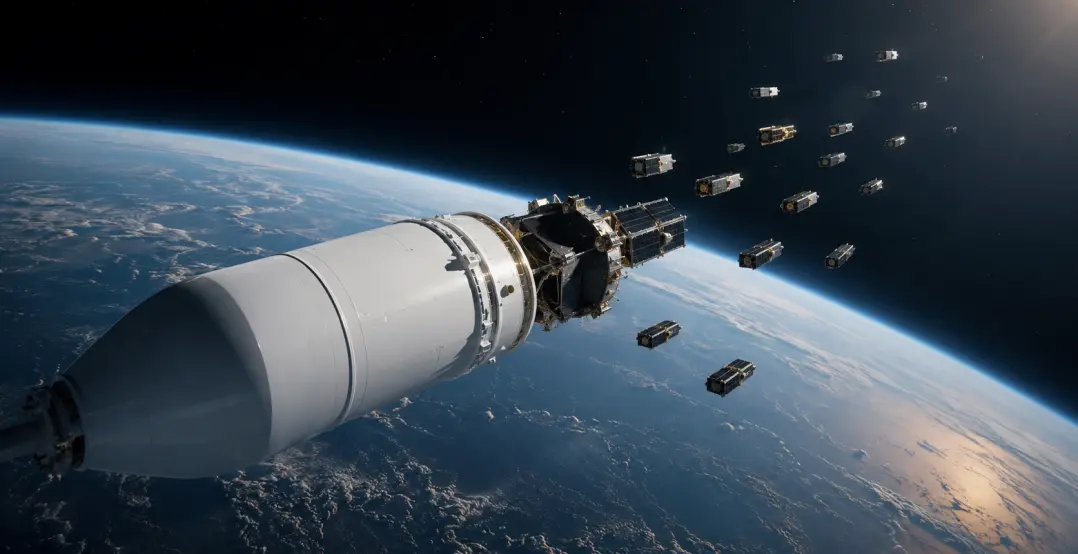
Last week, an Ariane 6 rocket launched 32 Amazon Leo satellites into low Earth orbit from French Guiana. It was the seventh Ariane 6 flight, the second using the heavy-lift four-booster configuration, and the second launch dedicated to Amazon’s broadband constellation.
Three days earlier, an Atlas V launched another 29 Amazon Leo satellites from Cape Canaveral. Two launches in four days. Over 300 production satellites now in orbit.
Amazon is building a 3,200-satellite constellation to compete with SpaceX’s Starlink, which already operates more than 10,000 spacecraft. The gap is enormous. And Amazon is under pressure – the FCC requires half the constellation to be deployed by July 2026, and they’re nowhere close to that number yet.
What that means for the space talent market: two mega-constellations are now building simultaneously, on aggressive timelines, and they need a lot of the same people.
The Scale of What’s Being Built
Amazon has booked 18 Ariane 6 launches, 38 Vulcan Centaur flights, and multiple Atlas V missions – over 80 launches total to complete the constellation. Each launch requires satellite manufacturing, integration, testing, and mission operations support. Multiply that across years of sustained production and you get a workforce requirement that looks more like automotive manufacturing than traditional space.
Starlink, meanwhile, isn’t slowing down. SpaceX has launched more than 10,000 Starlink satellites and continues to add capacity. The company recently proposed a million-satellite data center network. Whether or not that number materializes, the operational scale of Starlink already requires a manufacturing and operations workforce measured in thousands.
Two constellations of this size running in parallel creates demand across every stage of the satellite lifecycle: design, manufacturing, testing, launch integration, on-orbit operations, and ground segment development.
Where the Talent Pressure Shows Up
The engineering disciplines that mega-constellations need overlap heavily with the rest of the space sector – which is the problem.
RF and communications engineers are at the top of the list
Both Amazon Leo and Starlink are broadband networks. The satellites are communications payloads first, and the engineers who design, test, and optimize RF systems for LEO broadband are a small and heavily contested group.
Satellite manufacturing and integration engineers are the production backbone
Building 3,200 satellites isn’t a one-at-a-time operation. It requires production lines, quality systems, and manufacturing engineers who can maintain output at rates the space sector has never sustained before. Amazon’s satellite production facility in Kirkland, Washington is built for this kind of volume, but staffing it at scale means competing with every other hardware company in the region.
Ground segment software developers build the systems that manage the constellation
Tracking, telemetry, command, spectrum management, and the customer-facing network infrastructure. This is where the line between space company and tech company blurs completely. The engineers doing this work could just as easily be at a cloud provider or a telecom company, and the competition for them reflects that.
Mission operations and launch integration roles grow with every launch
Eighteen Ariane 6 missions alone require sustained operations support in French Guiana – a location that adds its own recruiting challenge. Launch cadence at this scale needs dedicated teams, not ad hoc support.
The Competitive Landscape for Engineers
If you’re an RF engineer, a satellite systems engineer, or a manufacturing specialist, the Amazon Leo buildout changes your market position. There’s now a second well-funded program competing for your skills alongside Starlink, the SDA’s military constellation, and the commercial communications companies that were already hiring.
Amazon brings something to the competition that most space companies can’t match: big tech compensation. Amazon’s total compensation packages – base salary, RSUs, signing bonuses – are benchmarked against the broader tech market, not against aerospace averages. An RF engineer who might earn $160,000 at a traditional space company could command $200,000 or more at Amazon, with stock that trades publicly.
That pulls the entire market upward. Space companies competing for the same engineers have to either match the numbers or offer something Amazon doesn’t – mission variety, technical ownership, smaller team dynamics, or roles that involve more than a single subsystem on a production line.
For candidates weighing the choice, it comes down to what kind of work you want. Amazon Leo is a production environment – high volume, standardized systems, optimized for throughput. The engineering challenge is in scaling and reliability, not in designing something from scratch. Starlink operates similarly. If you want to build one thing really well at a massive scale, these programs are compelling.
If you want to design a novel spacecraft, work on a first-of-its-kind mission, or own a technical problem end-to-end, the growth-stage companies in the sector offer something the mega-constellations don’t. The tradeoff is real, and it’s worth thinking through before you take the call.
The Ariane 6 Side of the Story
There’s a secondary talent story in this launch that’s easy to miss. Ariane 6 is Europe’s new heavy-lift rocket, and its launch cadence is ramping quickly. Seven flights in less than two years, with 18 more Amazon launches booked. Arianespace needs to scale its launch operations workforce – mission planners, range engineers, integration specialists, and the operations teams at the Kourou spaceport.
For engineers in Europe, this is one of the most significant launch programs on the continent. For US-based engineers, it’s a reminder that the space talent market is increasingly global – the companies building and launching the satellites may be American, but the rockets carrying them come from Europe, and the workforce serving those rockets is growing accordingly.
The Takeaway
The broadband space race now has two well-funded lanes running at the same time, on timelines that don’t wait for the talent market to catch up. Amazon needs to get from 300 satellites to 1,600 in a matter of months to meet its FCC deadline. Starlink is building toward a scale that dwarfs anything the sector has seen.
The engineers who can build, test, and operate communication satellites at production volume are some of the most in-demand professionals in the space sector right now. The question for companies and candidates alike is straightforward: who’s offering the work you want to do, and who can move fast enough to get you there?