
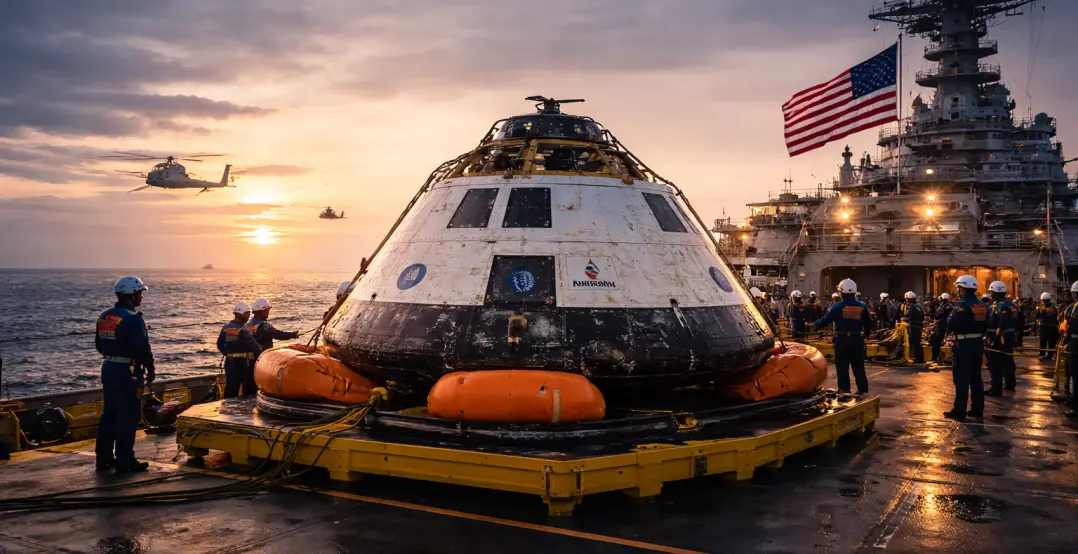
On April 10, the Orion spacecraft splashed down in the Pacific Ocean off the coast of San Diego at 8:07 p.m. ET. All four crew members – Reid Wiseman, Victor Glover, Christina Koch, and Jeremy Hansen – were recovered safely. NASA called it a perfect descent.
The ten-day mission accomplished everything it needed to. The crew broke the record for the farthest humans have ever traveled from Earth, surpassing Apollo 13. They completed a lunar flyby, observed parts of the Moon’s far side that no person has seen before, and tested Orion’s life support systems with a crew aboard for the first time. The heat shield – which had known design concerns after Artemis I – performed through a 25,000 mph reentry.
For the space sector, the question now isn’t whether the technology works. It’s whether the workforce can scale to match what comes next.
What the Mission Validated
Every technical milestone Artemis II hit unlocks the next phase of the program. And every phase requires people who don’t exist in sufficient numbers yet.
Orion’s life support systems sustained a four-person crew for ten days in deep space. That validation accelerates the timeline for Artemis III, which will test lunar lander docking in Earth orbit in 2027, and Artemis IV, which plans to land humans on the Moon in 2028. The heat shield’s performance clears the path for repeated crewed reentries at lunar return speeds – a capability that needs to work reliably for annual mission cadence.
Each of these validations isn’t just a technical checkbox; it’s a commitment to build the next thing. And building the next thing means hiring the people who can do it.
Artemis III introduces rendezvous and proximity operations with lunar landers from SpaceX and Blue Origin. That requires docking systems engineers, RPO specialists, and people with experience integrating spacecraft from different manufacturers – a skillset that barely exists outside of ISS operations. Artemis IV adds surface operations, EVA systems, habitat construction, and in-situ resource utilization. The workforce scope expands dramatically with every mission.
The 500-Company Supply Chain
More than 500 companies and 16,000 workers in California alone contributed to Artemis II. Across the full national supply chain – Lockheed Martin on Orion, Boeing and Northrop Grumman on SLS, Aerojet Rocketdyne on the RS-25 engines – the contractor workforce extends into the tens of thousands.
At annual cadence, that workforce doesn’t cycle off between missions – it stays on and grows. The thermal analyst who worked on Artemis II’s heat shield analysis is needed for Artemis III. The flight software developer who supported this mission’s trans-lunar injection burn will support the next one. And as each mission becomes more complex, the prime contractors need additional headcount – not the same team redeployed.
This creates a sustained lock-in of experienced aerospace engineers. The GNC specialist, the systems engineer with human-rated hardware experience, the mission operations lead who understands deep space communications – these people are now committed to multi-year program timelines. They’re not responding to job postings and a generic recruiter message isn’t going to move them. Reaching them requires an existing relationship, a deep understanding of what they actually do, and a compelling reason to consider something new. They can be hired – but not through simple methods.
The Commercial Squeeze Gets Tighter
While Artemis accelerates, the commercial sector is building on overlapping timelines:
- Vast is targeting Haven-1 for 2027
- Axiom Space has its fifth private astronaut mission confirmed
- Blue Origin’s lunar lander program is now formally part of the Artemis architecture
- Sierra Space is pushing toward Dream Chaser’s orbital debut
The Venn diagram between the people these programs need and the people Artemis contractors are locking in has significant overlap. A life support systems engineer is relevant to both Orion and a commercial space station. A GNC engineer with deep space experience is being recruited for both Gateway module work and commercial lunar lander programs.
For growth-stage space companies, the post-Artemis II hiring landscape is measurably more competitive than it was a month ago. The mission’s success didn’t just validate the technology – it validated the program’s momentum. That momentum means sustained demand for the exact talent pool that everyone else is drawing from.
What This Means for Hiring Right Now
The companies that will build teams through this period are the ones that accept a few realities.
Your competition has expanded
If you’re hiring for mission operations, flight software, thermal, GNC, or any human-rated systems discipline, you’re competing with the Artemis supply chain, the commercial station programs, and the defense constellation builds – all simultaneously. Your process, your compensation, and your speed need to reflect that.
Passive candidates are becoming harder to reach
Engineers who are embedded in Artemis-adjacent programs have less reason to take a recruiter’s call than they did a year ago. Their programs are funded. Their work is visible. Their job security is strong. Reaching these people requires a relationship that predates the open role — not a cold LinkedIn message after the headcount is approved.
The window for building pipeline is now, not later
Artemis III is less than two years away. The hiring that supports it is already underway at the prime contractor level. Commercial companies that wait until their own programs demand the same talent will be entering a market that’s already been picked over.
The Bigger Picture
Artemis II was a success by every measure. The crew is home, the spacecraft performed, and the program has momentum it hasn’t had in decades.
But the mission also confirmed something that the space sector has been approaching for years: the demand for experienced aerospace engineers is outpacing supply, and the acceleration of human spaceflight programs is making that gap wider, not narrower.
The companies that understand this (and start building candidate relationships now) will have the teams they need when their programs demand them. The ones that assume they can hire later are underestimating how much the landscape just shifted.