
Most people picture launch pads and mission control when they hear “careers in space exploration.” But a new corner of the sector is hiring, and it has more to do with rocks than rockets.
Asteroid mining is moving from concept to early-stage execution. The roles it creates go far beyond traditional aerospace engineering. EVONA connects talent with companies building toward off-world resource extraction, and this article maps the specific careers, skills, and entry points the field is opening up.
A Quick Rundown of Asteroid Mining
- Asteroid mining targets valuable resources like platinum-group metals and water ice from near-Earth asteroids for commercial and exploration use.
- Roles span engineering, planetary science, robotics, law, business development, and manufacturing operations.
- Companies like AstroForge and TransAstra are already flying missions and building out teams, making this a live hiring market rather than a future one.
- You do not need a traditional aerospace background to enter this field, as transferable skills from mining, software, and materials science apply directly.
- Early-stage companies are already hiring for mechanical, laser systems, and materials science positions tied to asteroid prospecting missions.
What Is Asteroid Mining?
Asteroid mining is the process of identifying, reaching, and extracting valuable materials from asteroids orbiting the sun. These small rocky and metallic bodies contain high concentrations of platinum-group metals, rare earth elements, water ice, and iron-nickel alloys.
The concept has moved beyond theory. AstroForge, a California-based startup, launched its Odin mission in 2025, its first attempt at flying by a near-Earth asteroid to check whether it held platinum-group metals. The mission represents one of the first private attempts to validate off-world resource extraction.
Why Is Asteroid Mining Gaining Attention Now?
Two shifts are driving interest. First, Earth’s reserves of critical minerals like platinum, cobalt, and rare earths face growing supply pressure from electric vehicle production, renewable energy, and semiconductor manufacturing. Asteroids offer a supply source that sidesteps geopolitical bottlenecks.
Second, reusable launch vehicles have dropped the cost of reaching orbit. What once required a government-sized budget now sits closer to startup territory. That cost reduction makes commercial asteroid prospecting missions financially plausible for the first time.
Investment and Hiring Are Picking Up
AstroForge has raised over $50 million in venture capital to pursue its extraction technology, while TransAstra’s funding is more modest and largely government-backed. TransAstra’s current business is space tugs and orbital debris removal, with asteroid mining still on the horizon. As these firms mature, they’ll need to build teams across multiple disciplines.
Other companies are on the same growth path. Karman+, a Dutch asteroid mining startup, raised $20 million in seed funding in 2025 to build its first spacecraft. The company also relocated its headquarters to Denver, beating out competing bids from the UK and Luxembourg. Karman+ joins a cluster of big names in Denver that includes Lockheed Martin, Sierra Space, and United Launch Alliance. Colorado approved close to $1.3 million in tax credits to land the deal. The move is expected to create 150 new jobs over seven years, with average salaries above $110,000, in roles spanning data engineering, market analysis, and mission operations.
But It’s Not Without Risks
It’s worth remembering this isn’t the sector’s first run. A decade ago, Planetary Resources and Deep Space Industries were the names to watch. Both were acquired and abandoned mining altogether by 2019. Early-stage space companies pivot fast, and anyone building a career here should be ready to pivot with them.
What Types of Engineering Roles Does Asteroid Mining Create?
The engineering demands here are different from typical satellite or launch vehicle programs. You’re designing systems that must operate autonomously in microgravity, millions of kilometers from the nearest repair crew.
Mechanical Engineers
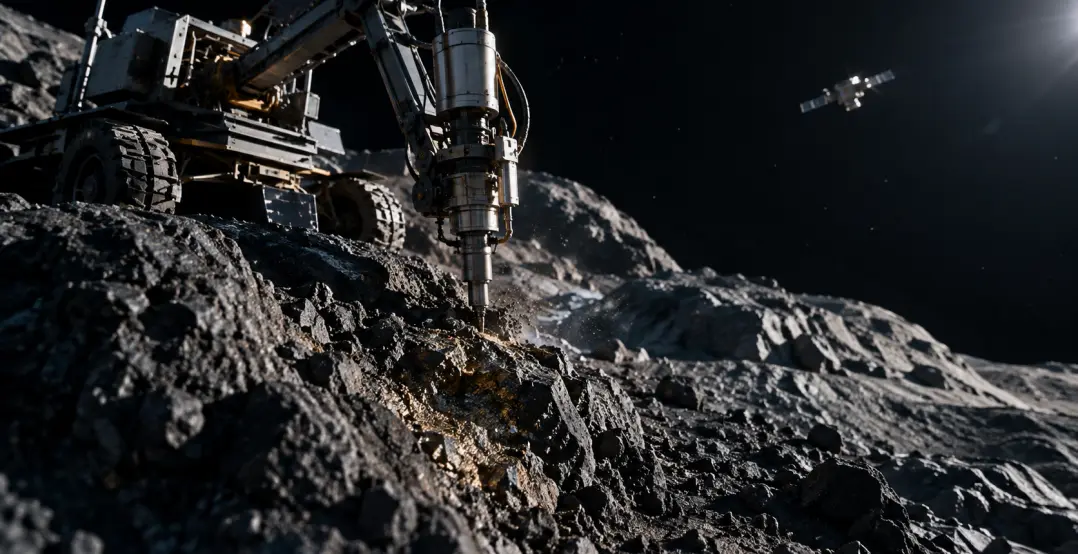
Mechanical engineers work on drilling systems, regolith collection mechanisms, and structural designs for spacecraft that can dock with irregularly shaped asteroids. Laser systems engineers develop ablation and cutting technologies for extracting material from asteroid surfaces.
Robotics Engineers
Robotics engineers build the autonomous machines that carry out extraction without human presence. These systems need to navigate unpredictable terrain, handle material in zero gravity, and operate reliably for months or years without intervention.
What Science and Research Roles Are Involved?
Planetary geologists and materials scientists play a critical role in asteroid mining. They classify asteroid types (C-type for volatiles, S-type for silicates, M-type for metals) and assess which targets hold commercially viable concentrations of specific minerals.
Materials Scientists
Materials scientists develop processing techniques for refining raw asteroid material in space. In our experience across 300+ space companies, these cross-disciplinary roles are among the hardest to fill because they require deep domain knowledge and an appetite for working on technology that doesn’t have a proven playbook yet.
Remote Sensing Specialists
Remote sensing specialists use hyperspectral imaging and spectral analysis to map asteroid surfaces from orbit. Their data determines whether a target is worth the investment of a full extraction mission.
Are There Non-Engineering Careers in Asteroid Mining?
This is where assumptions miss the mark. The reality is that asteroid mining companies need far more than engineers. Space law is one of the fastest-growing adjacent fields, because the Outer Space Treaty doesn’t explicitly address private property rights on celestial bodies.
Commercial extraction raises legal questions that require dedicated expertise. Regulatory frameworks, resource ownership, and international compliance are all open territory.
Business development and commercial strategy roles are essential for companies navigating the path from prospecting to revenue. Someone needs to negotiate supply agreements, manage investor relations, and structure the financial models behind billion-dollar resource valuations.
Manufacturing operations managers, supply chain specialists, program managers, and quality assurance professionals round out the hiring picture. Across the companies we work with, there’s demand for a wide range of space jobs.
What Skills Transfer Into Space Mining Jobs?
If you’re working in terrestrial mining, you already have relevant experience. The fundamentals of resource extraction, geological surveying, and safety-critical operations translate directly. The adaptation involves learning how those processes function in microgravity and vacuum conditions.
Software engineers with experience in autonomous systems, computer vision, or AI-driven decision-making are in demand. Asteroid mining spacecraft must make navigation and extraction choices without real-time human input due to communication delays.
Data scientists who can model ore body distribution, predict yields from spectral data, and optimize mission trajectories bring immediate value. Get crystal clear on where your existing skills overlap with space mining requirements, and you’ll find the transition more accessible than you might expect.
How Can You Prepare for a Career in Asteroid Mining?
Start with the technical foundation. Degrees in aerospace engineering, mining engineering, robotics, planetary science, or materials science position you well. But the sector also hires from mechanical engineering, physics, software development, and geoscience backgrounds.
Build familiarity with in-situ resource utilization (ISRU) research. NASA’s educational resources on asteroid mining offer a solid introduction to the engineering and scientific challenges involved.
The practical step is to start engaging with the sector now. Apply to early-stage companies, follow mission announcements, and learn how different roles contribute to the extraction lifecycle.
Asteroid Mining Careers Are Closer Than You Think
Asteroid mining isn’t a far-future fantasy. Companies are flying prospecting missions today, and they need mechanical engineers, laser scientists, materials researchers, legal specialists, program managers, and commercial strategists to build out their teams.
Your background in mining, robotics, software, science, or business operations could be exactly what these companies need. The opportunity is broader than you might expect.
If you’ve got the skills and the drive to help build something that hasn’t been built before, asteroid mining is a sector worth watching closely. As specialists in staffing for the international space sector, we’ve placed more than 2,000 people across 300+ space companies. The EVONA jobs portal lists current openings, and our recruitment team matches your skills to roles at companies working on asteroid mining and related space resource programs.
FAQs About Asteroid Mining Careers
What is asteroid mining and how does it work?
Asteroid mining involves sending spacecraft to near-Earth asteroids to extract valuable materials like platinum-group metals, water ice, and rare earth elements. Autonomous robotic systems carry out the extraction in microgravity, and the mined materials can support both Earth-based industries and future space infrastructure.
What careers does asteroid mining create?
Asteroid mining creates roles for mechanical engineers, robotics engineers, planetary geologists, materials scientists, space lawyers, program managers, and business development professionals.
Do you need an aerospace degree to work in asteroid mining?
Not necessarily. Skills from terrestrial mining engineering, software development, data science, materials science, and manufacturing operations transfer directly.
Which companies are actively pursuing asteroid mining?
AstroForge and TransAstra are two of the most active private companies. AstroForge attempted its first asteroid flyby with the Odin mission in 2025, and both firms are hiring for engineering, science, and operations roles.