
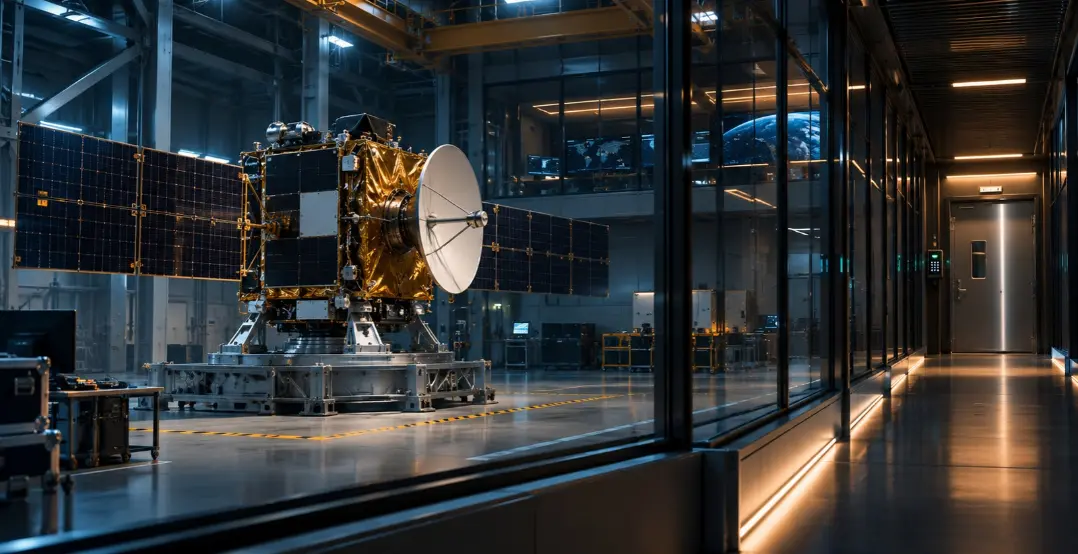
The more our economies depend on satellites, the more governments are spending to defend them, and that money is creating satellite security jobs.
This is part 3 of our series on emerging space sectors, following on from the jobs NASA’s Moon base is creating and the race to replace the ISS. Below, we look at who’s protecting US satellites and the jobs that work is creating.
Why Satellites Need Defending
Satellites support more than half of the critical services in the world’s major economies, from transport and energy to food supply, the Organization for Economic Cooperation and Development (OECD) found. That makes them worth protecting.
Jamming and spoofing of satellite signals is now common. Some satellites are also moving close enough to inspect, or even interfere with, other satellites. The Center for Strategic and International Studies (CSIS) reports that in one case, a group of satellites changed orbit to match that of a commercial radar satellite.
When those signals are disrupted, the effects reach the ground. A 2019 study for the National Institute of Standards and Technology (NIST) estimated that losing GPS would cost the US economy about $1 billion a day.
The US Agencies Protecting Satellites
In the US, two military organizations lead on protecting satellites. The Space Force is the military branch for space, and its Space Systems Command buys the satellites and other equipment the Space Force uses. US Space Command runs military operations in space and is responsible for defending US interests there.
The Space Force’s budget is now bigger than NASA’s, the OECD notes. Congress gave it $31.9 billion for 2026, and the request for 2027 is $71.3 billion.
The Jobs Satellite Security Is Creating
Much of the engineering will feel familiar if you’ve worked on satellites or defense systems, and the demand is growing.
Look out for these roles:
- Proximity operations and robotics engineers, who fly spacecraft safely close to other satellites
- Orbital mechanics and GNC (guidance, navigation and control) engineers, who plan and steer those maneuvers
- EO/IR (electro-optical and infrared) sensor and signal processing engineers, who help satellites see and track other objects in orbit
- Mission operations engineers, who run the spacecraft day to day
Many of these roles need a security clearance, or the ability to get one, and export rules limit most of them to US persons. That’s one reason veterans do well here. The US military was the single biggest source of the people we placed this year, as we covered in the space roles companies struggle to fill most.
Who’s Hiring for Satellite Security Jobs
Satellite security jobs come from four kinds of employers.
Startups Building Inspection Spacecraft
True Anomaly, for example, raised $650 million in April 2026 and plans to grow past 500 employees by the end of the year. At the time of writing, it’s hiring mission operations and GNC engineers in Colorado.
Satellite Tracking Companies
LeoLabs, for example, runs its own radar network and said in January that its US government contracts grew 186% in 2025.
Large Defense Companies
The Space Force picked 14 companies, including Lockheed Martin and Northrop Grumman, for a $1.8 billion program to build satellites that monitor other satellites in high orbit.
Government Agencies
Space Systems Command, which buys the Space Force’s satellites, aims to hire about 100 non-military staff a month, including engineers, program managers and contracting specialists.
Applying for Satellite Security Jobs: What to Expect
If you haven’t worked in defense before, expect a different hiring process. Interviewers may only be able to tell you so much about the project, and many roles need a security clearance, which involves a background check and can take months.
Some companies will sponsor your clearance and start you on unclassified work while you wait.
For more to check before you accept an offer, read our guide to whether a space startup is a safe bet. Next in this series, we look at how in-space manufacturing is creating jobs. To see which companies are hiring for satellite security jobs now, check the hiring signals on EVONA’s Space Intel.