
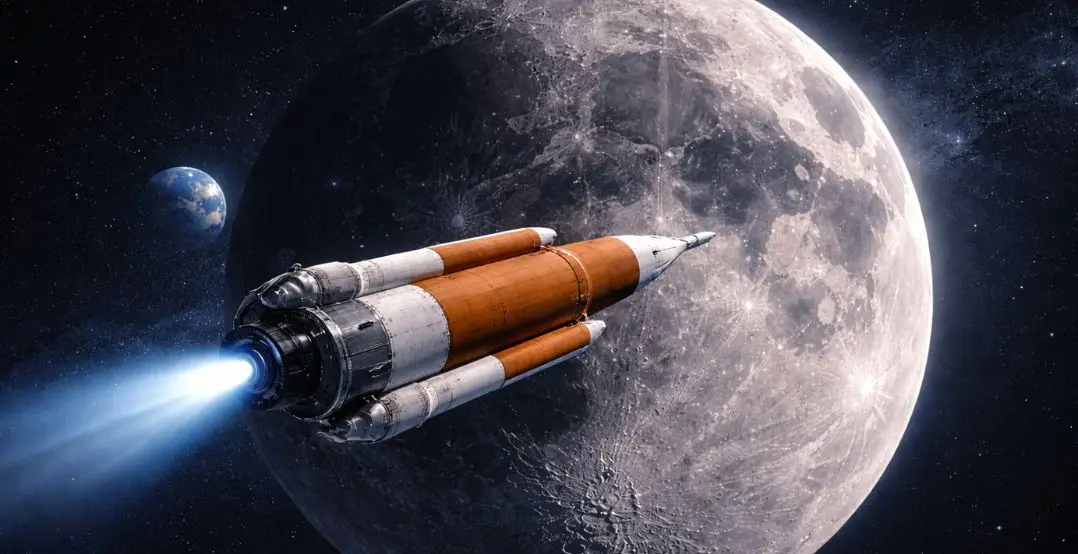
On April 1, four astronauts launched from Kennedy Space Center aboard the most powerful operational rocket in the world. By April 6, they had completed a lunar flyby, broken the record for the farthest humans have ever traveled from Earth, and seen parts of the Moon’s far side that no person has observed before. Splashdown is expected April 10.
Artemis II is the moment the space sector has been building toward for years. But the real story for anyone hiring in this market isn’t what happened this week. It’s what happens next.
The Cadence Has Changed
Artemis II was never intended to be a one-off event. NASA has confirmed that Artemis III will launch in 2027 – an Earth orbit mission to test lunar landers from SpaceX and Blue Origin. Artemis IV, the first crewed lunar landing under this program, is planned for 2028. A $20 billion moon base initiative was outlined just days before launch. And the agency’s new exploration budget would increase to $8.5 billion, a nearly 10% boost over current levels.
This is a sustained program cadence, not a series of isolated missions. And each step requires a larger, more specialized workforce than the last.
Artemis II needed mission operations, life support, avionics, and flight software expertise. Artemis III will add lunar lander integration, rendezvous and proximity operations, and EVA systems. Artemis IV introduces surface operations, habitat construction, and in-situ resource utilization. The technical scope expands with every mission, and the workforce has to expand with it.
The Contractor Workforce Equation
More than 500 companies and 16,000 workers in California alone contributed to Artemis II. Across the full supply chain – Lockheed Martin on Orion, Boeing and Northrop Grumman on SLS, Aerojet Rocketdyne on the RS-25 engines – the contractor workforce runs into the tens of thousands.
At annual cadence, those people don’t cycle off between missions; they stay on. And as each mission becomes more complex, the prime contractors need additional headcount rather than redeploying the same team.
This creates a sustained absorption of experienced aerospace engineers into the Artemis industrial base. The GNC engineer, the thermal analyst, the flight software developer, the systems engineer with human-rated hardware experience – these professionals are now locked into multi-year program commitments. They’re not in the open market. They’re not responding to startup outreach. And their replacements aren’t materializing from the university pipeline fast enough to offset the demand.
The Commercial Space Squeeze
While Artemis scales, the commercial space sector is building on overlapping timelines. Vast is preparing Haven-1 for a 2027 launch. Axiom Space has secured its fifth private astronaut mission. Sierra Space is targeting Dream Chaser’s first orbital demonstration. Blue Origin’s New Glenn is operational, and its lunar lander program is part of the Artemis architecture.
Every one of these programs requires people with experience that is directly relevant to Artemis work. The Venn diagram between “engineer who can work on a commercial space station” and “engineer who can work on Orion life support systems” has significant overlap.
For growth-stage space companies, this means the competitive landscape for experienced talent has fundamentally shifted. You’re not just competing with other startups or with the defense primes. You’re competing with a government program that now has momentum, funding, and multi-year continuity for the first time in a generation.
What the Budget Signals – and What It Doesn’t
The same week Artemis II launched, the White House proposed cutting NASA’s overall budget by 23%, including a 47% reduction to the science directorate (Space.com). But exploration – the budget line that funds Artemis – would get a 10% increase.
Congress rejected nearly identical cuts last year, restoring science funding and adding $2.6 billion for the Gateway lunar station. The same dynamic is likely to play out again. But the signal is clear: the political priority is human spaceflight and lunar presence, not broad-based science.
For the talent market, this creates a two-speed NASA. Exploration programs are growing. Science programs are under pressure. Engineers working on missions that could be terminated face uncertainty. Some will move to Artemis-adjacent work. Others will move to commercial space. Either way, the redistribution of talent within the sector is accelerating, and companies that are paying attention to where people are moving will have a structural advantage.
What Companies Should Be Doing Now
The Artemis acceleration is not a future event. It’s happening. The workforce effects are already visible in longer time-to-fill for experienced roles, rising compensation expectations, and candidates who have more options than they did 12 months ago.
Companies that are building teams through this period should be thinking about three things.
1. Identify where your roles overlap with the Artemis supply chain.
If you’re hiring for mission operations, flight software, GNC, thermal, or human-rated systems, you are directly competing with the contractor workforce that is expanding to meet annual mission cadence. Your hiring strategy, compensation, and timeline need to reflect that reality.
2. Build candidate relationships before you need them.
The companies that will hire successfully over the next two years are the ones that are already having conversations with the engineers they’ll need in six months. Reactive hiring – posting a role and waiting for applications – is increasingly ineffective for the skill sets that Artemis and commercial programs both require.
3. Move faster.
Experienced engineers in this market are closing offers within three to four weeks of first contact. If your process takes longer, you are losing candidates to organizations that are prepared to move at speed.
The Bigger Picture
Artemis II is a historic achievement. Humans are farther from Earth than they’ve ever been. The first woman and the first person of color to travel beyond low Earth orbit are aboard. A Canadian astronaut has left Earth orbit for the first time in any nation’s history outside the United States.
But behind the mission is an industrial reality. The people who made this flight possible are the same people every space company wants to hire. As the Artemis program accelerates from one mission to annual cadence, the competition for that expertise is only going to intensify.
The companies that understand this – and plan for it now – will build the teams they need. The ones that wait will be competing for whoever’s left.