
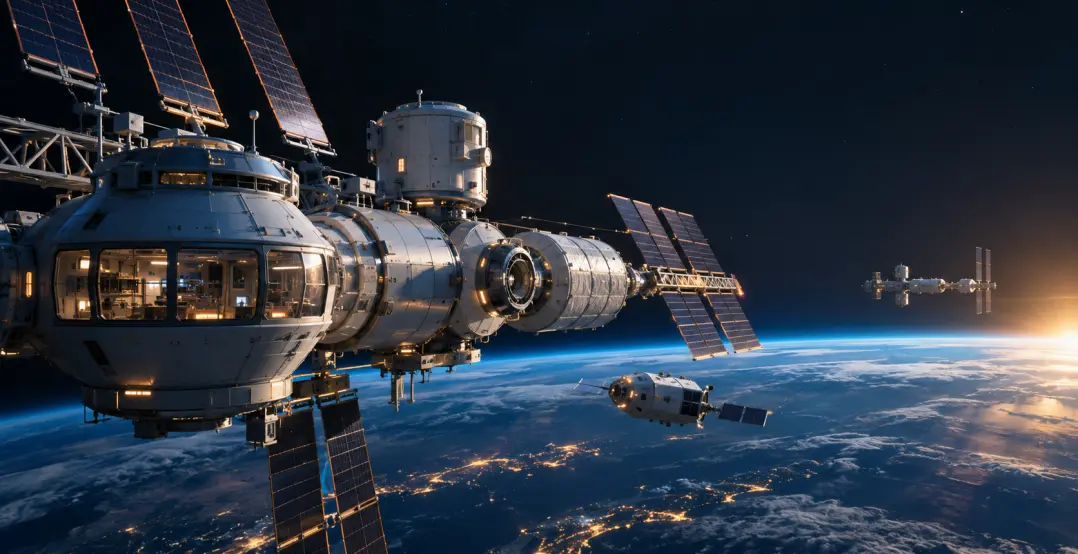
As NASA prepares to retire the well-worn ISS by 2030, commercial companies are racing to replace it. Building a space station was never going to be easy, and the challenges they’re facing are shaping their hiring needs. Each one is building its station differently, and you can see it in the space station jobs they’re advertising.
This is part 2 of our series on emerging space sectors. In part 1, we looked at the jobs NASA’s Moon base is creating. Below, we look at the companies bidding to replace the ISS and the roles they need to fill.
NASA Is Turning to Commercial Companies to Replace the ISS
NASA and its partners have kept astronauts on the ISS without a break since November 2000. When the ISS retires at the end of 2030, NASA wants to rent space on several stations built and run by commercial companies.
Investors are backing the idea too. Space station companies have raised $4.4 billion since 2009, almost all of it for habitats, the modules people live and work in, according to space investor Space Capital. You can follow the latest space funding rounds on EVONA’s Space Intel.
The Timeline
Here’s what NASA’s timeline looks like, according to The Space Review:
- October 9, 2026: NASA released its final request for proposals through the Commercial Low Earth Orbit Destinations (CLD) program
- December 8, 2026: bids due
- April 2027: NASA picks at least two companies to keep developing their stations
- Later: at least one is chosen for full development
- End of 2030: the ISS retires
The Main Contenders
With bids due December 8, four companies are leading the race, according to space business publication Payload:
- Vast: building Haven-1, a single-module station it plans to launch in 2027 for crews of up to four on short stays.
- Axiom Space: planning a two-module station that would grow to four modules. So far, it’s the only contender that has run private astronaut missions to the ISS.
- Starlab: a joint venture led by Voyager Technologies with Airbus, aiming to launch in 2029.
- Blue Origin: developing Orbital Reef, though it has kept a lower profile than its rivals.
The Challenges Facing Space Station Companies
Getting Crews to Low Earth Orbit and Back
SpaceX has privately told station companies that the Crew Dragon likely won’t be available for their stations, and is shifting its focus to Starship. And without a way to get crews there and back, a station has no one to host. This new problem affects how much money companies need to raise and who they need to hire.
NASA won’t fund new crew vehicles, but will arrange transport for its first missions to commercial stations. After that, space station companies are on their own. Administrator Jared Isaacman says there’s plenty of outside capital eager to get involved.
Commercial companies have had mixed reactions to this, with Axiom CEO Jonathan Cirtain saying, “I don’t have a pivot plan.” Vast CEO Max Haot pointed to NASA’s support for Boeing’s Starliner, the only other option for now. “We are optimistic,” he said. Blue Origin, which already has a NASA agreement for technical support on a crewed spacecraft, says it has “no plans to fund this internally.”
Meeting NASA’s Requirements Before 2030
At least one commercial station needs to be in orbit by the end of 2030 to avoid a gap after the ISS retires. NASA eased its requirements after companies pushed back.
Cirtain still worries that paperwork could slow things down. On Axiom’s NASA spacesuit contract, the company had to deliver 30,000 documents and close out 4,000 issues before a single design review. If a station is going to be ready by the end of 2030, there’s little room for that.
What Space Station Job Ads Reveal About Each Company
We reviewed the open roles on each company’s careers page in November 2026. How these companies tackle the challenges involved in building a space station determines who they will hire. Across the four, that would mean:
- Safety, certification and verification engineers, to meet NASA’s safety bar
- People who can build and test hardware quickly, to hit the 2030 deadline
- Mission operations and partnership roles, to solve the transport problem
Three of the four contenders are also practicing on the ISS itself. Axiom has flown four private astronaut missions there, and Vast and Voyager have each won a NASA private mission of their own, according to Payload. That helps explain why ISS experience shows up in station job ads as a bonus.
Vast
Vast describes its approach as “incremental” and “hardware-rich.” It’s learning by continuously building and testing hardware. Job ads at the time of writing lean toward:
- Hands-on build roles: welders, machinists and manufacturing technicians
- Integration and test engineers
- Life support, thermal and structures engineers
- Certification and mission operations roles
Axiom Space
Axiom plans to test its first module attached to the ISS, and Cirtain describes a “safety-first mentality,” in line with NASA’s strict standards.
Its station roles lean senior:
- Systems architects, requirements and verification engineers
- Safety and reliability engineers
- Power, structures and software engineers, often with ISS standards experience as a plus
Starlab
Starlab is built around partners including Airbus, Mitsubishi, MDA and Northrop Grumman. It plans to use its partners’ existing facilities and systems rather than build everything from scratch. That means much of the engineering may happen at partner companies, so check their careers pages too.
Blue Origin
Blue Origin sees itself as a launch and infrastructure company that competes on scale. It has said little publicly about Orbital Reef, so its station roles may be part of its wider engineering teams.
How to Position Yourself for Space Station Roles
- If you’ve worked on the ISS or other crewed programs, lead with it, the same way you’d show flight heritage on a space resume.
- Experience from other industries counts too. That’s especially true for test and thermal roles, which are among the space roles companies struggle to fill most. Show that you’ve designed to strict standards and documented your testing.
- Know the process. Familiarity with safety reviews, verification and certification comes up again and again, which can work in your favor if you’re moving from legacy aerospace to a newer space company.
- Check the fine print. Many station roles involve export-controlled technology, which can limit them to U.S. persons, meaning citizens and permanent residents. Many build and test roles are also on-site, so if a role means a move, read what to consider before relocating.
Where Space Station Hiring Goes From Here
NASA’s picks next April will decide which companies get funding to keep developing their stations. Most of these are younger companies, so check how stable a company is before you accept an offer. We’ve covered how in four signs a space startup is a safe bet.
Next in this series, we look at how space security is creating jobs.
If you’re curious where you’d fit, take a look at the space roles we’re hiring for right now.