
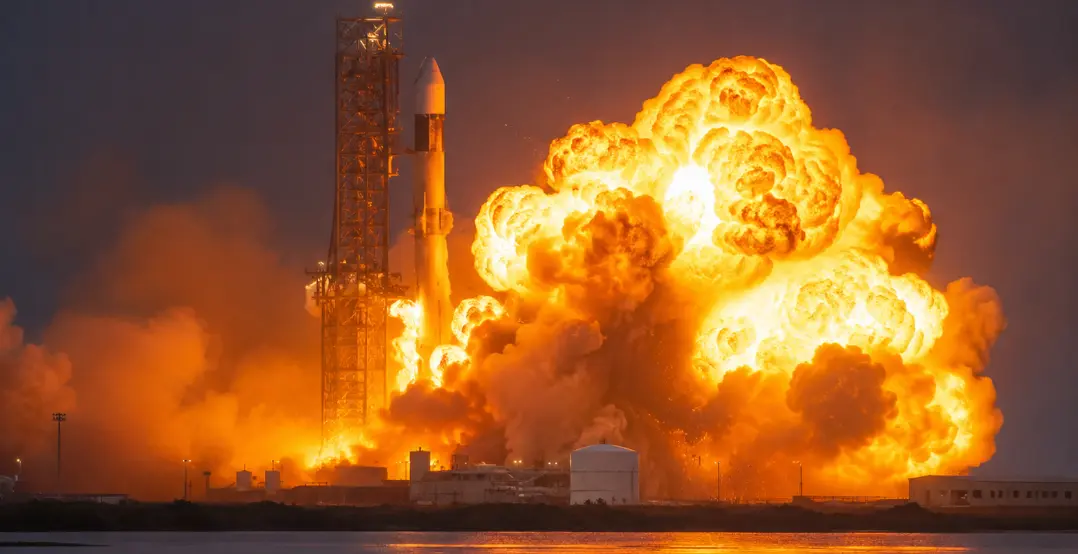
Last night, Blue Origin’s New Glenn rocket exploded during a static fire test at Cape Canaveral. The 320-foot rocket erupted into a fireball at around 9pm ET as the engines appeared to ignite. The rocket was destroyed. The launch pad (Blue Origin’s only pad for New Glenn) was destroyed. The transporter, erector, and at least one lightning tower were destroyed. No one was hurt.
The footage is dramatic.
The headlines will be dramatic.
And a lot of people will look at this and think Blue Origin is finished, or that the space sector just took a devastating blow.
They’re wrong.
What Actually Happened
Blue Origin was conducting a hotfire test – firing the rocket’s engines while it’s still bolted to the ground – ahead of a planned launch next week. The NG-4 mission was supposed to carry 48 Amazon Leo broadband satellites into orbit, the first of 24 launches Amazon has contracted Blue Origin to fly.
Something went wrong at the base of the rocket as the engines started firing. The first stage caught fire, the upper stage began tilting, and seconds later the entire vehicle exploded. It was the first on-pad explosion at the Cape since SpaceX’s Falcon 9 blew up on pad 40 in September 2016.
The cause hasn’t been confirmed yet, and this is a separate issue from the NG-3 upper stage failure in April, which was caused by a cryogenic leak that froze a hydraulic line. Blue Origin had just received FAA clearance to fly again six days before this happened.
Jeff Bezos posted: “Very rough day, but we’ll rebuild whatever needs rebuilding and get back to flying. It’s worth it.”
NASA Administrator Jared Isaacman said: “Spaceflight is unforgiving, and developing new heavy-lift launch capability is extraordinarily difficult.”
Both statements are worth taking seriously.
Failure Is How This Industry Works
This is hard to hear on the day a rocket explodes, but it’s true: every major launch company in history has been through catastrophic failures, and the ones that survived them came back stronger.
SpaceX’s Falcon 9 exploded on the pad in 2016.
The company was grounded for three and a half months. The pad was out of action for over a year. Today, Falcon 9 launches every two to three days and is the most reliable operational rocket in the world. SpaceX didn’t succeed despite that failure – the investigation and rebuild made the vehicle better.
Starship has exploded multiple times during its test program.
Each failure generated data that informed the next design. Starship V3 launched successfully on May 19, putting over 100 metric tons to orbit.
New Glenn has now flown three times.
The first flight reached orbit – something no commercial rocket had achieved on its maiden launch. But the booster didn’t land. The second flight landed the booster successfully, and the third flight landed the booster again but lost the payload due to the upper stage failure. Each flight taught the engineering team something that changed the next one.
Last night’s explosion is a setback, but the people who build rockets understand something that the headlines don’t capture: this is what the development cycle looks like. The question isn’t whether failures happen. It’s what you do after them.
The Immediate Impact
The short-term consequences are real and significant.
Amazon’s 24-launch manifest is frozen.
No satellites are going up on New Glenn until the pad is rebuilt and the vehicle is cleared to fly again. After the 2016 SpaceX pad explosion, it took over a year to rebuild the pad. Amazon has 270 production satellites in orbit against an FCC deadline of 1,618 by July. They’ll need alternative launch providers. Atlas V is already launching Amazon Leo satellites, and other vehicles may need to be added to the manifest.
Artemis timelines are at risk.
Blue Origin’s Blue Moon lander launches on New Glenn, the Moon Base 1 cargo delivery was targeting fall of 2026, and the Artemis 3 low-Earth-orbit demonstration is planned for mid-2027. NASA said it’s assessing the impacts, but any extended grounding of New Glenn directly affects these schedules. Just days before the explosion, NASA awarded Blue Origin a $188 million contract for lunar rover deliveries.
The pad needs to be rebuilt.
LC-36 was Blue Origin’s only New Glenn launch pad, and the infrastructure damage appears to be extensive. Rebuilding a launch complex is months of work involving ground systems engineers, facilities specialists, construction crews, and the entire pad operations team.
Why This Is Actually a Hiring Story
Here’s the part that most coverage will miss.
An explosion like this doesn’t reduce a company’s need for people. It increases it.
Blue Origin needs to investigate, rebuild, and return to flight. That means:
- Forensic engineers analyzing what went wrong
- Ground systems and facilities engineers rebuilding the pad
- Quality and reliability specialists reviewing every process that led to the test
- Manufacturing engineers building the next vehicle
- The entire existing engineering team continues to work on the programs that don’t stop because of one bad night (the BE-4 engine production line, the Blue Moon lander, the orbital reef program)
Bezos said “we’ll rebuild whatever needs rebuilding.” That’s a hiring statement as much as it’s a mission statement.
Beyond Blue Origin itself, the ripple effects create demand elsewhere. If Amazon needs to shift launches to other providers, those providers need to scale their operations to absorb the additional missions. If Artemis timelines shift, the programs downstream of Blue Origin’s lander – surface systems, crew equipment, science payloads – may need to adjust their own workforce plans.
What This Tells You About Working in Space
If you’re an engineer considering the space sector, last night might have given you pause. A rocket exploding on the pad is not exactly a recruiting video.
But here’s the reality: the engineers who work through failures like this are the most valuable people in the industry. The person who helps investigate what went wrong, redesigns the system, and gets it flying again has experience that can’t be taught in a classroom or gained on a program where nothing ever breaks.
SpaceX’s most experienced engineers are the ones who were there when Falcon 9 blew up in 2016. They stayed, they fixed it, and they built the most successful launch vehicle in history. The Blue Origin engineers who work through this will carry the same kind of experience.
The space sector doesn’t need people who only want to work on successes. It needs people who can handle the hard days, and last night was a hard day.
The Takeaway
New Glenn will fly again. The pad will be rebuilt. The Amazon launches will resume. The Artemis programs will adjust. That’s not optimism – it’s how the space industry has always worked.
The companies and engineers who treat setbacks as data rather than defeat are the ones who build the things that eventually work. Last night’s explosion is a chapter in a story that isn’t close to being finished.
As Bezos said: it’s worth it.