
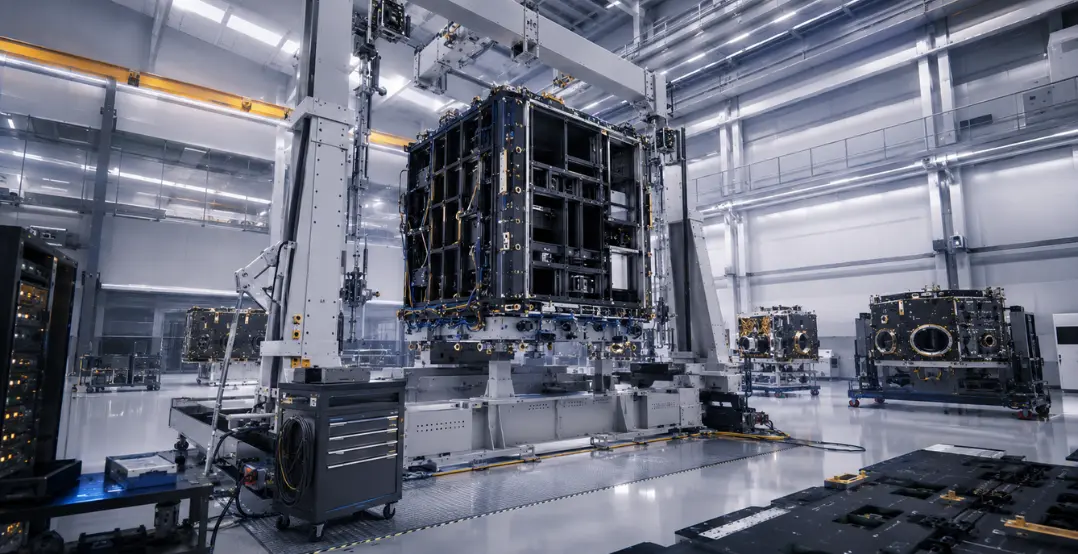
This morning, Vast announced a new product line: high-power satellite buses built for communications, Earth observation, national security, and orbital data centers. The first offering is a 15 kW-class bus with a dry mass of 700 kg, capable of hosting payloads of at least 350 kg. They’ve already signed a confidential customer for four satellites, with an option for 200 more. First batch launches are planned for late 2027.
Vast raised $500 million earlier this year to build commercial space stations and they have over 1,000 employees in Long Beach. Haven-1, their first station module, is targeting a 2027 launch. And now they’re entering the satellite bus market.
That pivot tells you something important about where the space sector is heading – and what it means for the people working in it.
The Pattern: Diversify Early, Hire Twice
Vast isn’t the first space company to expand beyond its original product. Rocket Lab started as a launch company and moved into satellite manufacturing. SpaceX went from launch to Starlink to Starshield. Blue Origin is building engines, rockets, and lunar landers simultaneously.
The pattern is consistent: successful space companies diversify earlier than most people expect, and each new product line creates a new wave of hiring.
What Vast’s CEO Max Haot said is worth paying attention to: every successful space company with heritage is diversified. The only questions are when and what. For Vast, the answer is now, and the answer is satellite buses – because nearly all the technology they’ve built for Haven-1 translates directly.
The avionics, power systems, flight computers, sensors, flight software, and GNC – all of it was already developed in-house for the station program and flight-tested on Haven Demo last year. The only major new pieces are deployable solar arrays and electric propulsion, both of which were already in development for Haven-2.
That means the initial engineering team can cover the satellite bus work without a completely separate hiring effort. But here’s where it changes: if the option for 200+ satellites gets exercised, Vast needs to build a production operation. And manufacturing satellites at volume is a fundamentally different workforce challenge than building a one-of-a-kind space station.
From Prototype to Production: The Hiring Shift
Building a space station is a craft operation. Small teams of experienced engineers designing, assembling, and testing a single complex vehicle. The skills that matter most are depth of expertise, the ability to solve novel problems, and comfort with ambiguity.
Building 200 satellites is a manufacturing operation. Production lines, quality systems, supply chain management, and the ability to build the same thing reliably at rate. The skills that matter shift toward manufacturing engineering, production planning, quality assurance, test automation, and supply chain coordination.
This is the transition that every space company faces when it moves from building one of something to building many. And it’s the transition that catches companies off guard if they don’t plan the workforce for it.
The engineers who designed the satellite bus are not the same people who will run a production line building 50 of them a year, but both of these groups are essential. However, the manufacturing and production workforce is the one that needs to be hired, and they’re in short supply across the entire industry.
We’ve seen this pattern across space companies scaling from prototype to production. The engineering talent that gets a company to its first flight is deep but small. The workforce that gets a company to its fiftieth unit is broader and harder to assemble, because manufacturing engineers, production managers, and quality specialists with space hardware experience are one of the tightest candidate pools in the sector.
The Defense Connection
There’s a second angle to this story that’s easy to miss. Vast is positioning these satellite buses for national security applications alongside commercial ones. And they’re entering the market at a moment when the defense sector is struggling with exactly this problem.
Earlier this year, the SDA’s director said that satellite buses – which were supposed to be a commodity – turned out to be one of the biggest challenges in the first tranche of the proliferated constellation. The constraint wasn’t the design. It was building and checking out enough of them at the pace the program needed.
A company like Vast – with over a billion dollars in capital, 1,000+ employees, and an in-house manufacturing facility in Long Beach – entering the bus market is directly relevant to that supply chain gap. If Vast can produce reliable, high-power buses at volume, they become a credible supplier for both commercial constellations and defense programs.
That dual-use positioning means the hiring will reflect both markets. Engineers who can build hardware to commercial timelines and engineers who can work within defense program requirements – and ideally, people who can do both.
The AI Layer
One detail from the announcement that stands out: Vast is offering an optional NVIDIA Vera Rubin Space-1 module for orbital data centers, AI edge compute, and autonomous space operations.
That’s not a standard satellite bus feature; it signals that Vast sees its platform as infrastructure for compute-heavy missions, not just traditional comms or EO payloads. The engineers who build and integrate AI processing systems for space applications sit at the intersection of two talent markets – space hardware and AI/ML – and they’re among the hardest profiles to find because the combination barely existed as a career path five years ago.
As more space companies add AI and edge compute capabilities to their platforms, this crossover talent pool will become one of the most contested in the sector.
What This Tells You
Vast’s move from stations to satellite buses is one company’s announcement. But it reflects something bigger happening across the sector.
Space companies are diversifying faster, leveraging technology they’ve already built to enter adjacent markets. Each expansion creates new hiring demand – sometimes for the same engineers, sometimes for entirely different ones. And the companies that plan their workforce around both the current product and the next one are the ones that scale successfully.
For engineers: the companies worth watching aren’t just the ones building one thing well. They’re the ones that are about to build the next thing. That’s where the new roles open up, the teams are forming, and the opportunity to get in early is real.
For companies: if your product roadmap includes a second product line in the next 18 months, the workforce plan for it should start now. The manufacturing, production, and quality engineers you’ll need aren’t sitting on job boards. And by the time you announce the product, the companies that planned ahead will have already hired them.