
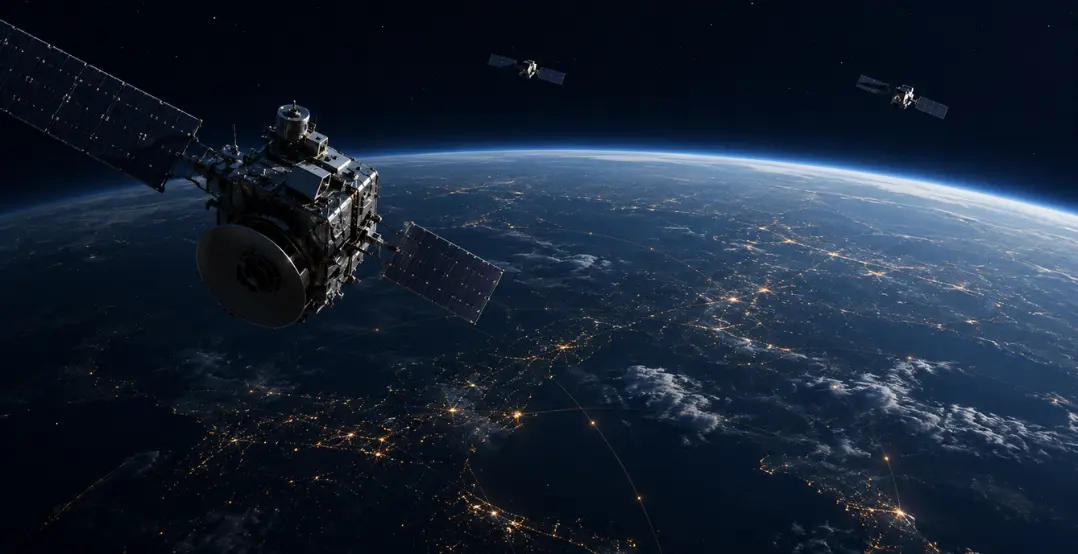
The Space Force just raised the contract ceiling for its Andromeda program from $1.8 billion to $6.2 billion. That’s an additional $4.4 billion for a program that builds the next generation of satellites designed to watch what’s happening in space.
Andromeda replaces two existing programs: GSSAP, the “neighborhood watch” satellites that inspect objects in geosynchronous orbit, and the classified SILENTBARKER space surveillance constellation. The Space Force described the expansion as a response to an escalating threat environment projected for 2030 and beyond.
Fourteen companies are eligible to compete for task orders under the contract. The list includes defense primes like Lockheed Martin, L3Harris, and Northrop Grumman alongside growth-stage companies like Anduril, True Anomaly, and Quantum Space.
What Andromeda Actually Needs
Space domain awareness
Knowing what’s in orbit, where it’s going, and whether it’s a threat – is one of the fastest-growing mission areas in defense space. Andromeda is the biggest single investment in that capability.
The satellites this program builds will need to do things that are technically demanding: detect and track objects at extreme distances, maneuver close to other spacecraft, process sensor data in real time, and operate in orbits where servicing isn’t an option. That translates to specific engineering disciplines.
Sensor and payload engineers
Sensor and payload engineers who can design and build the optical and infrared systems that detect objects in space. These are the eyes of the satellite, and the performance requirements for a space surveillance mission are different from a standard Earth observation payload. The targets are smaller, farther away, and sometimes deliberately trying not to be seen.
GNC engineers
GNC engineers who can design maneuver and proximity operations capabilities. If Andromeda satellites need to inspect other objects – which the GSSAP replacement mission implies – they need GNC systems that can safely approach, station-keep near, and characterize another spacecraft. That’s a skillset that overlaps directly with satellite servicing, debris removal, and the Golden Dome interceptor prototypes.
Orbital mechanics analysts
Orbital mechanics analysts who can plan and optimize the observation campaigns. Where does the satellite need to be, when does it need to be there, and how do you maximize coverage of the objects you’re tracking? This is applied math at a level that requires years of experience.
Systems engineers with clearances
Systems engineers with clearances who can integrate all of this into a functioning spacecraft that meets defense reliability standards. The systems engineering role on a classified space surveillance program is one of the hardest hires in the sector – you need someone who understands the full spacecraft, has experience with defense program management, and holds an active clearance. That combination narrows the pool significantly.
Flight software and autonomy engineers
Flight software and autonomy engineers who can build the onboard processing systems. A surveillance satellite that has to detect, track, and respond to threats in real time needs software that makes decisions faster than a ground operator can. The autonomy requirements for Andromeda are likely more demanding than for most commercial missions.
Fourteen Vendors, One Talent Pool
The vendor list is what makes this interesting from a hiring perspective.
Lockheed Martin, L3Harris, Northrop Grumman, and Raytheon have deep benches of cleared engineers. They’ll compete for task orders with existing teams, supplemented by targeted hires for specific technical gaps.
The growth-stage companies on the list – Anduril, True Anomaly, Quantum Space, and others – are in a different position. They’re competing for the same work but with smaller teams. Winning a task order means they need to staff up, often quickly, for a program that requires clearances, specific technical expertise, and defense program experience.
And here’s the squeeze: all fourteen vendors are drawing from the same candidate pool. A mid-career systems engineer with a TS/SCI clearance and space vehicle experience is relevant to every company on this list. That person is also relevant to the Golden Dome interceptor program, the SDA’s proliferated constellation, the Artemis supply chain, and the commercial companies building satellite servicing vehicles.
The demand for this profile was already intense. Adding $4.4 billion to a single program makes it tighter.
The Space Domain Awareness Career Path
For engineers thinking about where to build a career in defense space, space domain awareness is worth paying attention to.
Five years ago, SDA (the mission area, not the agency) was a niche within a niche. A handful of GSSAP satellites, some ground-based radars and telescopes, and a relatively small workforce managing it all. The career path was limited and mostly lived inside a few prime contractors.
That’s changed, and the Andromeda expansion to $6.2 billion is one data point. The Golden Dome program – which depends on knowing what’s in orbit before you can intercept anything – is another. The SDA’s proliferated constellation, which includes space domain awareness sensors alongside its communications and missile tracking payloads, is a third. And the commercial sector is building its own SDA capabilities, with companies like LeoLabs, ExoAnalytic, and others offering tracking services to both government and commercial customers.
The combined investment in knowing what’s happening in space is now measured in tens of billions of dollars. The workforce that supports it needs to grow accordingly.
For engineers with clearances and experience in sensor systems, orbital mechanics, GNC, or spacecraft autonomy, this is a sector where demand will be sustained for the foreseeable future. The programs are funded, the threat environment is driving urgency, and the number of companies competing for the work – and for the people – is growing.
The Takeaway
$6.2 billion for a single space surveillance program is a sign of where defense space is heading. The Space Force is investing at a scale that reflects how seriously the US government takes the space domain as a contested environment.
For the fourteen companies on the Andromeda vendor list, the opportunity is significant. For the engineers those companies need, the market just got more competitive in their favor. And for anyone hiring cleared space professionals in 2026, Andromeda is one more program pulling from a pool that was already stretched thin.