
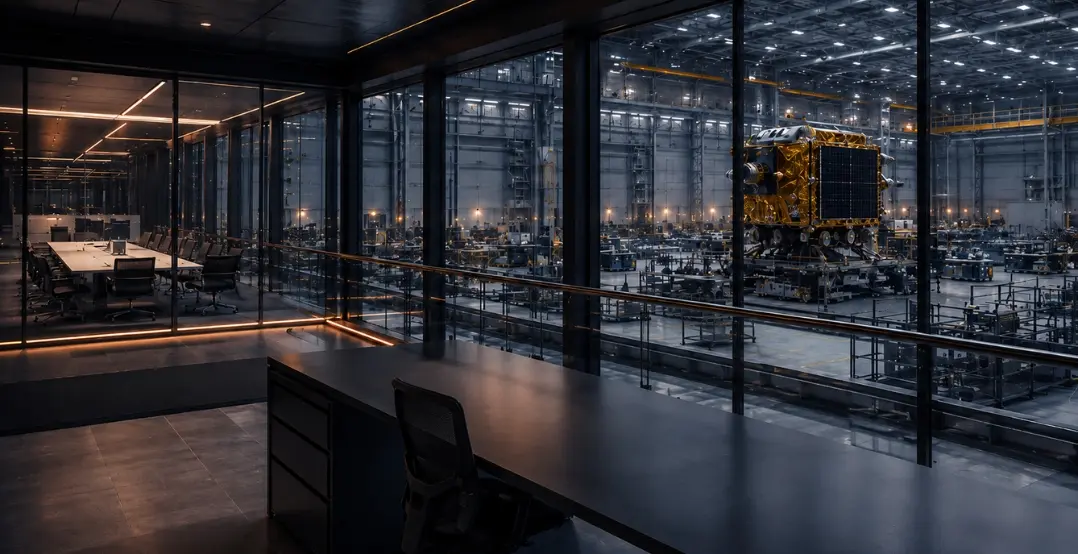
On June 30, 2026, NASA awarded a $600 million deal to three companies to build the next generation of robotic Moon landers. It’s one piece of their plan for a permanent Moon Base, continuously crewed by 2032. While doing something ground-breaking, this deal is betting on the availability of critically low space manufacturing talent. Companies involved will need to answer this question: “is there enough space manufacturing talent to actually build this?”
Who Got What: the Breakdown
Astrobotic, Firefly Aerospace, and Intuitive Machines have been tasked with delivering four landers between them, due on the lunar surface by late 2028:
- Astrobotic takes $297.9 million, for two lunar deliveries
- Firefly gets $144.2 million, for one delivery
- Intuitive Machines gets $148.3 million, also for one delivery
Altogether, the deal is worth close to $600 million, awarded through NASA’s Commercial Lunar Payload Services program, as part of its wider Moon Base effort.
Things get really interesting when looking closely at that split. More than half of Intuitive Machines’ award ($79.7 million of the $148.3 million) has nothing to do with landing successfully on the Moon. It’s a performance incentive tied to proving the company can build the same lander again, on a production line.
What This Means for Space Manufacturing Talent
Steve Altemus, CEO of Intuitive Machines, said that NASA is “shifting the paradigm from custom aerospace engineering to commercial mass production of lunar infrastructure.”
Building one hand-built lander takes a small group of elite design engineers who can solve a problem once. Building the same lander over and over takes a different organization, and a different set of people to run it.
Three Companies Now Need:
- Production and manufacturing engineers, to design the assembly line rather than just the lander
- Assembly technicians, who can replicate the same standard every time
- Supply chain specialists, who can source parts at volume
- Quality and reliability engineers, because doing it once is no longer the objective
These aren’t new roles in aerospace. What’s new is the scale of hiring required. Nobody’s built at this volume before, so the people who know how are clustered in just two places: SpaceX’s Starlink line, and Airbus’s OneWeb facility. Three companies are now chasing that same small group of engineers, and there aren’t enough of them to go around. That’s why the more realistic hires might come from automotive and consumer electronics, instead of aerospace companies.
NASA’s Commercial Space Strategy Catches Up to Satellites
The industry has gone from reusing a rocket booster, to reusing 85 percent of a rover’s hardware, to now paying a company just to prove it can build the same lander twice. The shift we’re seeing in the production of landers, is something we’ve seen before with satellites. Airbus and OneWeb proved that satellites can be mass-produced way back in 2019, and Starlink pushed the idea further still.
Their Florida facility ran two production lines, turning out two satellites a day. A custom satellite used to take over a year to build, and cost tens of millions.
A satellite that fails just gets swapped out on the next launch, one machine among thousands. A lander doesn’t get that luxury. NASA’s deal covers four landers, not four thousand, and each one has to work the first time.
What NASA’s Money Can’t Buy: Space Manufacturing Talent
Money buys parts, tooling, and facilities. It doesn’t buy an assembly technician who already knows how flight hardware differs from anything else they’ve built, or a supply chain lead who understands what happens when one connector supplier misses a date. Those people exist in small numbers, and they aren’t waiting to be found.
NASA can fund the shift to mass production, but it can’t fully control how it plays out. The outcome depends on three companies succeeding at something none of them has done before, all while competing for the same scarce production talent, on the same deadline.
NASA has made the funding available to build landers on repeat. Whether Astrobotic, Firefly, or Intuitive Machines pull it off will come down to who finds the right people first.