
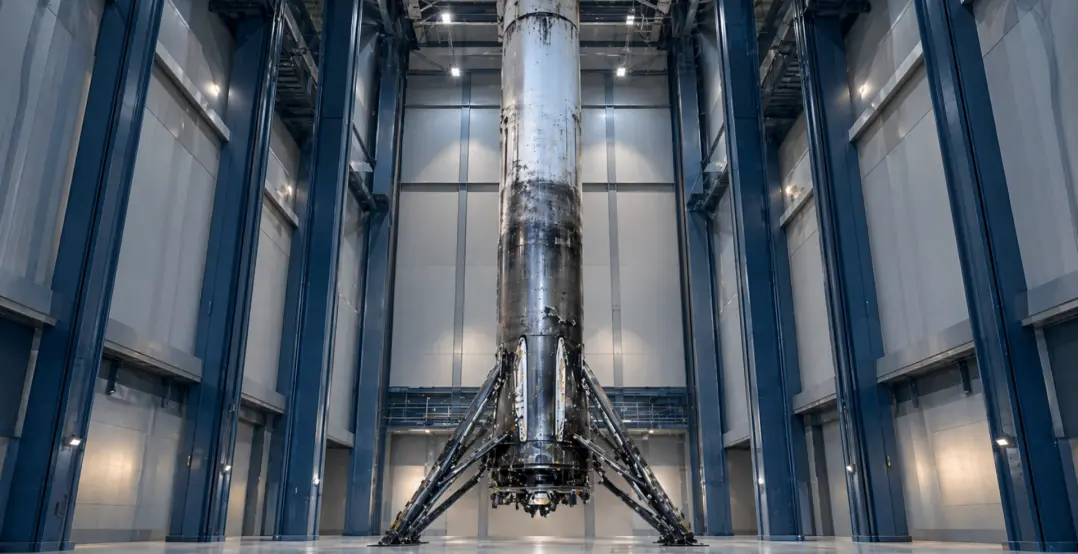
Blue Origin launched its New Glenn rocket for the third time, and for the first time, it did so with a previously flown booster. The first stage – named “Never Tell Me the Odds” – lifted off from Cape Canaveral, separated from the upper stage, and landed on a drone ship in the Atlantic Ocean. The booster reuse worked.
The upper stage didn’t. The AST SpaceMobile satellite it was carrying ended up in an off-nominal orbit, meaning something went wrong after stage separation. The payload is likely a loss. For Blue Origin, it’s a mixed result.
For the space sector’s talent market, the booster reuse is the story that matters.
Why Reuse Changes the Workforce Equation
SpaceX has been reusing Falcon 9 boosters for nearly a decade. It’s the primary reason SpaceX dominates the global launch market – reuse brings the cost per kilogram to orbit down dramatically, which brings the cost of everything else down with it.
Blue Origin achieving booster reuse on New Glenn means there is now a second company capable of operating a reusable heavy-lift rocket. That’s not a small thing. A second reusable launch provider means more launch capacity, more competition on price, and more customers who can afford to put payloads in orbit.
Each of those dynamics creates hiring demand.
More launch capacity means more missions, which means more launch operations staff – the pad technicians, the mission integration engineers, the range safety officers, the logistics coordinators who make each flight happen. Blue Origin’s VP of New Glenn mission management said in March that the company is focused on “increasing resources, tooling, and processes” to scale its flight rate. That’s a hiring statement.
More competition on price means more satellite companies can afford to launch, which means more spacecraft need to be built, tested, and operated. The downstream hiring effect of cheaper access to orbit touches every segment of the space economy – from EO startups to constellation operators to in-space manufacturing companies.
And more customers means Blue Origin itself needs to scale its commercial operations. The company’s manifest already includes missions for AST SpaceMobile, Amazon’s Kuiper constellation, and NASA’s lunar programs. Reuse is what makes that manifest economically viable. Without it, each New Glenn flight costs over $100 million to manufacture. With it, Blue Origin can begin approaching the flight economics that have made SpaceX’s model work.
The Talent Blue Origin Needs
Blue Origin is in the middle of a transition that has direct parallels to where SpaceX was seven or eight years ago: moving from a development company that builds and tests rockets to an operational company that launches them regularly. The company’s VP of New Glenn mission management said at Satellite 2026 that the focus is on “increasing resources, tooling, and processes” to scale flight rate.
That transition requires a different kind of workforce. Development-phase companies are dominated by design engineers – the people who figure out how to make things work. Operational-phase companies need a growing proportion of manufacturing engineers, operations staff, quality assurance specialists, and program managers who can keep a production line running while simultaneously supporting a launch cadence.
Blue Origin is hiring across all of these categories. The company has positions open at its facilities in Kent, Washington (manufacturing), Cape Canaveral (launch operations), and Huntsville, Alabama (engine production). As New Glenn’s flight rate increases – which reuse now makes possible – the headcount at each of those sites will need to grow.
The challenge is that many of the people Blue Origin needs are the same people every other space company wants. An operations engineer with launch vehicle experience can work at SpaceX, at ULA, at Rocket Lab, or at Blue Origin. A manufacturing engineer who knows how to build rocket engines at scale is relevant to Aerojet Rocketdyne’s RS-25 production line for Artemis as much as to Blue Origin’s BE-4 line.
The AST SpaceMobile Dimension
It’s worth noting what was on this particular rocket: a BlueBird 7 satellite for AST SpaceMobile, one of EVONA’s clients and one of the most ambitious companies in the space sector. AST SpaceMobile is building a network that delivers broadband connectivity directly to unmodified mobile phones from space. The BlueBird satellites are among the largest commercial spacecraft ever deployed, with antenna arrays spanning over 2,400 square feet.
The satellite ending up in the wrong orbit is a setback for AST SpaceMobile’s constellation buildout. But it’s also a reminder of the stakes involved when commercial space companies depend on launch providers. When a payload is lost or degraded, the hiring impact cascades – the satellite company may need to accelerate production of a replacement, which requires manufacturing and integration engineers, while simultaneously adjusting its operational timeline, which affects mission operations and ground segment staffing.
This interdependency between launch providers and their customers is one of the features of the space economy that makes the talent market so interconnected. A problem at one company creates ripple effects across several others.
What This Means for the Market
Blue Origin’s booster reuse milestone confirms what the market has been anticipating: there will be two major reusable launch providers operating at commercial scale. SpaceX is approaching its 600th Falcon booster landing. Blue Origin is at its first. But the trajectory is clear, and the hiring implications follow.
For companies that use launch services, a second competitive option is a positive development. It means more flexibility on timing, potentially lower costs, and reduced dependence on a single provider. But it also means another major employer absorbing engineers from an already constrained market.
For candidates, Blue Origin’s transition to operational reuse makes it a more compelling employer than it was a year ago. A company that is launching regularly is a company where your work ships. For engineers who want to see their designs fly rather than sit in testing cycles, that’s a meaningful shift.
And for every other company hiring in the space sector, Blue Origin’s growth adds one more competitor to a talent market that is already stretched. The GNC engineer, the propulsion specialist, the launch operations lead — these people have more options than ever. The companies that win their attention will be the ones that move fastest, offer the clearest growth path, and understand that in this market, hiring is as much a competitive capability as the technology itself.